
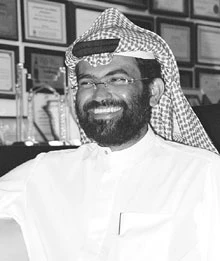
JEDDAH, 7 March 2004 — In the managing director’s chair of Aujan Industries sits a modest young man with a ready smile. He has a deep commitment to the importance of human resources, nationally and within his organization. An engineering background has also given him a deeply ingrained respect to rational planning.
Bader Aujan achieved his present position neither by family connections nor chance. Despite the same family name, he is not related to the founder of the organization. “It helped in that it got noticed,” he said. “It didn’t do me any favors in terms of promotion, though it made getting information I needed for the job easier.”
A dispersed trading family until 1905, the Aujans settled on Bahrain as their commercial center and formally established what was to grow into the current billion riyal organization.
A significant step forward in the family fortunes came in 1928, when they won the agency for Vimto, the favorite drink of British troops left in the area. Aujan took on the importation and marketing of the brand. Seventy-five years later, it remains in the company’s portfolio
In the 1960s, current Chairman Adel Aujan joined the company. He brought with him new ideas and business methodologies from his American and Lebanese education. “It was a coincidence of the right man with the right education at the right time,” said Bader Aujan. “Being there is only part of it. I strongly believe that a major factor is suitable human resources. Adel was a gift, able to convert a 10 percent chance into a 100 percent success; he’s the Godfather of the company.”
The 1970’s were fraught with difficulty for the trading company, despite being a boom time for the Kingdom. Container shortages and difficulties in supply made manufacturing an increasingly attractive proposition. “We were then and still are basically a trading family, but we saw at that time that manufacturing was a need - we didn’t really plan for it.”
After graduating in engineering from King Saud University, Bader joined another company as a project manager. In 1996, he joined Aujan and started work as an engineer on the production floor in one of the factories, “Because I had that qualification and put it to good use.”
Bader rose through the ranks at the factory until finally moving to head office as the planning and manufacturing director.
Somewhere along the line he fitted in an MBA from Ashridge College in the UK.
In 2000, after having taken on responsibilities delegated to him by Adel Aujan, Bader took over the position of managing director.
From his current position, he sees the company’s and the country’s chief asset as its human resources, which is both underused and not adequately planned for. “Handling that is extremely difficult. You can buy computers or equipment for specific tasks,” he said and agreed that the route to success was to equip the man, rather than to man the equipment. Those who call for Saudization, he feels, need to recognize this.
“Do we have the proper tools required to Saudize? Unfortunately I don’t think so.”
“If one percent is highly qualified, and there are a hundred in the market — the choice is one. With a thousand, you have ten. It is not enough.”
Saudization, he feels, has effects reaching beyond just local employment. He outlined three significant areas: Saudi Arabia’s attractiveness to foreign investors; keeping local capital in the Kingdom; and Saudi investors who do not bring their capital back from abroad. Other countries he noted are competing furiously to attract investment. “We need to plan. It is a crisis - are we managing it?”
“I am a strong believer in planning. We need to ask tough questions. Are colleges providing the proper degrees for people to be qualified for work? Are we teaching our children to work hard - harder than anyone else - from primary school level? “
Happy to employ more Saudis, Bader suggests that practical concerns take priority. One step might be to expand the business base in the Kingdom and attract more industries that use a high level of manpower. That could utilize some of the high school graduates who would probably not reach higher education. “They are not going to get the jobs they are looking for - and, in a commercial setting, how am I going to train them?”
He asked, “ Do I really need a hundred engineers and ten technicians? We don’t communicate the reality of business to people in or leaving high school. He gave the example of India where the heavy emphasis on IT training in schools has now made India the software outsource capital of the world.
“We need a 15 or 20 year plan and to use the advantage we have of being rich in petrochemicals.” To attract people from around the world to invest, he said, appropriately qualified people are also needed.
“We have 52 percent under 19 years — why can’t we convert this threat to an opportunity? It’s our fortune.”
Addressing the current reality, Bader prioritized. “Huge numbers of people are not employed — many graduates are just not getting jobs. The priority is probably getting jobs for those people first.”
Fifty percent of graduates in Saudi Arabia are women, yet only 10 percent of them are employed. Is that a waste of human resources?
“Absolutely,” said Bader. “Again, it’s a problem of planning.” Bader acknowledges and respects the culture and the religion but feels it limits him. He is unable to employ women in areas like engineering and often in management.
“We have specific areas in our businesses where women would contribute much more than men.” He gave the example of marketing where employing a woman would certainly add tremendous value to the team. “Who better to understand a woman’s needs? Be it juice or buildings, a man will not get to understand what the female market wants. There is a real need here.”
Employing women fully in business opens opportunities for a whole level of range of managerial careers. “It worked brilliantly when banking introduced a women’s section; we should have learned from that experience.”
He added reflectively, “I am afraid many just don’t want to hear these things.”