
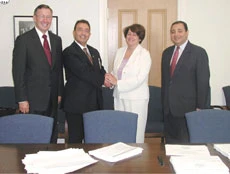
RIYADH, 11 September 2005 — Saudi Arabia appears all set to join the World Trade Organization (WTO) by the end of the year, following the signing of a key trade agreement with the United States on Friday, Commerce and Industry Minister Hashem Yamani said.
The agreement which was signed in Washington was the fruit of “nearly five months” of intensive negotiations and was “decisive” in Saudi Arabia’s drive to join the WTO, Yamani said.
The minister said he hoped Saudi Arabia would now be able to attend a WTO ministerial gathering in Hong Kong in December “as the 149th member” of the organization.
The Hong Kong conference is meant to set the seal on four years of negotiations for a comprehensive free trade treaty.
Saudi Arabia still needs to complete talks with other WTO members but the deal with Washington removes one of the biggest obstacles that stood in the way of its membership. The Kingdom has so far signed WTO accords with 38 countries.
Saudi and US officials have described the agreement as a major achievement and said it would boost investment, economic and trade cooperation between the two countries. Announcing the deal, US Trade Representative Rob Portman hailed it as a major boost to the cause of reform in the Kingdom. “As a result of negotiations on its accession to the WTO, we will see greater openness, further development of the rule of law, and political and economic reforms in Saudi Arabia,” he said.
Saudi Arabia’s decade-old bid to join the WTO received a major boost in April when Custodian of the Two Holy Mosques King Abdullah (he was then crown prince) and US President George W. Bush agreed to work together to get the Kingdom into the body before the end of this year.
Under WTO rules, a country wishing to join the organization must agree with its main trading partners on market access and cutting customs duties, which will subsequently be widened to all other WTO members.
The candidate must then make a commitment to ensure its trade legislation complies with all WTO rules as the last step before actually becoming a member.
Yamani said Saudi Arabia had recently introduced 42 new regulations concerning investments in the commercial, financial and economic sectors, facilitating the process of gaining WTO entry.
Saudi Arabia first applied to join the WTO’s predecessor, the General Agreement on Tariffs and Trade (GATT), in 1993. Two years later, that became an application to join the WTO. Carol Kalin, director of public affairs at the US Embassy, said: “We are delighted that Washington and Riyadh have signed an accord after long negotiations.”
The US is the Kingdom’s largest trading partner with two-way trade exceeding $26 billion annually. There are over 360 Saudi-American joint ventures operating in the Kingdom.
Asked about reports that the Kingdom has agreed as part of the negotiations that it will have trade relations with all WTO members, including Israel, Kalin responded: “I don’t have any details.” But, she pointed out, when you join an international agreement of this kind, any party must work within the framework of the agreements. The Arab League’s trade boycott of Israel, to which the Kingdom is also a party, has so far been a major stumbling block in the WTO negotiations.
Economist and Shoura Council member Ihsan Buhulaiga said he did not feel comfortable with the Israeli clause in the accord. “I’ve been flooded with calls from local and foreign journalists about the flexibility shown by the WTO team with regard to Israel. I really don’t feel good with the issue.”
Economists said the accession to the WTO would encourage foreign investment. It will also benefit US manufacturing and service industries, agriculture and American workers by providing increased access to the Kingdom’s growing markets.
“Saudi accession to the WTO will be beneficial for all GCC states, as they will be able to negotiate as a group” within the organization, said Jassem Al-Saadun, head of Kuwait’s Al-Shall Economic Consultants. Saudi Arabia will be the last of the six members of the GCC to join the WTO.
The bilateral pact requires Saudi Arabia to open its markets to imports of more US farm and manufactured goods, as well as service companies in sectors including banking, telecommunications, energy, express delivery, transportation and hotel and restaurant management.
In return, economists say the Kingdom can expect increased investment flowing from greater confidence in its commercial legal framework. “Foreign businessmen feel there is a legal infrastructure they can rely on — that there is a channel for disputes,” said Brad Bourland, chief economist at Samba Financial Group.
Yamani said the five-month-long final talks with the US were attended by experts from the Saudi ministries of foreign affairs, commerce and industry, finance, economy and planning, agriculture, health, culture and information, petroleum and mineral resources and labor as well as the Saudi Arabian General Investment Authority, Saudi Arabian Monetary Agency, the court of grievances, customs department, the Civil Aviation Corporation and the Saudi Arabian Standards Organization.

