
JEDDAH, 16 March 2006 — Saudi Arabia will soon allow foreign residents to invest directly in the country’s stock market as Custodian of the Two Holy Mosques King Abdullah yesterday instructed authorities to study measures for its implementation.
“The king ordered that the proposals be studied urgently and necessary measures taken to realize them,” the Saudi Press Agency quoted Finance Minister Ibrahim Al-Assaf as saying after meeting private sector representatives.
King Abdullah also advised Al-Assaf to study the possibility of reducing the nominal value of shares to boost the market and create further liquidity, SPA reported.
The report came following a meeting between Al-Assaf and top investors on Abdullah’s instructions. Al-Assaf briefed them on recommendations discussed by the Supreme Economic Council on Tuesday to strengthen the bourse.
The news was a shot in the arm for the stock market. The Tadawul All-Share Index (TASI) rebounded yesterday in the afternoon session after plunging 723.03 points or 4.85 percent in the morning session. At the close, the index recovered 706.34 points or 4.74 percent to 15,606.38 after falling below 15,000 points on Tuesday.
The market turnover increased to SR15.65 billion yesterday from SR5 billion on Tuesday. Out of 79 shares traded, 59 were higher while 20 were down. The index has shed almost 21 percent over the past week amid a massive correction in most Gulf and Mideast markets.
The Saudi market was also helped by an announcement by Saudi businessman Prince Alwaleed ibn Talal that his company would invest up to SR10 billion ($2.6 billion) in it. “This is a golden opportunity. There are excellent opportunities and we at Kingdom Holding will invest immediately in the next few days at least SR5 billion ($1.3 billion) and possibly SR10 billion in the Saudi stock market and in many sectors,” the prince told Al-Arabiya news channel.
The prince, an internationally renowned investor, blamed the market’s sharp drop on a “speculative bubble” created by a group of “unscrupulous investors.”
“Speculators exaggerated the prices of stocks. A company for example that never had a profit in its entire history saw its price reach an unprecedented level,” the prince said. Alwaleed welcomed the new proposals to strengthen the market. “Splitting shares is beneficial and allowing foreign residents (to invest in the market) is a good decision,” he told the Saudi-owned satellite television channel.
The prince warned against speculation for short-term gains. “The profit-factor now is very strong ... There are many solid and respectable Saudi firms which derive their strength from the Saudi economy,” he added. “The stock market in any country is a reflection of the economy. The Saudi economy is very strong and this gives reassurances and encourages the Saudi investor to return, buy and participate in companies that are respectable and have a good history.”
Alwaleed also urged the Capital Market Authority (CMA) to expedite the listing of firms to absorb excess liquidity. “There is a lot of liquidity in Saudi Arabia but not many investment opportunities,” he pointed out.
Earlier, during his meeting with top businessmen, Al-Assaf said the plunge of stock market in the past days was no reflection on the Saudi economy, which has been growing in a balanced and steady manner.
The Supreme Economic Council, which met on Tuesday under the chairmanship of King Abdullah, backed the measures being taken by CMA to stabilize the market.
Economist Ihsan Bu-Hulaiga, a member of the Shoura Council, called the plan to allow foreigners to invest in stocks as “a bold and timely decision.” He said it was an ideal solution to take the TASI index out of its downward trend.
“It will put it in a better competitive position relative to other markets in the region, and by opening it up to all who are interested in investing in it, that will make it the regional market,” he said.
Bu-Hulaiga said that the Saudi market is well placed to become the regional market because Saudi GDP is 25 percent of the combined GDP of all Arab countries and its capitalization is more than 55 percent of all Arab countries’ capitalization.
Salim J. Ghalayini, a Riyadh-based financial consultant, described the move to open the market to the expats as “positive.” It will reduce market volatility, since most expats are employees -- not entrepreneurs, and are used to gradual saving and increase of their wealth. Ghalayini hoped that events of the past couple of weeks would change investors’ behavior. “We expect many of the marginal investors to move back to cash, and others will invest only their excess savings and not the money intended for a critical matter like buying a house, or for getting married,” he said.
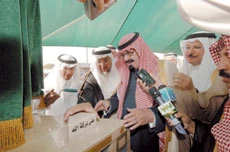
In another development, King Abdullah yesterday laid the corner stone for the permanent headquarters of King Abdullah Charitable Housing Foundation in Riyadh. The project is estimated to cost SR35 million. The foundation has so far constructed 2,200 housing units in various parts of the Kingdom at a total cost of SR500 million, according to Yousuf Al-Othaimeen, its secretary-general.