
ALKHOBAR/HYDERABAD, 25 April 2006 — On Friday, Satyam Computer Services Chairman Ramalinga Raju announced that the company had become the fourth Indian computer services and software vendor to make more than $1 billion in annual revenues. It joins Tata Consultancy Services which passed that mark in 2003 and Infosys Technologies and Wipro Technologies which both followed in 2004. All these companies are working hard to increase their business in the Middle East.
Satyam’s revenue for Financial Year 2005-06 was $1,096 million with growth of 38 percent over the corresponding fiscal year. Sounds good, but the path ahead is far from certain. The company is facing rising attrition rates which has led it to offer salary increases and restricted stock options in an effort to retain talented staff. Thus, although the company expects to increase revenues by 25-27 percent this year, growth in earnings is expected to be only 18-20 percent.
This disappointing earnings projection resulted in chaos on Friday among local media reporting to the investment community, and led Satyam’s CEO Rama Raju to cancel previously booked interviews with international media. Such a move was astonishing as Satyam makes the majority of its profits from business captured abroad. That the company’s most senior officers felt it necessary to deal with local shareholder issues rather than providing international customers with clarification on its operational road map for the coming year was discouraging, especially since the time spent with the assembled local media apparently did nothing to calm concerns over future earnings projections. Satyam’s shares trended mostly downward throughout the day Friday and continued to drop yesterday.
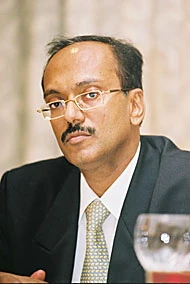
With Satyam’s CEO attempting to snuff out the media blaze at the press conference, it was left to Virender Aggarwal, director and senior vice president, head of Asia Pacific, Middle East, India and Africa, Satyam Computer Services Ltd., to take the conference call with Arab News.
“In the Middle East we have grown on a year-on-year basis about 60 percent and this market is important to us,” Aggarwal said. “We have set up operations in Kuwait and Qatar and we will be setting up operations soon in Jordan.”
Aggarwal stated that Satyam has more than 50 corporate customers across the Middle East. Al-Rajhi Bank is a reference customer for Satyam in the Kingdom, but other Saudi companies utilizing Satyam, and there are a number of SMBs taking advantage of its services, are reluctant for some reason to allow disclosure of their relationship. Satyam is about 90 percent completed with the requirements of setting up its own Saudi offices in Alkhobar. Currently, about 40 of Satyam’s people are working in the Kingdom through various partners.
“Saudi Arabia is extremely important given the fact that it makes up more than 50 percent of the Middle East economy,” said Aggarwal. “We would be kind of stupid not to be focusing on this market. The representation from Saudi Arabia (among our customers) has not been as big as we would have wanted. There have been some issues regarding getting outside people in to Saudi Arabia — immigration related issues. We also had to change the perception in the minds of our people and show them that it’s an interesting place to work. That there is a lot of challenging work.”
Satyam hopes to use several strategies to overcome manpower issues.
“By registering our company in Saudi Arabia that will give us some access to visas. Secondly, we have started employing more Arab nationals on our team. We have close to 10 people now and that number is set to go up significantly. Third, based on the suitability of the local Saudi people we employ, we will increase their number and that will entitle us to some more numbers to bring in also,” Aggarwal remarked.
Satyam may consider offering young Saudis training at its facilities in India as means of developing local staff with the needed skill sets.
“Recently we have done a program for South Africa. We have 15 Blacks who are the disenfranchised, disempowered people and the government is doing a lot for their benefit. They are getting trained in India for one year,” explained Aggarwal. “We have about 100 people from Malaysia who are fresh engineers who joined us and got trained. Now the Malaysian government is encouraging us to increase the number to 500 and they are extending benefits to us to cover the cost of training those 500 knowledge workers. Once we have a company in Saudi Arabia, we will explore the possibilities of doing the same with the Saudi youth who are coming out of colleges. Based on how they perform, compared to the other global staff that we induct, we will possibly see how we will ramp up. We will have an experiment and see how it goes (regarding) the quality of the people, whether they are able to cope with the intense period during which they will be expected to learn high end technology. If they cope with that, maybe we’ll increase their numbers.”
Aggarwal emphasized that turning Saudis into knowledge workers would take time. “It is not something that happens overnight,” he advised. “And when you’re a rich economy you need to have tremendous motivation to do high-end technical work.”
He indicated that for a long while the need for skills in high-end programming in Saudi Arabia would grow faster than those skills could be developed locally. With the government selling off its ownership in firms such as airlines, the requirement for competitiveness increases and inefficiencies will no longer be subsidized. If the ambitions for the Saudi economy under WTO are taken into account, the economy will have to be much more open and transparent.
“That means companies will no longer be able to afford hidden inefficiencies or to hide them,” warned Aggarwal. “That will lead them to look for the best solutions.”
Satyam advocates outsourcing as a potential solution to overcome local high-end technical inadequacies.
In the meantime, Satyam will have to continue to make inroads in a market which for years has looked to the West for its IT consultants. Satyam believes that with the Saudi government making positive moves to improve the relationship between the Kingdom and India, more Saudi firms will be willing to hire Indian companies for IT consultancy and implementations.
“We are hoping that over a period of time (Saudi businesses) will see that they have friends who are more friendly in other countries,” said Aggarwal. “That’s a political decision which I think they would overcome with time because generally in that part of the world there is not much support for the Arabic cause. At the slightest opportunity they’ll be at the defense of Israel. So to that extent I think we would expect that they would see what is to their own benefit and not feed the people who are going to go against them in various forums.”
He continued, “We won’t be bringing in any consultants from the West because all the Western companies are subcontracting, forgetting their own blue-eyed boys and subcontracting the work. So we don’t see any reason for engaging the people who in my opinion are decidedly not up to scratch for the money they charge. We don’t intend to inflate their egos by offering them what they don’t deserve. We think we can do a lot better job ourselves and we would want to do it right from the beginning to the end. As we are working for the global Fortune 500 I don’t see why we can’t do it for (Saudi) companies.”
This means Satyam will have to convince more of its own Indian high-end consultants and engineers to come to Saudi Arabia. That has been a challenge in the past, but Aggarwal is certain that getting staff to take up assignments in Saudi Arabia will be easier in the future.
“The general perception is that (Saudi Arabia) is not a fun place. Anybody would love to be assigned to Bahrain or Dubai or maybe with some reluctance to Kuwait or Qatar. That perception does not change easily,” he said. “However, if people visit they realize that it is not what they’d imagined. One of our colleagues who came from the Singapore office found that he could speak Hindi throughout his trip in Saudi Arabia. Saudi Aramco, where a number of women work, is a very positive example. Among our Saudi Arabia partners we found many women employees working. A lot of perceptions and mind-set changes take place when our consultants visit. As an increasing number of our consultants are going to Saudi Arabia, they are sending back information that the situation is different than they had thought.”
(Comments to: [email protected].)