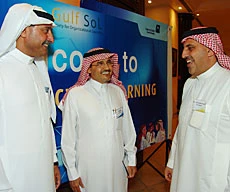
ALKHOBAR, 3 May 2006 — More than $100 billion will be spent on construction megaprojects over the next five years in Saudi Arabia, and business, academic and government leaders are meeting in Alkhobar to discuss ways to develop the Kingdom’s work force so that the money will stay in the local economy.
In a one-and-half-day event called the Megaprojects and Learning Dialogue, organized by the Gulf Society for Organizational Learning (Gulf SOL) and sponsored by Saudi Basic Industries Corp. (SABIC) and national oil giant Saudi Aramco, the discussions which began yesterday focused on using the current building boom as an opportunity to build core competencies in the construction and engineering sectors of the Saudi economy.
Over the past three years, Gulf SOL, a society of business and civil leaders committed to promoting innovation and sustainable approaches to development, has organized several events to focus on these challenges. Those meetings have resulted in several advancements in Saudi education, training, manufacturing and engineering. Organizers express optimism that the Megaprojects and Learning Dialogue will take Saudi Arabia to an important next level in its ongoing drive for economic development.
Speakers at the event include Dr. Abdulwahab Al-Sadoun of the Saudi Arabian General Investment Authority, Mutlaq Al-Morshed of SABIC, Salim Al-Aydh of Saudi Aramco and Muhammad Binladin of Saudi Binladin Group.
The event is unique in that people from all relevant disciplines are coming together to voice their viewpoints and build a consensus and shared vision. With representatives of major international engineering, procurement and construction firms, along with multinational manufacturers of critical plant equipment, Saudi contractors, government officials, educators and megaproject managers taking part, the potential for progress is impressive.
The payoff would be the creation of good-paying jobs for trained Saudis who could then use their skills to fulfill the Kingdom’s many engineering and construction needs, which now is usually done by foreign contractors. The creation of such jobs would keep money that now leaks out of the Saudi economy in the Saudi economy, increasing jobs in support sectors and economic activity across the Kingdom. To those ends, organizers are hoping to create a sustainable model for the ongoing development of the Kingdom’s resources and economy by building world-class capability and quality in the construction sector.
There are many challenges to achieving that goal, and participants hope to identify the obstacles to success and overcome them to create a future of increased prosperity for Saudi Arabia. International engineering firms are attending in hopes of developing partnerships that would be Saudi based and staffed; academic leaders are attending to get input as to the types of educational study and training that will be needed in order to do this work, and Saudi businessmen and government officials hope to identify the important steps needed for such an economic transformation to occur and start down that road to success.
Saudi construction firms tend to be smaller entities unable to take on the scope of work required by these massive infrastructure investments, which could lead to the formation of consortia of adequate size and capability to tender project bids.
Manpower issues also come to the forefront. With relatively few Saudis currently working in engineering and construction, training and appropriate educational tracks become important keys to success.
Many of the construction projects involve the Kingdom’s petroleum and growing petrochemical industries, which require work and materials conforming to the highest standards. Supply of world-class materials and process assemblies will require further development of the Kingdom’s manufacturing capabilities if such items are to be purchased in-Kingdom.
Of course, many Saudi manufacturers, universities and construction and engineering firms already are playing important roles in the projects, and representatives of those entities are sharing strategies for success with conference participants. The dialogue continues today.