
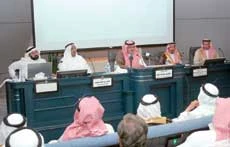
RIYADH, 21 September 2006 — Director General of Saudi Arabian Airlines Khaled Al-Mulhim announced here yesterday that the airline was planning to study methods of reducing ticket prices and levy fine on passengers who fail to arrive on time after purchasing tickets and making confirmed reservations.
In a heated discussion with several businessmen at the Riyadh Chambers of Commerce and Industry, Al-Mulhim was cornered yesterday as Saudi businessmen highlighted about the airline’s performance yesterday, with many of them complaining about poor services.
Many of the businessmen complained to the director general about Saudia constantly being late to depart. “I wish for once that when the airline says that the flight is going to depart at 8 pm, then it becomes airborne at that time,” one of the businessmen said, who preferred to remain anonymous.
Other businessmen complained about the poor service in Saudi airlines’ domestic flights, saying that it needed “immediate improvement”. Al-Mulhim, who remained calm when listening, said the airline would study the matter to avoid such problems in the future.
He said that Saudia intends to establish an alliance with several other airlines to obtain newer aircraft. However, he said that the new aircraft sought by the airlines from Boeing or Airbus would not be available before 2010. Answering a question by businessmen on the privatization of Saudia’s announced four sectors, Al-Mulhim said that it was intentionally done on a four-year basis, “so businessmen and investors could participate in an appropriate manner far away from problems.”
The director general said the airline has already started to implement a speedy electronic process using the latest technology to purchase tickets by making reservations on the website and having the ticket delivered to customers within 24 hours.
He also said that the Saudi Arabian Airlines intends to modify first class and business class lounges in all domestic and international airports, as well as increasing sales offices with the aim of establishing several offices in every city and town in the Kingdom. He added that the airline has considered establishing separate sales offices for women in various cities of the Kingdom, which are currently unavailable. Al-Mulhim said that Saudia also plans to establish a separate unit for operating Haj and Umrah services and utilizing it to make the optimum benefits of sales and services.
He also said that foreigners in the Kingdom could be targeted to gain more profits for the establishment. “There are six million foreigners here who could be encouraged to travel more if ticket prices were reduced,” he said.
As for privatization, Al-Mulhim said that a “plan has been put to privatize non-main units by turning them into strategic units and separating them from the main establishment.”
“We have already announced the privatization of strategic unit for catering. Other privatized units will be announced shortly,” he said, adding that the private sector can now invest in several investment opportunities through outsourcing, which has now been provided by the establishment.
As for training and rehabilitating Saudia employees, the director general said that flight attendants and employees who deal directly with the public would be made to undergo training courses abroad to improve their performance. “Administration and finance employees will also be trained by specialized institutions abroad,” he said.
Al-Mulhim said that the biggest challenge facing Saudia was the appearance of new airlines in a short period of time in the Gulf region. “Some of these airlines work on a low-cost budget,” he pointed out, adding that Haj and Umrah trips to the Kingdom have increased. Other challenges faced by the airline are alliances between airlines and the Kingdom joining the World Trade Organization (WTO), he said.
He added that the airline’s profits increased by 9.5 percent in foreign destinations, and that millions of passengers choose Saudia to fly to the holy cities.
AbdulAziz Al-Hazmi, assistant director general for marketing, said that Saudia’s catering sector will be open for investment by the private sector on Aug. 12, 2007 after the matter is approved by the Supreme Economic Council in November this year.
As for other sectors, the cargo sector will be privatized by the end of February next year, the ground services will be privatized in March next year, and the technical services will be privatized in May next year.
As for privatizing the training and aviation training sector, he said it would be open for investment in Oct. 2007 until Jan. 2008.