
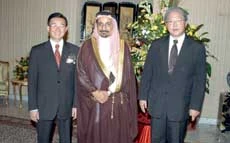
The Taipei Economic and Cultural Representative Office (TECRO) in Riyadh has announced that Taiwan’s multibillion dollar stock market has enabled some Saudi businessmen to rake in substantial profits by channeling their investment in a Taiwanese firm that is traded on the Taipei stock market.
Sheng-tsung Yang, TECRO’s Representative here, said that the total investment in the stock market stood at $121.5 billion over a six-year period from 2000. Of this, $31.4 billion, or 31 percent of the amount came through foreign investors. He pointed out that these overseas investors also included some Saudi companies which subscribed to the shares of Taiwan Fertilizer Co. (TFC) which went public last year when it floated shares worth $150 million on the Taipei stock exchange.
Interestingly, TFC has a joint venture with SABIC since the mid 1980s and the entity, known as Al Jubail Fertilizer Co., has been enjoying a roller coaster ride on the flourishing fertilizer market in the Kingdom and abroad.
Taiwan’s Representative spoke to Arab News on the occasion of the Double-Tenth Festival. Yan Hsing Yin, director, economic division, and Farid Hwang Tieh-shuan, director, information division, were also present during the interview. At the outset, Yang extended his warm greetings to the Kingdom’s leadership and the people on the advent of the holy month of Ramadan and the Saudi National Day.
In a wide-ranging interview, the TECRO Representative also disclosed that hundreds of Saudi teachers and students from polytechnics run by the General Organization for Technical Education and Vocational Training (GOTEVOT) have visited Taipei within the framework of the technical cooperation agreement.
Such an exposure, he pointed out, has not only honed their technical skills but also developed a strong work ethic among the trainees, making them productive members of the work force.
The tailor-made courses included a mix of theoretical study and hands-on experience in the fields of airconditioning, automobile, electronic appliances and computer repair.
A outcome of the technical training program was that it led to the import of machinery and equipment from the island. Meanwhile, 27 more technical colleges have either been built or are under construction. When completed, they will serve as an outlet for more teachers and students to be trained in Taiwan and more Taiwanese machinery to be installed, resulting in a win-win situation for both sides.
Referring to the bilateral trade, the TECRO Representative said Saudi exports to Taiwan last year were valued at $6.7 billion, registering a 47 percent growth over the previous year. Saudi imports from the island republic, valued at $321.2 million, declined by 6.5 percent during the same period to reach $342.2 million.
“This is due to cheaper goods (such as PCs and components) flooding the Saudi market from mainland China,” said Yan Hsing Yin, Director, Economic Division.
He added that the recent Taiwan’s electronic trade mission to Jeddah was a big success, since they picked up orders worth $500,000 on the first day, with $1.5 million in business opportunities explored during their two-day stay. “On the first day alone, 180 prospective business partners turned up for serious business inquiries. On the second day, there were 30 businessmen discussing the placement of orders. So the response was quite encouraging.”
Future prospects look rosy, since the Kingdom has unveiled mega projects worth $620 billion in infrastructure development alone. These projects have triggered enormous interest in Taiwan’s business community, which recently dispatched high-level trade missions for talks with the Saudi Arabian General Investment Authority (SAGIA) and Saudi Basic Industries Corporation (SABIC).
The Representative said that besides trade, Taiwan was also scouting for investment opportunities in the King Abdullah Economic City and other economic cities planned in different parts of the Kingdom. One aspect of its technology that has riveted the Kingdom’s attention is Taiwan’s strength in the new construction technology, especially its ability to fast-forward such projects via its state-of-the-art prefab technology, which is also cost-effective.
“Saudi Arabia and other countries in the Middle East have shown enormous interest in what is known as light gauge steel housing, a brand new version of prefab technology,” Yan pointed out. He added that some big names in the industry have offered capital investment and land for setting up a joint venture, especially as several mega projects are on the anvil.
Representative Yang said Taiwan was also exploring the possibility of concluding business deals in the IC (integrated circuit) sector. He pointed out that since the Kingdom is switching over to the next phase of its industrialization program with the planned establishment of IT parks, the island republic has a lot to offer in this regard.
“Here’s an excellent opportunity for Saudi investors to make a killing on the Taipei Stock Exchange. They only have to look at the balance sheet of TFC, which helped Saudis earn millions of dollars on their investments,” the TECRO Representative observed. He pointed out that with Taiwan’s communication industry set to reach a multibillion dollar turnover in future, there would be an escalating demand for chips related to analog, RF and wireless communication.
Yang also had a message for the Kingdom’s planners who have unveiled plans for setting up IT parks and industrial technology zones in Riyadh and other parts of the Kingdom. Since Taiwan ranks as the second largest in the world in IC design industry with more than 250 IC design houses, they would be happy to offer its expertise in the IT-related projects coming up in the Kingdom’s IT parks.
In this context, he mentioned that the Hsinchu Science Park in northern Taiwan alone has 384 high-tech companies, including 164 IC producers. “They invest three times as much in R&D as other manufacturing firms, with productivity more than twice the national average. Their total turnover reached $32.5 billion in 2004,” he said, adding that this equals to about ten percent of Taiwan’s GNP.
There are two other Science Parks which together contribute 15 percent to their GNP. He said that it is against this background that one should view the significance of the Saudi government’s decision to set up IT parks and industrial technology zones which have a huge investment potential waiting to be tapped.
Another joint venture possibility was in the field of petrochemicals. Many Saudi companies have evinced a strong interest in teaming up with their Taiwanese partners on this front. Negotiations are already in progress with some Saudi partners. Representative Yang referred to the setting up of Al Jubail Fertilizer Co. in the early 1980s as a joint venture between Taiwan Fertilizer Co. and SABIC. The project has panned out well due to efficient management and the competitive price of the product.
The Representative said the success achieved by Al Jubail Fertilizer Co. has had a magnetic pull on other petrochemical companies from the island. Elaborating on his remark, Economic Counselor Yan observed that SAGIA issued over 630 licenses to foreign investors last year. Of these, five companies were from Taiwan, bringing the total Taiwanese investment to $ 375 million. These projects range from petrochemical and engineering to cement and food processing units.