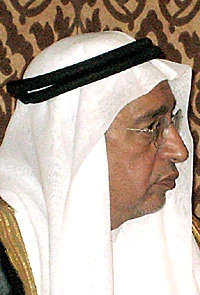
JEDDAH, 16 November 2006 — As part of the Water Road Show touring the Kingdom, Water Minister and Electricity Abdullah Al-Hussayen held a press conference at the Jeddah Hilton yesterday. He was closely questioned about the local water shortage, privatization and related water issues.
The minister denied describing the water shortage in Jeddah as “fabricated” and challenged the questioner to produce evidence. “I would like you to provide me with audio proof where I used the word ‘fabricated’,” he said. He explained that panic buying based on rumors of an imminent water shortage led to a peak in demand last month.
“If 200 people gathered in the small room of the distribution center to get water tankers (unsuccessfully), 200 out of 3 million people means there is no problem,” he said. “I have no doubts that there is a water problem, that there should be more water, and that obtaining water through tankers is not a solution, but there was a psychological factor that made things worse by people and as we see right now things are back to normal.”
He pointed out that as of today, there were no crowds at water distribution centers in Jeddah, citing the water center in Jeddah’s Al-Faisaliyah neighborhood as an example.
“The crowds in water distribution centers at the beginning of Ramadan were because of the pressure that happens during the beginning of the holy month,” he said, referring to the highly publicized problems that occurred with water distribution in Jeddah last month when hundreds were turned away every day. However, conceded the minister: “Jeddah is in need for more water.”
Turning to questions about the water pipelines currently being laid in Jeddah, he contended that most of the water pipe systems were not worn out. “In fact, most of them are only 15 years old, or less,” he said.
“Water pipe systems could live up to 50 or 60 years if the right material is used, and the proof is that there are water pipes systems in Europe that survived more than 100 years. ... However, pipes are not the system’s main concern because we’re focusing more on digging.”
On privatization Al-Hussayen said that there was no conflict between conservation and return on investment. The cost of water was, he admitted, “heavily, heavily subsidized to the tune of 90 percent plus.”
He pointed out that per capita consumption in the Kingdom was far more than it needed to be at about 250 liters a day compared with the European Union at around 130.
“We are far exceeding our very limited and very costly water resources — so there is no conflict at all,” he said.
The minister said that he would like to “push conservation to the ultimate” and become an example to the world in how we cut our per capita consumption. “The cost to the consumer will continue to be subsidized even after privatization so it is in our interest to cut the consumption because it will cut the subsidy in the process.”
The minister was unwilling to speculate on the possible level of subsidy. The rate of use of the groundwater in Saudi Arabia is greater than the rate of recharge; estimates vary from a ratio of 18 to one to as high as 99 to 1.
Al-Hussayen said that there was plenty of ground water if it was properly managed.
He cited as an example Alwasia aquifer that supplied Riyadh. “It has been supplying Riyadh with 200,000 cubic meters a day,” he said, adding that the drop in the water level was only six meters during that period. “So there is plenty of ground water if properly managed. You can go a long way with what we have.”