
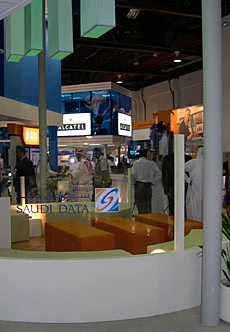
DUBAI, 5 December 2006 — This year’s GITEX was bigger than ever. That is in no small part due to the continuing demand for information and communications technology (ICT) hardware, software and solutions from the Saudi market. Speaking to numerous exhibitors at GITEX about their reasons for participating in the trade show, the desire to reach out to the Saudi market was a top justification for paying the hefty fees required to be at GITEX.
When asked what these exhibitors knew about the Saudi market, the following points were highlighted:
• The Saudi economy has been very strong due to the high prices for petroleum. Businesses, the government and consumers have money to spend on technology.
• The population is growing fast with a focus on youth. Young people are very interested in technology.
• Almost all ICT hardware, software and solutions are imported from abroad. Saudi Arabia is the largest market for ICT in the GCC and, in general, the largest ICT market in the Middle East.
• The Kingdom depends on ICT consultants brought in from abroad.
• The government is moving forward with e-government initiatives.
• There are opportunities for ICT companies offering products and solutions throughout the economic spectrum, from high to low end.
When asked why they did not exhibit at GITEX Saudi Arabia so they could interface with the Kingdom’s market more directly, those exhibitors gave a variety of reasons for avoiding the Riyadh show. Poor value for money, limited range of visitors, difficult environment, women prohibited as exhibitors, red tape in logistics and inadequate reach of the show were all reasons stated for exhibiting in Dubai, rather than in Riyadh. Sadly, the exhibitors’ answers weren’t surprising and it is evidence that the Kingdom has a long way to go when it comes to growing and diversifying its economy and attracting foreign investment. Terrible too, is that by not bringing down the barriers and making it easy for foreign companies to participate in Saudi trade shows, the Kingdom essentially gives up to other economies the huge revenues earned in many sectors by those exhibitions.
International Companies Focus on Saudi Arabia
At GITEX, numerous international IT vendors were keen to highlight success stories in the Kingdom. Oracle’s SOA suite has been implemented by the Zamil Industrial Investment Company (ZIIC), a part of the Zamil Group.
“Oracle solutions offered ZIIC instant return on investment, from the day we implemented the SOA suite,” commented Zaki Sabbagh, chief information officer, ZIIC. “With the geographical spread of our offices, we required a flexible solution that leveraged a service orientated architecture (SOA) based infrastructure to remain modular but remove the barriers between information flow around the company. This has vastly improved the ability of our regional and international offices to act quickly on business opportunities, which will drive our expansion plans and commitment to overall growth of the company.”
Al-Elm Information Security Company also signed a strategic agreement with Oracle during GITEX, to integrate Oracle E-Business Suite’s HR Module with Al-Elm’s Muqeem Service. The Muqeem service acts as an online go-between service for private sector HR departments tracking the status of foreign expatriate worker’s iqama (work permit) or passport status. Previously, the service worked through an online web portal, requiring companies to manually process requests. The integration with the Oracle application will automate these processes, delivering time savings for employees, which translates into revenue for the companies using the service.
“This agreement will allow a great number of foreign employees in the Kingdom to benefit from the services that Muqeem provides,” commented Dr. Khaled bin Abdul Aziz Al-Ghunaim, MD of Al-Elm. “Running Muqeem on Oracle will allow companies to more easily manage their HR processes, by connecting their systems electronically to the database of the Directorate General for Passports, enabling them to access the registry of their employees, as well as the search and inquiry feature. In addition, users can receive instant notifications for any record updates executed at the Directorate General for Passports at all branches in cities or borders.”
The main difference between the Muqeem service and standard HR software is that Muqeem obtains its data from the government databases instantaneously, whereas HR software relies on manual data entry.
“This agreement marks a strategic partnership between Oracle and private companies serving the public sector,” said Abdul Rahman Al-Theiban, VP, Oracle Saudi Arabia. “We are focused on delivering business benefits through better integration of data. This partnership will free expatriate workers to focus on their job rather than queuing in ministry departments, as well as giving hours back to HR employees who can now focus on innovative new programs to incentivize staff and drive productivity.”
Oracle’s competitor, SAP, had its own significant announcement on the Saudi market to make during GITEX. Sahara Petrochemicals Company has selected mySAP ERP as the primary backbone for the company’s shared services to be deployed across its petrochemical projects. This will include affiliates like the Al-Waha Petrochemical Company, a polypropylene plant established in Jubail Industrial City.
SAP solutions will be rolled out at Sahara’s affiliate plants in two phases, with the pilot roll out kicking off in January 2007. All baseline processes will be covered in the first phase, while the second phase will deal with logistics, production planning and distribution modules. Sahara is in the process of choosing a local provider for the implementation. The petrochemical company is also likely to deploy SAP’s xMII, a composite application that enables manufacturers and their production personnel to adapt to change and respond rapidly to shifts in demand by providing real-time visibility to manufacturing exceptions and performance variances.
“Unparalleled industry experience, combined with the broadest combination of tightly integrated business solutions, is the value proposition SAP offers its customers,” said Essam Enany, president, SAP Arabia. “According to McKinsey & Company, there will be a paradigm shift in the petrochemicals business from the West to the East, and the Middle East will emerge as a global hub in the future. We want to empower regional companies like Sahara Petrochemicals take advantage of this opportunity by providing them with end-to-end, cost-effective, business solutions.”
With the Kingdom’s ICT sector booming, more and more companies are setting up Saudi offices. Reichle & De-Massari (R&M), the Swiss structured cabling specialist announced at GITEX that they will be opening their second office in the region, in Riyadh.
“Saudi Arabia is currently the fastest growing IT market in the region. We felt it necessary to be physically present in Saudi Arabia, as this will enable us to engage more closely with existing and potential customers, helping them achieve their personal and business goals through our leading-edge technology and support our valuable partners in their mission to provide and market R&M solutions on the ground,” said Laurent Amestoy, Regional General Manager, R&M Middle East & Africa.
He continued, “Having served a number of customers in Saudi Arabia out of our regional HQ in the UAE and through our partners there, Softnet and Saudi Business Machines (SBM), we also believe that our decision to move in-country will provide us with the opportunity to expand our channel network in the Kingdom. The existing partner community in Saudi Arabia has already delivered several strong customer wins for R&M.”
As the Saudi market is expected to contribute to more than 25 percent of R&M’s Middle East regional sales share in 2007, the Riyadh office will act as a direct resource for R&M’s Saudi distributors and partners. The Saudi office will be responsible for developing the in-country channel in order to enhance the overall customer experience from pre-sales through to support.
Located in the Ghazzawi Commercial Center, R&M’s new Saudi branch office has the infrastructure to provide sales, customer support and technical support and will be fully reinforced by the regional HQ office in Dubai. The Saudi office will boast a team of professionals with in-depth knowledge and expertise who have gone through an intensive induction and training program at the R&M’s European head office.
At GITEX, Sun Microsystems was another company touting its success in the Kingdom. Sun Microsystems Middle East and North Africa (MENA) has recorded overall regional growth of more than 38 percent in the last financial year. The market has been growing at approximately 25 percent year on year in the Middle East, according to analysts such as IDC, so Sun Microsystems is proud to assert faster than average growth during FY06, taking market share from vendors such as IBM and HP. Sales of new products, driven largely by Sun’s software and AMD-based servers for the mid-tier market, were up by more than 40 percent, while support services for regional customers grew at 20 percent over the previous year.
“Our major areas of growth across the Middle East in 2006 were market share increases in key countries like Saudi Arabia and Egypt, where customers are investing in total solutions that encompass Sun servers and storage managed by Sun software and backed up by our support services,” said Chris Cornelius, managing director of Sun Microsystems MENA.
Saudi Companies Exhibit at GULFCOMMS
While there are many companies exhibiting at GITEX who were interested in expanding their relationship with the Saudi market, some Saudi companies were at Dubai’s World Trade Center trying to get some attention outside their core market. Electronia, a company based in the Kingdom’s Eastern Province, was one of those firms. Prominently displayed at their stand in Zabeel Hall at the GULFCOMMS trade show, which ran alongside GITEX, was a fully equipped disaster recovery vehicle which could be used in numerous emergency response situations.
Electronia’s disaster recovery vehicles, apart from being exceedingly mobile, also pack in an array of state-of-the-art information and communications technology and medical equipment. The vehicles are designed for fast response with secure communications and the ability to provide both information and assistance under even the most difficult conditions.
Not far from Electronia, Saudi Telecom (STC), had set up its huge display. Show organizers estimated that STC had spent at least SR1 million on its total GULFCOMMS presence. It can well afford such an outlay. STC is listed 13th in Telegeography’s rankings of telecommunication companies worldwide in terms of outgoing minutes. With a network in Saudi Arabia of approximately four million fixed lines, over 13 million mobile subscribers and more than 2.5 million Internet subscribers, STC is the largest telecommunication company in the Middle East.
In Dubai, STC announced that it had signed an agreement with NavLink and AT&T to deploy an AT&T Global data node in Saudi Arabia. Provisioning of the node is well advanced and it is scheduled to be operational by the first half of 2007. The advanced data Node from AT&T will allow AT&T and NavLink customers to directly interconnect to STC’s nationwide Multi-Protocol Lab Switching (MPLS) network — the largest and most advanced MPLS network in the Middle East. STC customers will benefit from being able to access AT&T’s global network one of the world’s most advanced and powerful global data backbone infrastructures, carrying 7.6 petabytes of traffic on an average business day to nearly every continent and country, with up to 99.99 percent availability.
Upon completion of the node and interconnection of the AT&T network with STC’s national MPLS Network, AT&T and NavLink will be better able to respectively serve the global enterprise customer requirements for service in Saudi Arabia as well as national customers’ requirements for service in the rest of the world.
“With our association with AT&T and Navlink and having completed one of the most advanced national MPLS networks in the world, STC is entering a new era of global managed data services. Such an achievement enhances the Saudi economy, which is regarded as one of the fastest growing in the region,” said Saud Al-Daweesh, STC’s president. “With this extension of MPLS coverage to more than 150 countries, STC can proudly announce that its enterprise customers will have seamless reach to virtually any destination in the world.”
(Comments to: [email protected].)