
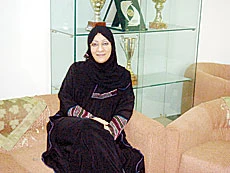
JEDDAH — The world’s richest person, Bill Gates, unveiled the reality of Saudi society during this year’s World Economic Forum. He said to be truly competitive on the world stage, a country’s economy must utilize women’s talents as well as men’s.
Nadia Baeshen, 52, had the very same vision 16 years ago. She believed that limiting the rights of women hinders economic growth. Her belief was the motivating force that paved the way for the establishment of the Khadija bint Khuwailid Center in 1998 to train, qualify and empower Saudi women.
In 1991, Baeshen finished working at the King Abdul Aziz University (KAAU) as vice-dean of the Business and Economics College. She wasn’t interested in renewing her contract or taking other assignments at the university. “I had my eyes out on the private sector,” she said.
Baeshen witnessed students with promising potentials graduating from KAAU and then going home and doing nothing. For women there were seldom employment opportunities in government and the chances of landing a government job in schools, the Education Ministry and in hospitals — which were the only sectors women could work in — were slim to none.
“I thought of ways to start addressing the problem. It might not have seemed so huge at that time in terms of numbers and statistics. But at the time if you multiplied the factors, looked 20 years ahead and took into consideration the fact that we were putting out between 1,200 and 1,500 students each year then we would end up in the least with a minimum of 20,000 graduates,” said Nadia, adding, “I was thinking of only one college, one university and one city in the whole of the Kingdom.”
Baeshen thought there was no chance of changing the system by working within KAAU. The university had a “very funny” argument when Baeshen and her colleagues tried to address the problem of graduates not finding jobs, especially business and economics students. The college was doomed to be closed because the administration thought graduates were a burden. They did not know where to direct them as far as labor was concerned. Baeshen and her colleagues stood up for that decision and refused to close the college. Nowadays, the business and economy graduates are the ones in demand.
Baeshen said men at KAAU did not anticipate what was coming. They did not have the vision, the inclination, the desire or the intention to make a change. All they wanted was to see women graduate instead of actually seeing women accountants working in banks and assuming managerial roles at companies. Baeshen’s plans were a threat.
“Nowadays, the private sector is demanding for women who are accountants, financial analysts, marketeers, planners, general managers, directors and supervisors. They are all our graduates,” said Baeshen.
Women had the vision, but men never anticipated seeing women entering the labor market as employees in the private sector. Women were limited to jobs in either the education sector or as doctors in hospitals. Baeshen and her colleagues — most of whom have Ph.Ds in economics, business and operation research — believed they could transform that vision into a reality.
“It was a group effort and some of these women are still teaching at KAAU and graduating wonderful women. Seeing those graduates makes me so proud. When I walk into an office and bump into an ex-student of mine, I say ‘Oh Gosh you’re the head of this department or the GM of this company,’” said Baeshen. “It just makes me feel so honored.”
Some of Baeshen’s students who became success stories in the private sector include Rasha Noailati, branch manager of Samba in Jeddah, Soha Abu-Alfaraj, senior manager at Samba headquarters in Jeddah, Sarah Al-Mansori, head of the treasury at the NCB located in Bahrain, and Mona Bin Sagr, owner of a multimedia and public communications company.
After leaving KAAU, Baeshen met Abdullah Dahlan who was secretary-general at the Jeddah Chamber of Commerce and Industry (JCCI). Being a major decision-maker and man of influence, Dahlan invited Baeshen to a meeting with a delegation of male and female academics from Duke University in the US who were visiting the Kingdom. “Abdullah needed a woman to converse with the guests and tell them about the status of women and education,” said Baeshen. “I went to the JCCI and met the delegation. Dahlan asked me what I wanted to do now that I had left KAAU. Training, training and training is what I said to him.”
That was the starting point for Baeshen to begin working in collaboration with the JCCI. Her doctorate was in strategic planning for human resource development. She believed that her major could cater and be used to help in a certain situation.
Dahlan took a very daring decision that created huge turmoil. He asked the university to lend Baeshen’s services to the JCCI as a part-time consultant. At the time Osama Shobokshi was the head of the university.
“What do you want to do? What are you going to do at the chamber of commerce?” Shobokshi asked Baeshen. “Lots of things. As a start, we’re going to initiate a training center for women under the umbrella of the JCCI,” she replied.
Baeshen wanted to help qualify and train businesswomen. She noticed that businesswomen were few and lacked the ability to come out. She said that was not because they were stupid, but the rules and regulations had put them in a certain restrictive framework that slapped them in the face with issues of what is forbidden and not allowed. In order to exist, the businesswomen had to go with the flow.
“This told me so much about these businesswomen. They were so dedicated and tenacious that regardless of those obstacles and the very small area they were left with, they still made wonders,” said Baeshen. “I wanted to communicate with these women and get them out of the cocoons they were forced into. I wanted to start letting them see what is happening outside, to follow the latest trends, understand the changes happening in the local environment around them as well as seeing other women.”
Baeshen and Dahlan shared the same vision. They believed that the key to accomplish change was to train women. They needed to come out with full-fledged training programs to educate women and graduates. Dahlan coined a phrase: “Requalifying graduates.” In other words to prepare graduates for jobs available in the labor market or to allow them to start their own businesses. They wanted to train women in managerial skills, leadership, business, planning, organizing and supervising. These were many of the things that they had been theoretically studying but never given the chance to know how to do. Baeshen worked as a consultant at the JCCI from 1991 until 1998. She made wonders not by herself but with the help and courage of many businessmen and officials. They shared the very same inspirations and subscribed to the same beliefs of wanting to help women do something.
When asked whether women supported her after she was elected to work at the JCCI, Baeshen said with a sorrowful sigh, “During my student years in the States, I took management 101 and 102 courses. It sort of prepared me for what I faced. The Queen Bee Syndrome theory appeared in the late 1960s in the US and it’s so much alive nowadays in Saudi Arabia.”
Baeshen was referring to how in every beehive there is only one queen, who does not allow other queens to live as long as she is there. Queen bees tend to kill their competition and the only time they allow their rivals to live is when they submit to become workers and laborers that help and serve her but do not threaten or challenge her. “That’s exactly what I faced from women when I worked at the JCCI,” said Baeshen.
According to Baeshen, queen bees are getting there without lending a helping hand to the bees behind. Women are suffering in different organizations and queen bees join forces with men because they enjoy and flourish being the only one. “We have a disease called ‘the first woman.’ It’s just stupid,” said Baeshen. “I would take pride in saying I’m the last one to have done it knowing everyone else did it. It’s hindering our progress. If we’re always waiting to see the first, when are we ever going to see the last?”
Ignoring all of that, Baeshen in cooperation with Dahlan started to put a provision for a business plan. They formed a committee that included Abdullah Zainal and Ghassan Al-Sulaiman, who also supported Baeshen’s ideas and allocated money and a place.
The very first Khadija bint Khuwailid Center was opened at the old JCCI location in Hindawia. This was the first training center for women to be set up under the umbrella of the JCCI. Gradually, the institute started to thrive and women began to show a lot of interest. After sometime, the chamber moved to a new location on Al-Amana Street. The third floor was made into an economic library. Baeshen suggested that the library be used by women and after another struggle succeeded in making it available to women on Thursdays.
“The working hours were between 8 a.m. and 3 p.m. for women to make use of the library. I brought in women to help me and that was the first time we hired part-time women employees at the JCCI,” said Baeshen. “Women visitors were increasing and we made huge profits unintentionally out of this library.”
The library was a resource for businesswomen, university students and teachers to make use of. Photocopying services, computer searches and a book-lending system were also available. As a result Baeshen went to the International Book Fair in Egypt and bought 1,500 new titles for the library.
In 1995 the JCCI witnessed a remarkable change when women were given the chance to run and vote for the board of directors’ elections. Baeshen pushed for businesswomen to vote because nothing in the JCCI constitution forbade women from voting. “Unfortunately, women were so reluctant they didn’t show up the first year. It was too good to be true,” said Baeshen. However, two years ago 18 women ran for the JCCI board of directors’ elections. Two women were elected and two were appointed. These included Ulfat Qabbani, Lama Sulaiman, Madawi Al-Hassoun and Nashwa Taher.
Baeshen is now traveling across the Kingdom to encourage the empowerment of businesswomen in different cities. She has visited Riyadh, Dammam, Alkhobar, Qassim, Taif, Abha and Jizan. “Women in rural areas are in need of our help and support. I’m trying to build bridges. I don’t know how but there must be a way,” she said. “When I joined the JCCI I started the bridging process. When I started the Khadija bint Khuwailid Center some of the programs were presented in partnership with different chambers around the Kingdom. Yet a lot still needs to be done,” she said.
During her visits to different cities, Baeshen addressed businesswomen and cited examples from Islamic history. Women are still struggling with taboo issues and religious regulations. “I don’t need to go there and talk about Nadia Baeshen, Nahed Taher or Lubna Al-Olayan with all due respect. These are not the examples those women want to hear or can identify with. They want to know about Khadija bint Khuwailid, the Prophet’s wife who was a businesswoman who brought prosperity in her trade to Makkah; Nasiba bint Ka’ab, and Ayesha bint Abu Bakr.” It was for these same reasons that Baeshen named the center after Khadija, the Prophet’s wife.
The Khadija bint Khuwailid Center along with the JCCI has a huge responsibility because of the role they can play in empowering women. When Baeshen left the JCCI, she left behind wonderful women on the board of directors, a lady running the Khadija bint Khuwailid Center and a qualified well-trained staff to carry forward her torch. “Unfortunately, I’m not seeing that happening. None of the dreams and the plans are coming to reality,” she said.
“Women have to push the envelope to overcome the rules and regulations that are hindering them. It’s just getting worse. In the past, the rules were limiting, nowadays they are destroying the training industry if you think of it as a sector. When we talk about Saudization and unemployment problems, we’re actually addressing training,” said Baeshen. “Rules are set every day and if we’re just going to submit to them without putting up a fight we have ourselves only to blame.”