
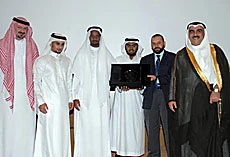
ALKHOBAR, 26 June 2007 — Last Tuesday, some of the brightest students in the Kingdom were recognized as Microsoft Saudi Arabia proudly announced the winning team to represent Saudi Arabia in the Software Design category at Microsoft’s international Imagine Cup finals due to take place in Seoul, South Korea, in August.
The Imagine Cup is one way in which Microsoft is encouraging young people to apply their imagination, passion and creativity to develop technological innovations that can make a difference in the world today. Now in its fifth year, the Imagine Cup has grown to be a truly global competition, with close to 100,000 registered entrants from all around the world, striving for the unique opportunity to present their ideas to an international audience of millions.
“The students who participate in the Imagine Cup represent the next generation of technology and business leaders,” said Dr. Khaled Al-Dhaher, GM, Microsoft Saudi Arabia, on presenting the awards to the winners. “Their creativity and innovation speak volumes about the promise of technology to really make a difference in peoples’ lives and in the way we think, work and communicate.”
This year’s theme challenged the entrants to “Imagine a world where technology enables a better education for all,” and with this firmly in mind, some of the most promising students in the Kingdom embarked upon a project that will see the winning national team face competition from over 100 countries.
The winning Saudi team this year in Software Design is SmartPal, from King Fahd University of Petroleum & Minerals (KFUPM). Their concept is to design a “teacher” based on advanced artificial intelligence that will be able to acquire information in any field via multiple sources including the Internet, and then answer any question or query in that field via normal human conversation (sound), video presentation (animation) or text representation (writing).
SmartPal faced extremely tough competition from two other short-listed finalists who both displayed a tremendous level of creativity and originality in their submissions. The team Genius Point from KFUPM developed an application to help instructors and teachers easily prepare their lectures and make the classroom more interactive by producing on the fly descriptive PowerPoint 2007 presentations via voice commands, intelligent auto feed content search and shareable knowledge experience. Coming in third, the team Summary Source from KFUPM designed a software application that creates a practical academic summary for any technical paper marking out only valuable information — giving the reader the ability to summarize a 500-600 page book in just a few condensed pages.
The other teams winning awards in the Software Design category were all female teams. “Most Professional Web Application,” went to the team Deanship of Distance Learning, King Abdulaziz University. “Most Effective Community Impact,” went to the Dot NET Club, King Abdulaziz University. “Most Rich User Experience,” was awarded to the Effat College Team, Effat College.
The winning teams won through the votes of a 12-member panel of judges. To ensure fairness, the votes of the judges, who were advisers to teams with projects entered in the competition, were withheld in the voting on those projects.
Speaking about the Imagine Cup event, Jeddah Mayor Adel Faqeeh said: “Following on from Ahmed Al-Nuaimi’s recent high-profile success with his Smart Shoe for Blind People at Intel ISEF, it is fantastic to see even more home grown talent developing some truly inspiring technological ideas. We wish SmartPal the best in Seoul and we encourage more companies in the private sector to organize similar programs.”
The 2007 Imagine Cup competition in Saudi Arabia began with over 3,000 male and female students attending launch events at universities in the Central, Western, and Eastern Provinces of the Kingdom. Eventually, 360 students were part of teams that entered the Software Design category of the competition. Microsoft hopes that next year that number exceeds 500.
“This year’s competition has perhaps been one of the most difficult competitions I have ever had the privilege to judge, with all the short-listed teams producing some fantastic pieces of work,” said Dr. Arwa Al-Aama, Vice Dean, College of Computing & Information Technology, King Abdulaziz University.
The key to winning the Imagine Cup, according to Microsoft Saudi Arabia’s GM, is innovation and creativity.
“If you look at the team that won this year’s competition, they came up with a really innovative idea,” Dr. Al-Dhaher explained. “It’s an artificial intelligence type application. It’s a system that actually learns and interacts and provides a lot of insight, which is very advanced and creative for this level of students. The other important aspect of this competition is the teamwork. We do not have a lot of channels and opportunities to give our students the flavor of teamwork. I think it’s important that we encourage that. Most competitions worldwide are usually for individuals. This is one of the few competitions that are team competitions and in the real word it’s essential to know how to work as part of a team.”
SmartPal will not have long to enjoy their success. Before they embark upon their trip to the South Korean capital, they will have to work hard with their Academic Mentor Dr. Mohammed Al-Shayeb and others at KFUPM to prepare their software application and get ready for the world stage.
“We knew we were going to face really tough competition from the other teams, so we just worked as hard as we could,” said Salman Al-Ansari, team leader of SmartPal. “We are thrilled to be chosen to represent our country in Seoul, but we know our challenge has only just begun. Last year’s Saudi team coming 10th in the global Imagine Cup finals was an inspiration to us. We’re hoping to do even better this year.”
While the software design competition of the Imagine Cup is run locally by Microsoft Saudi Arabia, students compete online directly through Microsoft Corp. in eight other categories of the Imagine Cup. For example in the Project Hoshimi Programming Battle, which tests the skills of programmers worldwide, Maan Ashgar from KFUPM is the winner at the GCC level and has now advanced to the final round. In the 2007 Imagine Cup online categories, 207 students from Saudi Arabia participated.
Microsoft Saudi Arabia wanted to emphasize though that the Imagine Cup is much more than a tech competition. It is really a way to encourage and identify those individuals who can play a strong role in the Knowledge Economy.
“Last week I visited Madinah’s Knowledge City and I was very pleased to hear that their target is to have more than 50,000 knowledge workers within the city. This is a huge challenge,” advised Dr. Al-Dhaher. “There is no question in my mind that moving toward a Knowledge Economy requires that the basic infrastructure be there. And one of the most important elements of the basic infrastructure is people — our children. Giving high school and university students the opportunity to compete in such an event as the Imagine Cup, better prepares them to be more competitive in a Knowledge Economy. At the end of the day the Knowledge Economy is dependent on access to the Internet and the ability to compete worldwide. This competition gives them a perfect platform to contribute and compete in the Global Knowledge Economy and helps to build knowledge-based industries in Saudi Arabia.”
Microsoft Saudi Arabia is certainly a company to show with actions, even more than words, that it believes in the potential of such events as the Imagine Cup. The company was so impressed with the Saudi winners of the 2005 and 2006 Imagine Cups that now three of the students have become full time employees of Microsoft Saudi Arabia, putting their skills into practice.
In 2007, students from over 100 countries stepped up to the challenge of imagining a world where education is accessible to all. Even before the finals of the 5th Imagine Cup take place, Microsoft has already announced that the theme of the 2008 Imagine Cup will be “Imagine a world where technology enables a sustainable environment.”
According to Waleed Assal, Marketing Communications Manager, Microsoft Saudi Arabia, students from all over the world, male or female, 16 years and older, who attend an accredited high school or university, full- or part-time, may compete in the Imagine Cup. Students who attend any school in the Kingdom, whether Saudi or non-Saudi, are eligible to compete in any of categories in the competition. Assal said that Microsoft already sponsors the Imagine Cup in most Middle East countries. For 2008 there is a plan to bring the competition to Iraq and Palestine.
Registration for the Imagine Cup 2008 will open in August after the Imagine Cup 2007 Worldwide Finals. For more news of the Imagine Cup 2008, and to follow the progress of the 2007 finalists who will compete in Seoul, Korea from August 5-11, see www.imaginecup.com.
(Comments or queries to: [email protected].)