
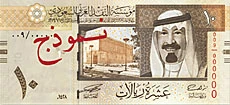
JEDDAH, 27 August 2007 — Though Saudi Arabia is under mounting pressure to revalue the riyal and possibly to follow Kuwait’s lead in ending its currency’s peg to the US dollar, the costs of changing the exchange rate far outweigh the benefits, said a report by the Jadwa Investment recently.
The Riyadh-based Jadwa report said that as oil revenues are earned in dollars and converted into riyals for budgetary spending, a revaluation of the riyal would permanently impair the riyal value of oil revenues, reducing the size of the current budget surplus and accelerating the day when the budget falls into deficit. The value of the government’s mostly dollar-denominated foreign assets, currently in excess of $240 billion, when converted into riyals, would also be cut.
Brad Bourland, the Jadwa Investment chief economist and head of research, said: “If the riyal were revalued upward by 20 percent, the government would be able to buy 20 percent less in riyal terms with its oil revenue. In 2007, projected oil revenues accruing to the budget are $135 billion. Based on the current exchange rate, these revenues can fund expenditures of SR505 billion. In the event of a 20 percent revaluation, the same oil revenues would only be able to finance spending of SR404 billion. If spending is unchanged, the lower revenue would result in a budget surplus of just 1.4 percent of gross domestic product (GDP) compared to the current forecast of 9.5 percent of GDP.” Bourland added: “With regard to foreign assets, assuming that 75 percent of SAMA’s holdings are dollar-denominated, then a 20 percent revaluation would result in a loss equivalent to $36 billion (10 percent of GDP) when these assets are converted into riyals.”
He added: “The Kingdom’s banking sector would also see impairment of the value of its assets. As of June 2007, commercial banks net foreign assets were SR89.6 billion. Since the banks state their earnings in Saudi riyals, any earnings on dollar-denominated assets that are paid in dollars, such as coupons paid on bonds or sukuk, would be of lower value when translated into riyals.”
The Saudi Arabian Monetary Agency (SAMA) has repeatedly said that there would be no change to the 21-year-old exchange rate peg and that it has the means to fight off any speculation.
The Saudi riyal has been effectively pegged at 3.75 riyals to the US dollar since 1986.
SAMA’s net foreign assets totaled $243 billion at the end of June, equivalent to 130 percent of broad money supply (M3).
Bourland said: “SAMA can easily afford to buy every riyal in circulation in Saudi Arabia if the peg came under any pressure. Should SAMA decide that a change to the exchange rate regime is in order, then a communication plan to gradually and credibly prepare the markets and the public would likely precede it. Since this has not happened, we believe the policy remains firmly in place to keep the current rate and mechanism.”
The Jadwa report also warned that the introduction of a more expensive riyal to foreign investors and exchange rate uncertainty caused by an adjustment to the peg would act as a deterrent to foreign investment.
Even with oil prices and foreign exchange earnings at high levels, the Kingdom continues a policy, spearheaded by Saudi Arabian General Investment Authority (SAGIA), the investment promotion arm of the government, of strongly encouraging foreign investment. The Kingdom has a goal of becoming among the top ten most attractive destinations for foreign investment in the world by 2010. Revaluation and the introduction of exchange rate uncertainty would undercut this policy initiative.
The report also said Saudi companies which export would see their products become more expensive overseas, making them less competitive.
The report added that if the riyal were pegged to a trade-weighted basket of currencies, under such an arrangement it would move in line with the currencies of its major trading partners, reducing the scope for imported inflation and giving some latitude to set interest rates independently. This was the route taken by Kuwait, which dropped its peg to the dollar in May and resumed managing its currency against a trade-weighed basket (with a heavy dollar weighting). The disadvantage is that markets and the public do not easily understand the concept of a peg to a basket of currencies, and in the Kuwaiti case, the basket currencies and their weightings in the basket are not publicly disclosed, which reduces transparency of the arrangement and the efficiency of markets in understanding and trading the currency. Since mid-July, the Kuwaiti central bank has revalued the dinar five times and devalued it seven times, in line with moves in the dollar during the period. Bourland said: “We do not think the introduction of this uncertainty and volatility would be helpful to the Saudi economy.” He added: “Changing the peg to the dollar may make sense over the long term, as the economy diversifies and the central bank develops a need for more independent interest rate setting tools. That time is not here yet, and changing the exchange rate primarily to chase movements in the dollar would now do more harm than good.”
Bourland said: “The only chance of an adjustment to the riyal in the current conditions would be as a means of spreading the oil windfall to local citizens, who are seeing their incomes eroded by rising inflation.”
The fall in the riyal has coincided with a period of rising inflation in Saudi Arabia. Inflation has climbed from an average of 0.3 percent in 2003 to 3.1 percent in June. A weaker riyal raises the local currency cost of imports not denominated in US dollars.