
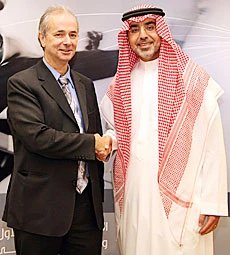
RIYADH, 1 October 2007 — Saudi Arabia is the seventh fastest reformer globally and the second fastest in the region in the World Bank’s annual “Ease of Doing Business” report, World Bank Vice President Michael Klein said on Saturday evening at the Saudi Arabian General Investment Authority (SAGIA) headquarters.
Speaking to a large audience of executives, officials, and media persons, the World Bank executive explained how the Kingdom also managed to successfully jump up the ranking this year to 23rd from 38th last year, outranking all Arab and Middle Eastern countries.
“This year Saudi Arabia made bold business reforms making it one of the world’s leading reformers. Saudi Arabia is now the top ranked economy in the Middle East,” said Jamal Haider, co-author of the Doing Business Report 2008.
“We expect these reforms will continue to position Saudi Arabia as a business-friendly economy,” he added.
SAGIA Governor Amr Al-Dabbagh said the jump in the new ranking from was a major step toward achieving the “10 by10” goal sought by SAGIA to place the Kingdom in the top 10 position in terms of investment globally.
“Saudi Arabia has become the number one recipient of foreign direct investment in the Middle East. Inflows have increased from $2 billion to $18 billion in the last two years,” Al-Dabagh said.
The governor said the figures would grow more rapidly with the development of Kingdom’s six new economic cities, and special economic zones that are attracting top global companies with major investment opportunities.
Klein explained that Saudi Arabia successfully eliminated the minimum capital requirement of 1,057 percent of per capita income. In addition, Saudi Arabia successfully reduced the days needed to start up a company from 39 to 15.
Other major accomplishments were the Kingdom’s launch of a commercial credit bureau whose reports include the credit exposure of companies.
The Kingdom also sped up trade, reducing the number of documents required for importing and cutting the time needed for handling at ports and terminals by two days for both imports and exports.
The Kingdom’s exceptional performance in this year’s rankings has been driven by Custodian of the Two Holy Mosque’s King Abdullah’s vision to increase the prosperity of the people of Saudi Arabia.
The King has been the country’s strongest advocate for modernizing the Saudi business environment. He has sought to encourage domestic and foreign investment law, establishing SAGIA, privatizing public companies and pursuing membership to the World Trade Organization (WTO).
Saudi Arabia jumped up more than 100 places on the Ease of Starting a Business indicator. In the previous year, the Kingdom ranked 136th.
According to Klein, Saudi Arabia managed to successfully adopt several strategies.
First of all, the Kingdom merged 6 procedures into 3 for person or establishment to start a business. Currently, the procedures have been simplified into category of product name, publication name and commercial registration.
The Kingdom also eliminated 2 procedures that were compulsory for obtaining registration in opening a new business (municipal approval and chamber of commerce stamp).
In addition, it reduced publication and registration costs. It also eliminated the minimum capital requirement. Previously, Saudi Arabia imposed the fifth largest minimum capital requirement in the world. The minimum capital requirement used to be 1,057 percent of per capita income. Entrepreneurs no longer face this obstacle.
Saudi Arabia launched a commercial credit bureau in March 2007. Private credit bureau added cell phone companies as providers of information. It also started listing firms in its database (before, it only listed individuals).
Private bureau coverage jumped from 12.5 percent to 23.5 percent of adult population.
Also, the public credit registry was closed in September 2006. The private credit bureau SIMAH, whose coverage is 60 times larger than the public registry, now provides all credit information in Saudi Arabia.
“This seems like a bad reform, but it is actually good for the private bureau, as all lenders now go there for info and this means more business,” Klein said.
As of May 2007, commercial credit bureau is issuing reports, including reports about the credit exposure of companies.
Klein further said the Kingdom has reduced the number of documents required for importing, adding that Saudi Arabia also abolished the requirement for a consular certificate.
The Kingdom also allows now the transfer of data electronically, which made hard copies of documents unessential.
Development at certain port facilities in the Kingdom and the time needed to clear certain shipments or containers is another factor which improved the Kingdom’ rating.
“Saudi Arabia has improved the capacity of port facilities, allowing the port of Jeddah to clear more containers per day,” Klein said, noting that the time for handling at ports in Saudi Arabia in general is down by 2 days (for both imports and exports).
“Saudi Arabia has one of the most aggressive targets in the world on jumping in those rankings. It is possible to reach them. We will see how that happens,” Klein said. He added: “The rankings are not everything. A number of other things have to come together including business cultures and openness to competition.”
According to Klein, the biggest challenge in the investment climate in Saudi Arabia today is contract enforcement.
“If you want to do business, you want to be able to rely on other people ...on their word … to enforce contracts. And if they don’t keep their word, you want to be able to use the legal system to enforce the contract. That is the good old principle that governs everywhere including Saudi Arabia,” he told Arab News.
“At the moment, the mechanisms to enforce contracts in Saudi Arabia are still quite complicated. If Saudi Arabia wants to be very ambitious to reach the 10 by 10 goal, it needs to do something about that.”
Currently, Saudi Arabia does not have civil courts and commercial disputes are being handled in religious courts.
Other challenges faced by the Kingdom in the investment scene, according to the World Bank executive, are bankruptcy legislations, shareholder protection for equity holders, as well as access to credit.
Al-Dabbagh said the government body would continue to collaborate with other government bodies to improve the Kingdom’s status as well as eliminate shortcomings. “We cannot deal with 600 indicators all at once,” he said. “ From the indicators we have dealt with the previous year, we will move on to other indicators this year, and so forth.”