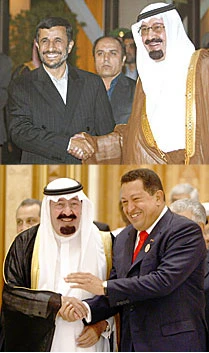
RIYADH, 18 November 2007 — Saudi Arabia has contributed $300 million toward a fund to establish an international program for scientific research into energy, the environment and climate change. Custodian of the Two Holy Mosques King Abdullah announced the contribution last night when he opened the third OPEC summit at the King Abdul Aziz International Center in Riyadh. In his opening speech, King Abdullah also rejected the notion that oil could be used as a weapon.
Venezuelan President Hugo Chavez warned the United States of the “foolishness of attacking Iran,” as it would increase the price of oil per barrel to over $200. “If America is foolish enough to invade Iran, then the price is expected to jump to $200,” said Chavez, adding that it was necessary to ensure the price of oil remained stable through a steady supply and by cooperating with oil importing countries.
The Venezuelan president also called for OPEC to play an important role in the fight against poverty in Latin America, Africa, and Asia.
Chavez said $100 a barrel was a “fair” price for oil. Oil has lapped against the $100-mark this month, prompting consumer nations to call on the exporter group to help ease price pressure by providing the market with more crude.
“OPEC should be a more active geopolitical agent and demand more respect for our countries... and ask powerful nations to stop threatening OPEC,” the Venezuelan president said.
Apart from Chavez, prominent leaders attending the summit are President Mahmoud Ahmadinejad of Iran, Iraqi President Jalal Talabani, the emirs of Qatar, the UAE and Kuwait, and senior representatives of other member states who witnessed King Abdullah taking the mantle of the OPEC presidency from Venezuela.
Libyan leader Muammar Qaddafi was conspicuous by his absence.
Calling on other nations to follow the Saudi initiative, King Abdullah exhorted them to support an independent research body devoted to the joint mission of protecting the planet.
Pointing out that oil was fundamental to the progress of the international community, the king said it should be used as an instrument of energy for construction and not as a tool to instigate conflict or to satisfy one’s whims.
Tracing the background to the launch of OPEC almost 50 years ago, he said it was originally conceived as an organization to safeguard the interests of member states, protect their economies from sudden turbulences in the oil market and to allow them to prosper.
The king said that those who say that OPEC is an organization that takes advantage of opportunities “are mixing truth with falsehood.” He added that OPEC has always acted with modesty and wisdom, the best example of which is the current price of oil that, in spite of spiraling inflation, is the same as it was in the 1980s in real terms.
“It has been said that oil has an impact on climate. This is false. Such arguments tend to mix facts with fantacies,” he said, adding that imposing tax on oil would have a negative impact more on importing countries than the oil producers themselves. The king called for a comprehensive study on oil, the environment and climate change, which he proposed be handled by an independent body free from political pressure and influence.
Earlier, Chavez stressed the importance of OPEC going back to the roots of its origins in the 1960s “when it was launched as a revolutionary institution.” He said it was a period when the organization was against imperialism and colonialism.
“OPEC was born as a geographical and political force initially against aggression and pressure from First World countries, which sought to use the resources of Third World countries,” he said.
He also mentioned how the US attacked OPEC over the years and cited the example of former President Ronald Reagan. “I call on member states to review the initial declaration held in 1975, which illustrated that the organization was created as a revolutionary body,” he said, adding that the organization was based on opportunities of progress and development not given to Third World countries.
Chavez also lauded the late King Fahd’s call for a second summit to be held in Venezuela. He described the summit as a phase “when OPEC rose from its ashes in the 1970s.”
The summit in the Saudi capital is being held under three main themes: providing petroleum, promoting prosperity and protecting the planet. The summit will enable OPEC to strengthen its already solid credentials with regard to oil, as the heads of state review the challenges facing the industry today, address strategic implications for member states and plan the organization’s strategies in years to come. In a press conference held prior to the summit, Minister of Petroleum and Mineral Resources Ali Al-Naimi said OPEC officials would not discuss the hike in oil output during the two-day summit.
He also ruled out that the summit would discuss surging oil prices and production quotas. Rather, he said, a ministerial meeting on Dec. 12 in Abu Dhabi would address the issue of production quotas.
Foreign and finance ministers of the OPEC countries on Friday brushed off a proposal by Iranian and Venezuelan delegations to add a subject to the final communiqué regarding the delinking of the US dollar from oil. Foreign Minister Prince Saud Al-Faisal warned of the consequences of such a study, stressing that it could not only weaken the dollar further, but also cause more problems for OPEC countries.
OPEC is a permanent and intergovernmental organization created at the Baghdad Conference in September 1960 by Saudi Arabia, Iraq, Kuwait, Iran and Venezuela. The five founding members were later joined by nine other countries: Qatar (1961), Indonesia (1962), Libya (1962), the United Arab Emirates (1967), Algeria (1969), Nigeria (1971), Ecuador (1973), Gabon (1975-1994) and Angola (2007).
OPEC currently groups 12 countries and will reaccept Ecuador — a former member which withdrew from the group in 1992 — as a formal member during the summit.
The 12 current OPEC members are Algeria, Angola, Indonesia, Iran, Iraq, Kuwait, Libya, Nigeria, Qatar, Saudi Arabia, the United Arab Emirates and Venezuela.