
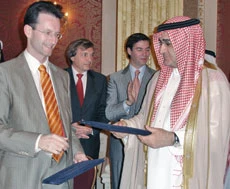
JEDDAH, 21 February 2008 — The 30-member trade delegation, including Crown Prince Guillaume, of Luxembourg visited the Kingdom with a view to exploring the possibilities of cooperation between the two countries in the fields of trade, banking and finance, investment and industrial sectors.
After visiting Riyadh on Monday, the delegation was here to further enhance their cooperation in various fields.
Saleh Al-Turki, chairman of the board of the Jeddah Chamber of Commerce and Industry (JCCI), and Carlo Thelen, member of the managing board and head of the Economic Department and the International Department of Chamber de Commerce Luxembourg (CCL), yesterday signed the first Memorandum of Understanding to help improve cooperation and trade relations between the two countries.
After welcoming the delegation, Al-Turki said: “It is a great day for Saudi Arabia as the country is going through a major economic boom. It is time for cooperation and Saudi Arabia is open for everyone.” He added: “Luxembourg is a major banking and financial sector. We can also gain from its experience and expertise.”
Jeannot Krecke, minister of the economy and foreign trade, said Luxembourg is a small country but it has huge importance because of its political and social stability, skilled and multilingual work force, state-of-the-art infrastructure, excellent connectivity to markets, favorable legal environment and attractive tax climate.
Krecke said “this is my first visit to Saudi Arabia and it was a mistake not to come earlier because I see a plenty of opportunities of cooperation in various fields and Luxembourg also offers an exceptional range of assets and opportunities for doing business in Europe.”
He added, “The Luxembourg government has always pursued a proactive economic development policy, making possible for Luxembourg to become an international financial center and establishing itself as a prime business location.”
Krecke said: “Small is beautiful! The modest dimension of the Luxembourg economy is the key to explaining its historic openness to larger markets. With population of about 460,000, foreign trade is the main engine for economic growth. More than 80 percent of the goods and services produced in Luxembourg are exported and almost 85 percent to the European market.” Krecke added that “Luxembourg will continue in its efforts to extend its presence in markets outside the EU in order to reduce its vulnerability to external shocks and to further develop through trade.”
Jean-Claude Knebeler, director of foreign trade, Ministry of the Economy and Foreign Trade, said Luxembourg has become a key location for first- and second-tier suppliers to the automotive industry. At the crossroads between Belgium, France and Germany, Luxembourg is an ideal location for component suppliers with a multi-customer base to deliver its products fast and reliably.
Knebeler added, “Plastics and the chemical industry are thriving pillars of the Luxembourg industrial sector.” He said Luxembourg airport is the 5th largest air cargo hub in Europe. With its modern air cargo center, speedy ground handling and excellent connections to markets, Luxembourg is the logistical airfreight hub par excellence.
Fernand Grulms, CEO, Luxembourg for Finance, said, “Luxembourg banks are allowed to operate as universal banks on the home market as well as abroad. Banks are world renowned for their sophisticated know-how and their strict adherence to rules and regulations.”
Private banking arrived in Luxembourg many years ago and is now mature and well established. For a high network of individuals a number of banks applies a global approach to structuring a customer’s wealth over the longer term, incorporating financial and professional assets, life insurance and real estate, with a view to optimal long-term planning.
While thanking Saudi officials and businessmen, Guillaume said “...economic and political stability are preserved, and thanks to a broad consensus for sustainable development. Luxembourg supports economic openness, strengthening of foreign relationships and integration into larger markets...”