
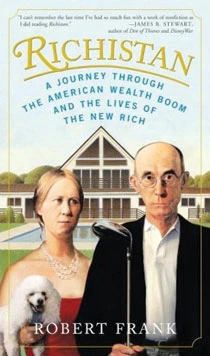
"Richistan” offers an enthralling introduction into the lives of a new breed of billionaires who first emerged in the United States and are now appearing in China, India, parts of Southeast Asia, Eastern Europe and Latin America. The present global wealth boom is due to the rise of financial markets, new technologies and a freer flow of goods and information around the world.
The author, Robert Frank was writing a series of articles for the Wall Street Journal on the New Rich when he discovered that today’s rich “had built a self-contained world unto themselves, complete with their own health-care system, travel network, separate economy... The rich weren’t just getting richer, they were becoming financial foreigners, creating their own country within a country, their own society within a society, and their economy within an economy. They were creating Richistan.”
To understand Richistan, Robert Frank spent a year interviewing the most interesting “richistanis” — all worth $10 million or more. He quickly realized that they are people we never hear about since most New Rich today prefer to keep to themselves. They have little in common with Donald Trump, Bill Gates, Warren Buffet and the other Forbes superstars we hear so much about in the media.
For the purpose of this book, the author focuses on the US but he acknowledges that New Rich or “richistanis” are found all over the world. While the Unites States still has the largest number of new rich people, the millionaires grew 7 percent in the UK, 8.5 percent in Australia, 11 percent in Brazil, 7 percent in China, 19 percent in India and 17 percent in Russia. In the United States alone, the number of millionaires has more than doubled since 1995 and is now more than eight million and is likely to increase by 6 percent in the next few years. In Robert Frank’s words Richistan is a borderless country, with citizens spread around the world. The New Rich with their palatial residences are in dire need of household help, especially butlers (a dying profession for much of the twentieth century), maids, nannies, personal assistants and private security guards. A butler can start at $80,000 to $120,000 a year. The lifestyle of the New Rich has triggered a number of highly paid jobs, which were frowned upon not too long ago.
In the past, it took a lifetime and often more to build a business, but today’s New Rich amass wealth very quickly (but they can also lose it just as quickly). Stock markets, hedge-funds, private-equity firms and mergers create new opportunities for cash. With venture capital, a company can be set up, launched on the global market and sold within a few years: “One of the defining characteristics of Richistan is its diversity. Almost anyone, anywhere can make a fortune today with the right idea,” says Robert Frank. Ed Bazinet made a fortune selling miniature ceramic villages. But Bazinet and other Richistanis have trouble relaxing and enjoying their success. Moreover, they are often too young to retire! As a result new billionaires are rarely satisfied. According to a 2005 study, about half of today’s New Rich feel that wealth has not made them happier and 10 percent even think that their wealth has created more problems than it solved.
The lavish lifestyle of the New Rich has triggered acute parenting problems. Kids who rely on house staff and parents do not develop a sense of motivation and basic skills such as managing money, working with other people: “Money gives people the ability to buy their way out of life experiences. The parents may think they’re helping their child, but they’re actually robbing them,” writes Robert Frank.
In the past, the rich who built their wealth on breeding and lineage were idle but today’s New Rich have climbed their way up from the middle class and are workaholics running their own businesses and driving their own cars. They feel they are just ordinary people and they like to appear normal: “While old wealth prided itself on modesty, tradition, public service, charity and sophisticated leisure, Richistanis pride themselves on their middle-class ethic, self-made fortunes and big spending” explains Frank.
The New Rich with their huge wealth are creating new kinds of super luxurious products and services such as space travel private jets and shadow yachts. A shadow boat is a floating garage that accompanies the main yacht and carries cars and smaller boats. One shadow yacht, the Paladin, can hold up to six cars, several motorcycles, jet skis, a submarine and a helicopter. It also has a decompression chamber, a walk-in freezer, gym and night vision cameras. The upkeep of a mega yacht is enormous. It costs about 10 to 15 percent of the purchase price of a boat to maintain it, which means about $2 million a year for a typical 140 feet yacht. The biggest yacht is the Rising Sun, a 450 feet floating palace with 80 rooms on five stories! However the owner of a huge yacht decided to sell it because when he was on the deck, he felt too far from the water!
According to one study, America’s richest half-percent consume at the rate of $650 billion a year, equal to the total household spending in Italy. Middle class and lower income families are also trying to emulate the New Rich and by doing so, they are going into debt, working longer hours, sleeping less and spending less time with their families while trying to keep up. Besides their huge spending power, the New Rich are known for their charitable donations. Philanthropy among the New Rich has never been so fashionable but they are no longer happy to give a check to charity, they want to see where their money goes and most of all, they want positive results. They are disillusioned with the way traditional charities are managed, wasting too much donated money on fund-raising costs and administrative expenses. Ron Perelman, for example, chose to donate millions to a cancer doctor rather than the American Society. The doctor, Dennis Slaman, helped develop Herceptin, which is widely used in the treatment of breast cancer.
As they become increasingly wealthy, the super rich will become increasingly separated from everyone else. “They will form a ‘third’ culture, not from their own country, but from a different, shared world of wealth. They’ll stay at the same hotels (Four Seasons, Ritz), drive the same cars (Bentleys, Rolls), wear the same clothes and accessories (Gucci, Vuitton, Frank Muller) and go to the same vacation spots,” explains Robert Frank. However, as the rich become richer, inequality will only increase. The super rich are always in the best position to take advantage of the global economy. They have the available cash to set up factories, to build or buy property or invest in hedge funds. We can only hope that the New Rich will feel responsible for the way they spend their enormous wealth and invest more in philanthropic activities. Bill Gates has already shown the way and his $31 billion foundation is the largest in history and has increased thanks to the $31 billion donation of another enlightened philanthropist, Warren Buffet.