
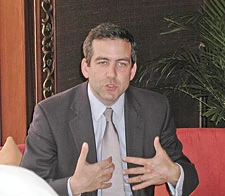
JEDDAH, 14 April 2008 — A senior US official while highlighting the “enormous investment opportunities” in Saudi Arabia, said the Kingdom could attract more foreign investors by stepping up its economic liberalization policy.
Speaking to a select group of journalists, David Bohigian, US assistant secretary of commerce for market access and compliance (MAC), also underscored the growing Saudi-American political and economic ties.
“US-Saudi Arabian relations have never been stronger and we will continue to work on boosting further our political and economic relations,” he said.
Saudi Arabia is one of the most important export markets for the United States and is ranked 22nd in the world export market in 2006, Bohigian said.
“We will continue to build on that because we have seen growth in Saudi economy and part of that growth is because of Saudi Arabia’s accession to the World Trade Organization (WTO),” he added.
The US assistant secretary of commerce also spoke highly about the Kingdom’s improving investment climate. “Saudi Arabia’s recent leap of more than 10 places in World Bank ranking shows the Kingdom is taking necessary steps to be even more competitive,” he said.
“The World Bank recognizes you, your neighbors recognize you and we also recognize that Saudi Arabia is taking steps to open its economy and we think it will enhance prosperity for the majority of Saudis who are under 30 and who are looking for opportunities in the decades ahead,” the US official said, adding, “We are also trying to create opportunities for our workers in America.”
The US Department of Commerce launched the “Invest in America” program last year to promote foreign direct investment (FDI) in the United States. “Invest in America is the primary US government mechanism to coordinate investment promotion and address business climate concerns of international investors,” the official said.
US foreign direct investment in Saudi Arabia is growing rapidly. In 2006, US investment in Saudi Arabia increased to $4.3 billion compared to $3.5 billion in 2005. However, Bohigian pointed out that FDI from Middle East accounted for only one percent of the total investment of $160 billion US received in 2006.
Bohigian, who visited the Jeddah Chamber of Commerce and Industry and King Abdullah Economic City in Rabigh to explore possible avenues for investment, focuses on creating a positive global business environment for American firms and workers by eliminating barriers to trade and investment as well as solving commercial disputes involving foreign governments.
In 2007, MAC created global opportunities worth more than $120 for an American family of four, up more than 80 percent from 2005. In his tenure, Bohigian established the “Invest in America” initiative to attract foreign direct investment to the United States. He also launched entrepreneurship.gov to promote US export through developing pro-growth policies overseas, and led the United States’ first clean energy trade mission, which introduced American firms to China and India.
Bohigian, on his first visit to Jeddah, said the US is open to foreign investment and is committed to providing fair, equitable and nondiscriminatory treatment to all investors in the country.
On the issue of visas, Bohigian said: “The US welcomes foreign visitors and is committed to ensure that the visa process is not an impediment to legitimate business travel, international trade and tourism.”
He said a new US Consulate General in Jeddah is being built and would be ready to issue visas within two years. “You don’t have to go to Riyadh to get a visa,” he said, adding that visas would be issued to Middle East investors more efficiently.
The Department of State issued over 3.4 million tourist and business visas in 2006, the official said. “Statistics from the first half of 2007 indicate its volume grew continuously,” he added.
Bohigian refused to take any questions about US dollar policy but said US economy had faced challenges after 9/11, high energy prices and the recent credit crisis. However, he expressed optimism that the US economy would recover.