
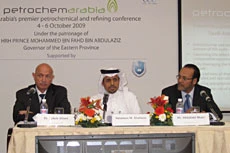
DAMMAM: Petrochem Arabia 2009, which brought together business and industry leaders and government officials for discussions about the Kingdom’s feedstock and geographic advantages in petrochemicals, concluded Tuesday.
Panelists in different sessions shared insights about the need for better collaboration and anticipation of customer demands to create a more sustainable, competitive environment for the industry.
In one session, Mohammad Al-Mojil Group President and CEO Ibrahim S. Al-Shuweir highlighted the challenges facing Saudi petrochemical contractors and said the sector would continue to expand due to high global demand and the Kingdom’s significant developmental investments.
“It is expected that SR94 billion will be spent on petrochemical projects in the Kingdom during the period from 2010 to 2014,” Al-Shuweir said. “Our group has been a leading Saudi contractor active in the petrochemical sector for more than four decades.”
He detailed the challenges private-sector businesses face in the sector.
“Local contractors shoulder the major risk of material and service price fluctuations. They suffer from an acute shortage of skilled, imported manpower and the migration of expatriate workers,” Al-Shuweir said. “Project over-runs and delays pose financial burdens on Saudi contractors. Then, there is stiff competition, both internal and external.”
He called for the immediate formation of an association of petrochemical contractors in the Kingdom to address common issues and facilitate continuous interaction with major clients, government departments and chambers of commerce. He also called for the creation of internationally recognized arbitration centers, similar to the ones in the UAE, to settle disputes between local contractors and international contractors or major clients.
Al-Shuweir said local contractors should not cut bid prices and fuel unnecessary and unhealthy competition. “As a result, all contractors become losers. There should be better understanding, more cooperation and synergy between contractors for their common good,” he said.
The conference provided a forum for regional business and institutional leaders to raise awareness and share insight about challenges and opportunities in the hydrocarbon and petrochemical industry. Participants also discussed the current and anticipated finance environment, joint-venture strategies and the role of technology in the sustainable economic development of the Kingdom.
Conference participants brought together thought leaders from the oil, gas and manufacturing industries.
Zuhair Allawi, commercial director for Dow Chemical in India, Middle East and Africa, discussed the role of technology and sustainability in driving economic development in the Kingdom. He discussed how minimal investments in the company’s environment, health and safety culture helped generate $5 billion in savings in 2005.
Dow’s ambitious 2015 goals will leverage strategic technologies to drive energy efficiency and conservation, solve global world challenges, such as clean water and alternative energy. Dow’s 2015 goals will also support innovative research and development in the field of chemistry and support sustainable community relationships.
“Saudi Arabia is going through a modern-day industrial revolution. Dow believes and supports the Kingdom’s efforts to become a knowledge-based, indeed a technology-based economy,” said Allawi. “We believe that by incorporating sustainability into the Kingdom’s growth agenda, the country can become a net exporter of innovative solutions for everyday human needs. Consideration for the environment, social responsibility and economic success don’t come in isolation. Whether maximizing effective use of hydrocarbon resources, or incorporating energy-saving technologies into plant processes, respecting the natural environment, enhancing professional and academic opportunities for the Saudi talent — all such measures must be part of an overall economic-development strategy that pays off for future generations ... and by definition, sustainability must be an integral part of this strategy.”
The GCC region is on track to become the global petrochemical hub, with many sources citing that nearly 75 percent of all forecasted petrochemical investments are slated for the Gulf Cooperation Council states. According to SAGIA’s (Saudi Arabian General Investment Authority’s) estimates, approximately $90 billion in investment is expected in the Kingdom’s petrochemical industry. This is nearly a third of the $270 billion expected for the Kingdom’s power generation, petrochemical and water desalination sectors. Companies present at the forum confirmed their commitment to the country’s diversification agenda and expressed hope to maximize value from the country’s vast resources of low-cost feedstock.
An example of the projects prominently discussed was the Ras Tanura Integrated Project (RTIP), a proposed joint venture between Saudi Aramco and Dow Chemical. RTIP would represent the largest proposed foreign direct investment in the country’s petrochemical sector. RTIP would also be the largest petrochemical facility to be built in one phase and among the largest facilities in the world.