
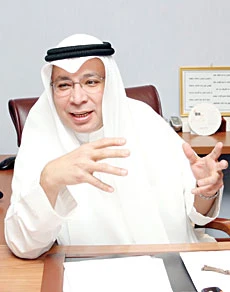
JEDDAH: Despite the global financial crisis, the Kingdom’s banking sector has shown overall resilience, benefiting from the Saudi government’s continued commitment to support the economy through infrastructure projects and planned expansion. The Saudi Arabian Monetary Agency’s (SAMA’s) prudent policies have helped banks weather the crisis, said Faisal H. Alsayrafi, managing director & CEO of the Jeddah-based Financial Transaction House (FTH) in an interview with Arab News.
While the Saudi banking sector was able to absorb most of the initial impact of the crisis, the challenge now is how to deal with the second round effects owing to slowing domestic demand, consumer consumption and the effects of the oil prices, Alsayrafi said.
Excerpts from the interview:
Saudi Arabia’s economy remains solid and its banks have weathered the global crisis, the IMF said in a recent report. Do you think the impact of the global financial crisis was less on Saudi banks compared to other banks in the region?
Many rating agencies and analysts have concurred that Saudi Arabia’s banks have been able to weather the economic downturn much better than many others. The banking sector has shown overall resilience, benefiting from the Saudi government’s continued commitment to support the economy through infrastructure projects and maintaining planned expansion. In addition to support from the Saudi government, and the fact that Saudi banks are not significantly dependent on market funding, SAMA’s prudent policies have helped banks weather the crisis, and overall we do see a lower-than-expected year-on-year decline.
SAMA Gov. Muhammad Al-Jasser has said in an interview that Saudi Arabia has managed assets as reserves and not as sovereign wealth funds, and is focusing on safety, liquidity and risk-adjusted returns. Do you think SAMA is going in the right direction?
That is not to say the Saudi economy has not seen any effect; there’s been a notable decline in deals. However in comparison to other parts of the world, and even the region, credit and spending has remained relatively stable. Maintaining a proactive fiscal policy and facilitating the availability of liquidity by SAMA has been essential in maintaining the Saudi economy. As a result, Saudi inter-bank rates have fallen and deposits are now growing faster than lending, bringing the loans-to-deposit ratio down to 77 percent. Banks, however, have been very stringent in passing on this facility to private customers, and as a result, we see that private sector credit has not experienced the same growth that was hoped for.
There are lot of activities in the real estate sector in Saudi Arabia and other Gulf countries. Saudi Arabia also announced major economic cities in different regions. You can say there is a boom in the real estate sector. Do you believe this is sustainable?
Unlike other Gulf States, real estate in Saudi Arabia has been expanding at a steady rate, with no specific boom. Increased efforts are being made to address the huge supply gap in residential, commercial and hospitality space, with projections that the growth rate will hold at between 5 and 7 percent until 2012. Investments in the real estate sector alone this year are estimated to reach SR1.125 trillion, with projections of up to SR1.5 trillion by 2010.
Saudi Arabia is adopting various reforms to attract foreign direct investment (FDI). How can investments be brought into the Kingdom and in which sectors?Reforms have taken place in all sectors in an attempt to attract foreign direct investment into the Kingdom. At the moment, the Kingdom’s relative economic stability is one of the main motivators, drawing investors into the region. In addition, the Kingdom’s growth potential makes it an attractive location for investors, suppliers, and contractors looking for promising business opportunities. With the country facing a shortage in housing due to a rising population and a decline in household size, we see a huge demand-supply gap. Therefore, we will see a particular surge in the housing construction industry.
Nowadays there is a slowdown in the initial public offerings in the Kingdom as well as in the Gulf region. We talk of plenty of liquidity available in the region. So why is there a slowdown in IPOs?
Saudi Arabia did slow down in early 2009. However, we did see a comeback of IPOs in Q2 and Q3, although most were par offerings. Premium offerings were definitely negatively impacted due to various reasons; valuations of companies witnessed significant drops, which meant shareholders were no longer willing to sell; shareholders and investment banks were worried that premium offerings would not be justified or covered; and liquidity was still an issue in this region with many investors losing money in the downfall of the markets. In an effort to solve these obstacles, many companies have chosen to postpone their IPO plans.
Saudi stock market is undergoing a very turbulent period. Despite CMA’s efforts, the market has not stabilized yet. Where do you think the market is heading?
The CMA has tried to stabilize the market. However, we still see that there is a huge lag in investor confidence. Global trends in international markets, as well as regional and international news, especially regarding crude oil prices, all have important effects on the direction of TASI (Tadawul All-Share Index). With our markets being closely correlated with the movement of the US markets, the CMA’s efforts and their effects can only go so far in improving the market stability and condition.
The Saudi stock market is dominated by day traders. Do you think the measures taken by CMA will help improve the situation?
The market is dominated by day traders, but the CMA cannot do anything about it. Any measure by the CMA to limit day trading will lock up liquidity, which will ultimately affect the liquidity in the market.
In the Gulf region, mergers and acquisitions are very slow compared to Europe, Asia and the US. Do you believe M&A trend will pick up speed in the region?
We have definitely started to see an increase in M&A activity. Although deals are concentrated at either the top or bottom of the scale, mid-market activity is increasing, and our expertise and know-how will be essential in servicing this sector of the market as M&A activity becomes more popular as an exit strategy for owners and an expansionary strategy for businessmen.
What kind of role does FTH play in executing M&A transactions? So far how many transactions have you completed?
FTH plays an important role in M&A transactions, both local and cross-border. We play an integral part in the valuation process, and in the advisory and arranging procedure. After meeting local and international valuation and legal standards, FTH has a wide network of contacts, which we draw on in an attempt to match buyer and seller in a successful agreement.
Is FTH planning any expansion in the Kingdom or in the region?
FTH is planning to expand further into the MENA region, with plans for offices to open in Dubai, Bahrain and Egypt well under way.