
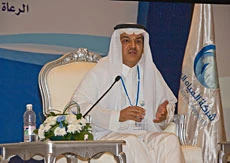
JEDDAH: One year into its existence, the National Water Company (NWC) has reviewed its achievements and set out its vision for the future in a seminar held in Jeddah on Wednesday. Loay Musallam, CEO of NWC, said that the company’s ambition was to be the best in the region within three years and use its multibillion budget to establish a world-class water company.
“Serious action over water supply and management has really arrived,” he told Arab News on the sidelines of the seminar.
NWC has, in the first year, set up 16 call centers across the country to establish the extent of the challenges ahead. They have proved effective, one receiving over 3,000 calls a day.
While the challenge to produce an efficient and effective water supply is huge, the budget for the numerous civil projects is generous at nearly SR800 billion in the relatively short term. Jeddah alone, which experiences particular pressure on the system from the high throughput of visitors, has a projected investment budget of SR34 billion up to 2014.
Setting out longer-term plans, he said that the next 20 years would necessitate expenditure on a much greater scale with a $37 billion capital expenditure budget planned for water distribution and sewage collection and treatment, divided by 62 percent (SR86 billion) and 38 percent (SR52.5 billion) respectively.
“Part of the problem we face is that investment is fragmented,” Musallam said. “Part of the process is integrating and harmonizing it within the system.”
One of the particular areas where improvements could and would be made physically, said Musallam, is in the supply of water and the question of leakage. The exact percentage of water leakage from delivery systems and storage in the Kingdom is not precisely known, but most experts put it at about 35 percent with individual areas — some parts of Riyadh for example — topping 70 percent on occasions.
To achieve this, said Montazar Muhalhal, executive director for strategy, NWC had developed a very clear set of business strategies. “The business value chain focuses on management, operations and maintenance in the municipal sector,” he said, adding that the adoption of performance-based entrepreneurial skills to develop competitiveness within the sector in the Kingdom and in the region were a core part of the mix.
He noted that part of the plan was to reduce NWC’s financial dependence on the government “by increasing cash flow from each cubic meter of water.” He expanded the point by telling conferees that this would be achieved by a much more efficient process of debt-collection rather than manipulation of the unit price of water. That currently lies within the government purview and will remain so for the foreseeable future.
The seminar reconfirmed the message from the Saudi Water and Power Forum that the Kingdom is committed to the privatization of the water sector as the way forward.
Mahmoud Fallatah, executive director of projects, detailed the projects under way and planned. Most important are projects that seem to have stalled.