
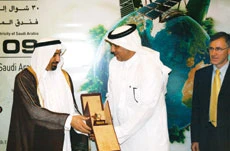
RIYADH: The final phase of a joint power grid for GCC countries will be completed by early 2011, announced Saleh Bin Hussein Al-Awaji, deputy minister for water and electricity, at a conference and exhibition held at the Marriott Hotel on Monday.
“The first phase of a joint power grid for GCC countries linking the grids of Saudi Arabia, Qatar, Bahrain and Kuwait was completed on July 26, 2009. By 2011, the United Arab Emirates and Oman would link to the grid,” said Al-Awaji at the GCC Power 2009-5th GCC International Conference and Exhibition For Electrical Equipment 2009.
Al-Awaji said that with the completion of the project, GCC countries would have a joint power grid that would guarantee an adequate supply of power, even in emergencies, and reduce the cost of power generation in member countries.
Ongoing power projects in the GCC have been estimated to be worth up to SR607.5 billion with Saudi Arabia accounting for around 50 percent of total investments.
Inaugurating the exhibition, Al-Awaji said that he is happy that the private and public sector is keen on meeting future challenges in the power industry. “The participation of a large number of related companies demonstrates their interest in the field of meeting the growing needs of the power sector,” he said.
More than 500 local, regional and foreign delegates took part in the event.
GCC Power 2009 is owned by CIGRE, the GCC Regional Committee for Large Electric Systems, a leading global organization in the field of high voltage electricity. For the fifth straight year, CIGRE has co-organized the event with IFP Qatar and Riyadh Exhibitions Company. Saudi Electricity Company (SEC), in association with local companies, is also supporting the premier trade event as exclusive “Platinum Sponsor.”
The GCC-CIGRE conference is held annually in different Gulf countries and is considered by the council as its most important event. Saudi Arabia was chosen this year because of the leading role it plays in the power field.
Thani Al-Khusaibi, chairman of the Board of Directors of GCC-CIGRE, said that the conference and exhibition would provide a good platform for companies to exchange experiences and gauge the volume of the market. He said that 38 technical papers would be discussed during the conference’s seven sessions.
“The significant number of power projects in Saudi Arabia has helped boost demand for innovative products and services as well as technologies and expertise in renewable power resources,” said Edward Rabbat, deputy general manager, Riyadh Exhibitions Company.
“It creates an interesting business-to-business platform for suppliers, technology vendors, government and corporate decision-makers and other trade visitors to identify and discuss evolving challenges in the regional power industry, and at the same time cultivate collaborative efforts among all industry stakeholders,” he added.
One of the major highlights of the event is the inauguration of a 400kV GCC Interconnector Grid, which was commissioned during the summer. The project underscores cooperation among GCC countries in addressing power challenges, particularly in terms of higher reliability and security of integrated power systems.
According to the 2007 SEC annual report, Saudi Arabia added more than 2.3 GW last year, including expansions at the Shuaibah Power Plant, and nearly 900 MW of gas-fired turbines in Riyadh, Tehama and Jizan. Some of the newest and largest facilities include the $1.7-billion, 2,400 MW Ghazlan II plant north of Dammam, the first power project to be debt-financed; its sister plant, the 1600 MW Ghazlan I; and the 2,500 MW Qurayya I and II.