
- JEDDAH/AMMAN: Saudi shares moved up and down last week in what analysts described as profit-taking tactics to make benefit from temporary rallies.
The market then witnessed a very short-lived rally on Monday and Tuesday which could not sustain for long and ended the week with a loss.
The Tadawul All-Share Index (TASI) shed 0.61 percent to 6,056.41 points last week.
The decline was led by the petrochemical sector, particularly the Saudi Basic Industries Corp. (SABIC), which went down by 0.87 percent to SR85.
On a week-to-week basis, the sector activity was widely split with 8 out 15 sectors closing with losses ranging from 0.61 percent by the Industrial Investment sector to 2.56 percent by the Hotel and Tourism sector. On the other hand, the gains ranged from 0.02 percent by the Transport sector to 1.79 percent by the Building and Construction sector, the Financial Transaction House (FTH) said in its weekly market commentary.
Saudi Ceramic Company was the top gainer for the week as its shares jumped 17.23 percent to SR139.50. Gulf General Cooperative Insurance Co. shares surged 11.29 percent to SR34.50.
The top losers for the week were Red Sea Housing Services Co. (12.34 percent) and Tourism Enterprises Co. (7.12 percent).
The value of Saudi traded shares dropped to SR12.90 billion last week compared to SR14.58 billion in the previous week.
Meanwhile, Saudi investment bank Falcom Financial Services is set to launch an exchange-traded fund (ETF) for Saudi petrochemical shares on Tadawul on Saturday with an initial value of SR25 million.
Other Arab stock markets were also volatile last week in response to fluctuations on world markets, conflicting recovery signals and expectations of second quarter earnings, financial analysts said Friday.
Almost all Arab bourses picked up on Wednesday and Thursday reflecting improving performance on the world's main stock exchanges and positive indicators released about US and European economies, they added.
"I believe Arab stock markets are still captives of what happens on world bourses," Nizar Taher, head of brokerage at the Jordan Ahli Bank, said.
"Regional markets rallied on the last couple of days of the week, but I think the rebound could be short-lived as regional investors keep a close eye on developments at global markets," he said.
Taher expected semi-annual results and oil prices also to play a key role in deciding the trend of Middle East markets in the coming weeks.
Jordanian shares picked up on the last two trading days of the week due to what Taher described as fresh liquidity and improving foreign demand.
The all-share price index of the Amman Stock Exchange lost 0.37 percent on weekly basis, closing at 2,340 points, according to the ASE weekly report.
Kuwait's KSE all-share index closed week almost unchanged at 6,430 points with the market receiving support from the sectors of banking, real estate and investments, analysts said.
The Unite Arab Emirate shares closed in the green last week, receiving support from the real estate, transport and investment sectors, according to analysts.
The all-share index of the Dubai stock exchange gained 2,03 percent last week, closing at 1,499 points while the Abu Dhabi index was up 0.75 percent on weekly basis, closing at 2,528 points.
Qatar's benchmark gained 0.94 percent last week, closing at 6,910 points while Bahrain's index dipped by 1 percent, closing week at 1,366 points.
Egypt's AGX30 index, which measures the performance of the market's 30 most active stocks, shed 0.1 percent, closing week at 6,026 points.
The GulfBase GCC Index increased 0.15 percent to 3,569.09 points. The value of GCC traded shares, however, fell by 9.08 percent to $4.49 billion and volume declined by 7.72 percent to 2.44 billion of shares.
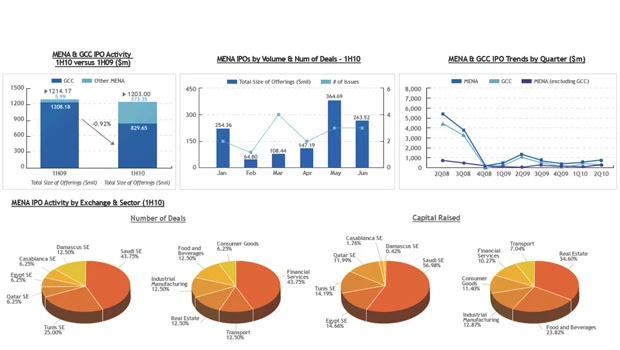
According to Zawya's IPO quarterly bulletin issued last week, funds raised in IPOs (initial public offerings) by MENA companies remained unchanged at $1.20 billion in the first half of this year compared to the same period of last year.
The Zawya bulletin said Saudi Arabia accounted for 43.75 percent of the deals and 57 percent of the capital raised in the MENA region.
Knowledge Economic City Co.'s $271.98 million IPO was the largest representing 22.6 percent of the total proceeds in the MENA region, the bulletin said.