
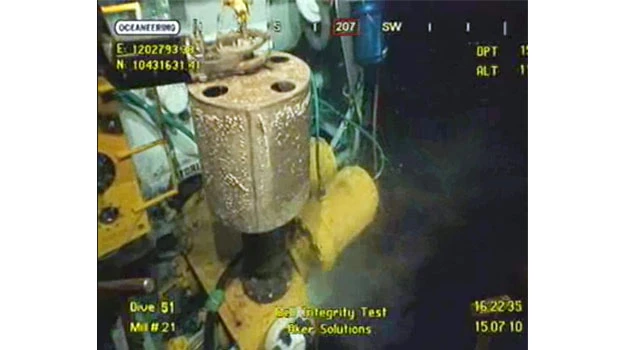
- HOUSTON: BP Plc conducted pressure tests on its blown-out Gulf of Mexico well on Thursday and said no oil was leaking into the ocean for the first time since the accident began in April.
As part of the test, BP shut off the valves to a newly placed containment cap. Initial results early on in the test showed that the cap had completely contained the flow from the ruptured deep-sea well, BP said.
BP's US shares jumped 10 percent after the company announced that its test had managed to shut off the flow of oil into the ocean.
US President Barack Obama Thursday welcomed BP's announcement that oil had stopped flowing into the Gulf of Mexico, but cautioned it was still early in a new process. "I think it's a positive sign. We're still in the testing phase," Obama said.
BP's announcement came at the start of a 48-hour test after engineers closed three valves on a new cap placed on the ruptured well, effectively shutting in the leak.
Obama, who is being kept closely informed of the developments, said he would have more to say on the oil spill on Friday.
Meanwhile, the US government says BP will be required to pay royalties for oil collected from its blown-out well.
Michael Bromwich, director of the Interior Department's regulation and enforcement office, sent the British oil giant a letter Thursday requesting oil and gas production reports and said royalty payments were required. Failing to pay royalties violates the Federal Oil and Gas Royalty Management Act, Bromwich said in a letter to Guy Otwell, of BP America Inc.'s Tax Department.
BP has tried numerous strategies to collect oil gushing from the bottom of the Gulf since the April 20 rig explosion. It's collected about 34.3 million gallons since May, and more will be pumped from the well while the company continues to work on a set of relief wells that could plug it for good.
Some of the oil and gas has been burned off, but the company also has started selling the oil. BP said in June that it planned to donate the money it makes from the oil to the National Fish and Wildlife Foundation.
The Interior Department said those sales also would be subject to a fee of 18.75 percent of the revenue. And BP would be responsible for paying additional fees if it violated federal law.
A BP spokesman declined to comment Thursday about the letter from Bromwich. An estimated 90 million to 179 million gallons of oil have leaked out so far
After a delay to fix a leak, BP began the test on Thursday afternoon on the cap that could stop all or most of the flow of crude that has been polluting the ocean and coastline.
Earlier in the day, the top US oil spill official backed away from earlier assurances that the new cap would be used to completely seal the well until relief wells eventually kill it with heavy mud and cement.
Retired Coast Guard Adm. Thad Allen said the cap could possibly shut the well, but might also be used only to block the flow during emergency situations like a hurricane, when BP's surface containment effort would be suspended.
"The intention of the capping stack was never to close in the well per se," Allen told reporters in New Orleans. "The best reason to be able to shut in the well right now ... is it allows us to abandon the site if there is a hurricane."
"We can certainly consider shutting in the well - that is a possibility and of course we would like to do that."
As the company pushed ahead on the spill control effort, US energy company Apache Corp was moving forward on a possible $10 billion deal for some BP properties, including major assets in Alaska, CNBC reported.
Reports that Apache was seeking $6 billion to $7 billion for the purchase helped extend a rally in BP's US shares, bringing them up 3 percent in mid-afternoon trade.