- JEDDAH: While the supply of water and electricity has to be further streamlined, its wastage should be reduced.
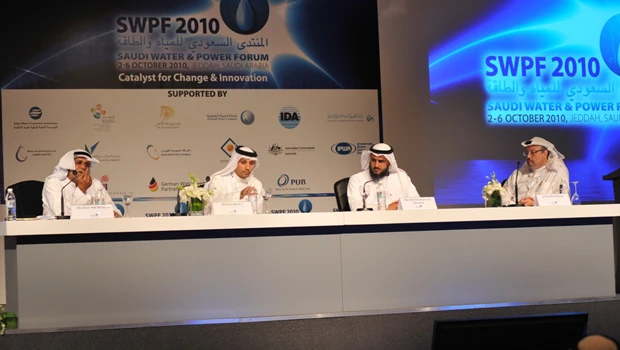
- This was the message given by speakers at the last session of the three-day Saudi Water and Power Forum (SWPF) at Jeddah Hilton on Tuesday.
While pleading with the community to use water and electricity judiciously and avoid wasting, Asad Abu Rizaiza of King Abdulaziz University suggested that incentives would be more helpful than levying stiff penalties for wastage.
He wondered what could be construed as wastage — using water for a car wash or watering the grass in the compounds of villas. “We should clearly define what constitutes wastage,” he said.
A question also discussed was whether the Kingdom would change its existing system of water supply to the one in vogue with the West, or continue with households and offices, storing them in underground or overhead tanks.
Journalist Jamal Khashoggi, moderator, wanted supply systems and pricing to be streamlined for the benefit of consumers and called for rationalization in the consumption of water and electricity.
“For supply agencies of water and electricity, consumer satisfaction should be uppermost and not profit,” he said.
Water supply and sanitation in Saudi Arabia differ from most other countries in three significant aspects.
First, it relies almost exclusively on two sources that are absent in most other countries: water desalination and fossil water. Second, given the substantial oil wealth of the country, water is provided almost for free.
Third, there is no separation between institutions in charge of policy and regulation on the one hand, and those in charge of providing services on the other.
Other aspects of the sector are reminiscent of the situation of many developing countries. First, despite massive investments, substantial inequities remain. Those not connected to the drinking water system have to rely on expensive water provided by private trucks. Second, institutional capacity and governance in the sector are weak, reflecting general weaknesses in the public sector.
“Campaigns for saving water and electricity have to be an ongoing program and television and other forms of the media could be among the tools,” said Khalid Agala of the National Water Company (NWC).
Most of the leakages in water supply have been plugged, especially in Riyadh and Jeddah, he added.
“NWC bears over 90 percent of the cost of water, while citizens pay only 10 percent,” he said, adding that any interruption in the supply of electricity should not exceed 18 hours at a stretch.
Abdulrahman Al-Ibrahim, vice governor for consumer and service provider affairs at the Electricity & Co-Generation Regulatory Authority, said the authority, a financially and administratively independent organization, has succeeded in regulating the electricity and water desalination industry in the Kingdom to “ensure provision of adequate, high quality and reliable services at reasonable prices.”
Supply goes up 25%
Minister of Water and Electricity Abdullah Al-Hussayen said on Tuesday there was a 25 percent increase in drinking water supply to the main cities of Makkah province this year compared to 2009.
“Average water supply to Makkah, Jeddah and Taif reached 1.6 million cubic meters per day compared to 1.2 million cubic meters per day last year,” the minister said.
Speaking about per capita consumption of water, Al-Hussayen said it reached 330 liters in Makkah, 285 liters in Jeddah and 200 liters in Taif.
“The increased water supply has reduced the number of water tanks moving to these cities by 50 percent,” he pointed out.