
- LONDON: Stock markets fell Friday after China took further steps to rein in lending and amid worries that Ireland’s financial rescue package is being delayed by disagreement over reforming its low corporate tax rate.
In Europe, the FTSE 100 index of leading British shares was down 70.25 points, or 1.2 percent, at 5,698.46 while Germany’s DAX fell 33.96 points, or 0.5 percent, to 6,798.15. The CAC-40 in France was 38.12 points, or 1 percent, lower at 3,829.85.
In the US, the Dow Jones industrial average was down 49.16 points, or 0.4 percent, at 11,132.07 soon after the open while the broader Standard & Poor’s 500 index fell 6.58 points, or 0.6 percent, to 1,190.11.
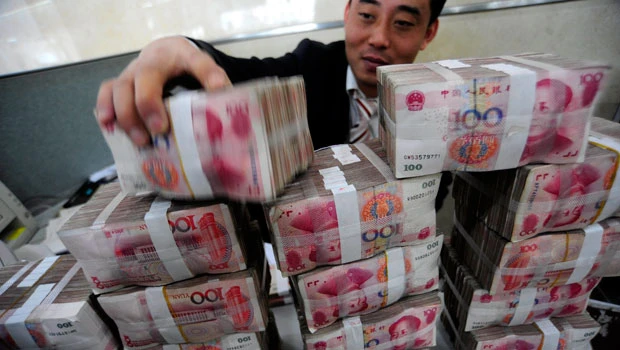
Weighing on sentiment was the news that China’s monetary authorities have ordered its banks to hold back more money as reserves in a new move to curb lending and cool inflation.
That was the second reserve increase in two weeks and came as Beijing tries to restore normal financial conditions and curb inflation, which rose to a 25-month high of 4.4 percent last month.
The central bank ordered lenders to set aside an additional 0.5 percent of their deposits, with effect from November 29.
One of the main worries in the markets alongside Ireland’s debt crisis over recent days has been the prospect of slower Chinese economic growth in the wake of tighter monetary policy. That’s important because China is now the world’s second largest economy.
Though Friday’s policy change did not include the expected rise in interest rates, analysts said higher borrowing costs in China are imminent.
“Another interest rate move is only a matter of time now that the government has made taming inflation its top priority,” said Mark Williams, senior China economist at Capital Economics.
The increase in the reserve requirement ratios was announced after Chinese stock markets had closed higher following a fairly torrid few days, largely on concerns of tighter Chinese policy.
The benchmark Shanghai Composite Index rose 22.15 points, or 0.8 percent, to 2,887.60. The Shenzhen Composite Index for China’s smaller, second exchange climbed 2.9 percent to 1,297.48.
US Federal Reserve chairman Ben Bernanke took a swipe at China in his keynote speech at a banking conference in Frankfurt, Germany, arguing that the country’s inflexible currency regime, which has the yuan effectively pegged at a low rate against the dollar, is preventing a much-needed rebalancing of growth in the global economy.
Bernanke has faced a barrage of criticism over the past couple of weeks, both in and out of the US, after the Fed decided to pump another $600 billion into the US economy, in effect to get unemployment down.
His argument, which has many backers in the international community, is that the US needs to export more and consume less, while China needs to do the opposite.
Investors are also keeping a close watch on developments in Dublin to see if a bailout package for Ireland emerges following discussions between the Irish government and representatives from the European Union, the International Monetary Fund and the European Central Bank.
Speculation that a financial bailout package that could run up to €100 billion will be agreed had increased Thursday after leading Irish officials, including the country’s leading central bank and the finance minister, hinted that a rescue deal was in the offing.
However, investors are concerned that a standoff is developing between Ireland and its partners in the eurozone, notably Germany and France over Ireland’s exceptionally low level of corporate tax.
The worry in the markets is that the Irish government’s apparent refusal to consider changes its 12.5 percent tax rate will prevent a deal from being agreed soon.
Elsewhere in Asia, Japan’s benchmark Nikkei 225 stock average gained 0.1 percent to close at 10,022.39 and South Korea’s Kospi added 0.7 percent to 1,940.96. Australia’s S &P/ASX 200 was 0.2 percent lower at 4,629.2, and Hong Kong’s Hang Seng fell 0.1 percent at 23,605.71.
In the currency markets, the euro was trading 0.1 percent higher on the day at $1.3660 while the dollar fell 0.1 percent to 83.45 yen.
Benchmark oil for December delivery was up 11 cents to $81.96 a barrel in electronic trading on the New York Mercantile Exchange.