- (Update) KARACHI: Employees of Pakistan’s state airline have called off a four-day strike that crippled air travel in the country after the resignation of the top company official.
The leader of the employee union for Pakistan International Airlines says their major demand was the resignation of the company’s managing director.
The official submitted his resignation on Friday evening, prompting celebration among the strikers.
Union leader Sohail Baloch says they hope to have flights running again after midnight.
The strike lasted four days and grounded more than 200 flights.
Pakistani International Airlines is the country’s largest carrier and the main operator of domestic flights. At least 250 domestic and international flights have been canceled since the strike began Tuesday, PIA spokesman Mashhood Tajwar said.
Pilots and support staff went on strike Tuesday over a proposal to have the struggling carrier share routes with Turkish Airlines. PIA managers say the route-sharing idea will lessen its financial losses, but strikers fear it will lead to job and pay cuts.
No PIA flights were in the air Friday in any city, and the carrier also closed its main booking office in the southern city of Karachi, Tajwar said.
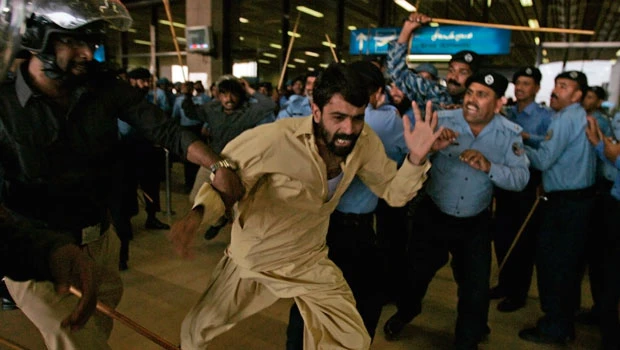
A relatively peaceful rally of employees and supporters in Karachi turned violent Friday afternoon as police wielding batons charged a group of men sitting on the airport floor, according to footage broadcast by a private Pakistani television station. Most of the men ran off, but some were clubbed by police. One man in a brown tunic crouched on the floor cradling a bloody nose in his hands.
Police officer Sohail Faiz said the strikers were trying to damage airport property.
“We had to manage them,” Faiz said. The police went after the strikers soon after a group of pro-management employees and supporters held a counter-rally at the airport. It was not clear if the two events were connected.
The strike is costing the airline roughly $6 million (500 million Pakistani rupees) a day, Tajwar said. It’s also likely affecting other parts of the country’s already struggling economy, which is being kept afloat by billions in loans from the International Monetary Fund.
In the capital, Islamabad, police carefully guarded gates to the airport. Though plenty of would-be passengers stayed away, some showed up in hopes of finding some sort of alternate path to their destination.
In Rauf Ahmad’s case, that’s Italy, where he hopes to spend a second season working in a fruit orchard. After learning his flight had been canceled, the 28-year-old said he was at a loss about what to do next.
“I just came here to see what is happening and nothing is happening, he said. “I don’t know what happens if I don’t get there on time.” Rukhsar Ahmad, a former government official in Pakistan’s side of the Himalayan region of Kashmir, was hoping to visit his family in Manchester, England, where he lives part-time and owns restaurants.
“It’s a loss of time, and a loss of money and a loss of business,” Ahmad said while pondering if he could get on another carrier.
The strike is already cutting into Pakistan’s economy, said Muzzammil Aslam, a chief economist as JS Global, a Pakistani investment firm. Along with passengers, perishable air cargo such as flowers and fruit have been left to spoil. He estimated the export losses from the four days so far at around $20 million.
“It’s quite a major dent to the economic activities,” Aslam said.
Abdul Malik, a representative of Pakistan Fruit Exporters Association said they’ve had heavy losses, as they haven’t been able to get produce to markets in Europe and the Middle East. Now they’re worried that international customers will cancel future orders.
PIA bosses say the route-sharing idea could raise money for the struggling carrier, which has been posting multimillion dollar losses for years because of bad management and competition from Gulf airlines. Carriers around the world have increasingly struck route-sharing deals to tap new markets without investing in extra planes and staff.
Management denies that there will be job or salary cuts, but strikers say they don’t trust the promises and continue to be opposed to the deal.
But strike leaders are adamantly opposed to the idea, though management denies they will see job or salary cuts.
The airline spokesman had said that officials were meeting with union representatives in the capital Friday, but a pilot leading the strikers said the meeting had been superseded by the ceremony swearing in the Cabinet.
“We were staging strike for four days in a peaceful manner. But now the management has moved people, who are their agents, against us,” Sohail Baloch said, referring to the counter-demonstration in Karachi. “If any of our colleagues is harassed or harmed, we will stretch our strike indefinitely.” Pakistan’s ruling party is trying to shore up the country’s economy, which is wracked by inflation, chronic power shortages and other problems, but it has met resistance from allies and the opposition on pursuing major reforms, including a new sales tax. Subsidizing PIA and other loss making state-run businesses eats up a significant chunk of the government budget each year.
___