
- BRUSSELS: European Union leaders hope to deepen trade and economic ties with North Africa following the upheaval in the region, but steps in this direction are likely to be modest and slow.
European suspicion of North African workers and farm goods, and uncertainty about the political changes in North African states, mean the creation of a network of deep trade ties spanning the Mediterranean is a distant goal.
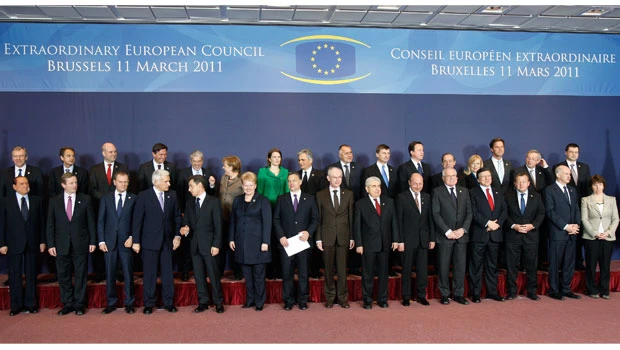
The British and German foreign ministers called this week for broad and deep economic integration. Europe’s main business lobby, BusinessEurope, and lobbies from the textile, car and chemical industries urged a focus on North African regional integration. EU leaders also discussed the situation in North Africa at a summit in Brussels on Friday.
“Ideally we’d like to have one huge market, without duties, without problems at customs. We are hoping for the creation of a bigger middle class,” said Eric Bergelin of the European Automobile Manufacturers’ Association, whose members include Volkswagen, Renault and Fiat.
“But of course that will take a very long time.”
British Prime Minister David Cameron said at the EU summit that Europe must step up measures to isolate Libyan leader Muammar Qaddafi and do more to encourage democratic change across North Africa.
.”..It is the moment for Europe to understand that we should show real ambition about recognizing that what is happening in North Africa is a real democratic awakening, and we should be encouraging these countries down a democratic path,” he said.
Attempts at creating a free trade zone between the 500 million-strong EU and the North African region, launched in the 1990s, failed, and trade between the EU and North African countries is currently based around bilateral deals that have opened industrial markets on both sides of the Mediterranean.
Counted together, goods trade between the EU and nine North African and Middle Eastern states — Algeria, Egypt, Israel, Jordan, Lebanon, Morocco, West Bank and Gaza, Syria and Tunisia — accounted for 140 billion euros ($193.3 billion) in 2010, less than 5 percent of the EU’s external trade.
Algeria, Egypt and Syria mainly export fuels and mining goods to Europe, while Tunisia and Morocco are the most diversified, with exports ranging from minerals and textiles to farm produce and machinery.
The EU executive, the European Commission, has proposed short-term trade openings and other financial incentives to try to cut red tape on industrial sourcing rules between the bloc, Turkey and North African, Middle Eastern and Balkan states.
Under the proposals, North African states would be able to source inputs for their manufacturing — such as machinery parts or yarn for textiles — more easily from outside the region, in some cases from China, but still qualify for low tariffs when moving their goods into the EU.
The EU also wants to complete deals to eliminate tariffs on 55 percent of farm imports from Morocco and a similar amount from Tunisia, and says it is prepared to loosen EU visa requirements for North African skilled workers.
In the long term, the EU wants to conclude bilateral trade agreements that include clauses encouraging EU investment in the region and hopes to root out state enterprises which it says hinder competitiveness in several states.
The proposals face some resistance. EU states have long been fearful of North African laborers entering the bloc, and European farmers this week warned against market openings to produce such as tomatoes and olive oil.
“Any further opening of trade with North African countries would have a devastating impact on (EU) producers and thereby, whole regions of the EU,” Europe’s farmers’ union Copa-Cogeca wrote in a letter to Europe’s top trade negotiator on Tuesday.
Morocco and Tunisia have also resisted farm trade openings in the past, fearing an influx of EU goods.
Developing countries in other parts of the world may also feel slighted by any deal granting North African states similar preferential sourcing rules.
But a single set of rules on sourcing or rules of origin has the backing of some of Europe’s powerful industrial lobbies.
“The idea is that we use these countries as manufacturing hubs,” said Luisa Santos, head of international trade at Europe’s textiles lobby, Euratex.
Such trade openings could be hard to implement in the short term but are pivotal to boosting the region’s economic diversification and long-term stability, trade analysts said.
“Outside of oil and gas, that part of the world has not found a niche in the world economy,” said Daniel Griswold, a trade expert at the Cato Institute, an independent think tank in Washington.
“That’s partly our fault. We cling on to high tariffs on textiles and agricultural goods. But it’s also their fault — they’ve operated protectionist regimes, isolating their people.”