- JEDDAH: Philippine Vice President Jejomar Binay says he wants Manila to scrap some of its rules that has caused Saudi Arabia to stop hiring Filipino household workers.
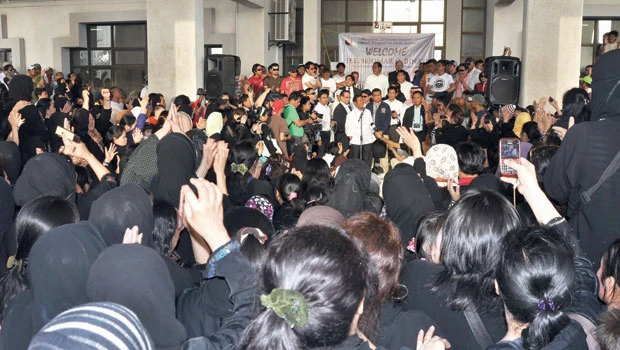
In a meeting with Filipino community members in Jeddah Monday night, Binay said that a technical working committee will meet in the next few days in Manila to discuss the matter and recommend a compromise solution.
Binay arrived in the Kingdom a week ago to meet with Saudi officials after the Kingdom rejected a Philippine rule that requires verification of new contracts of maids being sent to work in Saudi Arabia. The Kingdom’s rejection of the requirement has meant that no new contracts could be processed.
He said he was given an audience by Riyadh Gov. Prince Salman, Labor Minister Adel Fakieh, Commerce and Industry Minister Abdullah Zainal Alireza and Undersecretary at the Interior Ministry Ahmad Al-Salem. He also met with Kingdom Holding Co. Chairman Prince Alwaleed bin Talal, and officials of Riyadh and Jeddah chambers of commerce.
Binay refused to talk about the outcome of his meetings with Saudi officials, but said he was optimistic that the conflict would be resolved soon.
He said the Kingdom objected in particular to a requirement that prospective Saudi employers provide a sketch and photograph of their houses. Another rule being objected to, he said, was the imposition of a $400 minimum monthly salary, which many Saudi families reportedly could not afford.
Both rules were enforced by the Philippine Overseas Employment Administration (POEA) last year to address the alarming number of Filipino domestics being abused in Saudi Arabia and elsewhere.
In an interview after late Monday's community meeting at the Philippine Consulate in Jeddah, Binay said he wanted to see these rules scrapped if they cause more harm than good to Filipino workers and the Philippine economy as a whole.
During the meeting, Binay said that in his discussion with Saudi officials, he was made to understand that the home sketch and photograph requirement was tantamount to an invasion of privacy and also posed a security risk to employers.
He said it was “unrealistic” for the POEA to impose a minimum salary rule for all labor markets considering the differences in employment conditions. Unlike in Saudi Arabia, he noted, expatriate workers are taxed in many other countries.
He acknowledged that the minimum salary rule was imposed to discourage Filipino domestics from seeking work in places where they are vulnerable to abuse and exploitation.
“However, it has turned out that this rule was being circumvented. Our workers are given contracts for $400 but when they reach the workplace, they are given new contracts or the pay they were promised are not given in full, resulting in more of our domestic workers running away from their employers,” he said in Filipino.
Binay said he was surprised to find out that in Saudi Arabia, the majority of Filipino workers belong to the skilled and professional brackets, and are largely content. He said only about 15 percent of the Filipino workers are domestic helps.
"This is not to say that we should neglect them. We will continue to give them protection and welfare," he said.
Binay was accompanied by his son Makati City Mayor Jun Jun Binay, his adviser former Sen. Francisco Tatad, former Ambassador Apolinario Lozada, Vice Gov. Ben Loong of Sulu province, business leaders Jesus Varela and Ed Lacson, and Vice President Alex Aguilar of Pag-IBIG Fund.