
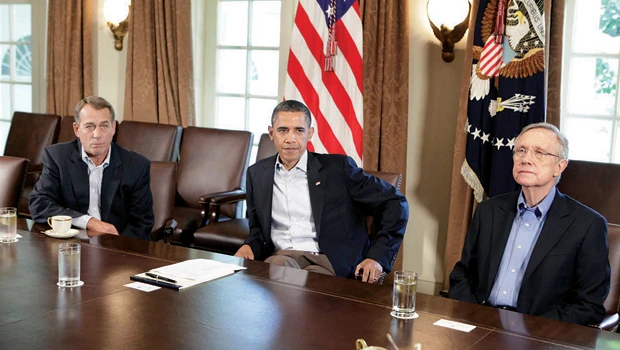
- WASHINGTON: US President Barack Obama told congressional leaders on Saturday to find areas of agreement and draft legislation to avert a catastrophic debt default, with both sides aiming for a deal by Monday.
Obama, a Democrat, held talks at the White House with House of Representatives Speaker John Boehner and other congressional leaders for a bare 50 minutes, a day after Boehner broke off negotiations in a festering dispute over spending and taxes with an Aug. 2 default deadline drawing ever closer.
Nancy Pelosi, leader of the House Democratic minority, said Obama instructed the lawmakers to find where they can come to a deal and that a short-term extension of the US debt ceiling is definitely not being considered.
A Senate Democratic aide told Reuters that congressional leaders agreed their staffs would "work together throughout the weekend" to try to craft a deficit-reduction bill to clear the way for a debt limit increase.
A senior Senate aide, speaking before the White House meeting, said the goal will be to work out a deal this weekend and have legislation ready to introduce on Monday.
The mood around the table in the White House Cabinet Room appeared strained as Obama, the Democrats and their Republican adversaries sat down a day after negotiations collapsed in acrimony.
Senate Republican leader Mitch McConnell said after the meeting that congressional leaders were working on fresh legislation to prevent a default that would have global economic reverberations and jeopardize America's Triple-A credit rating.
"The president wanted to know that there was a plan for preventing national default. The bipartisan leadership in Congress is committed to working on new legislation that will prevent default while substantially reducing Washington spending," McConnell said.
A senior Republican aide said a fallback option initially presented by McConnell would not be the basis of the new bill. New legislation would be aimed at cutting spending, preventing default and not raising taxes, the aide said.
With the world's biggest economy set to run out of money to pay all of its bills on Aug. 2, the window was closing fast for a "grand bargain" of spending cuts and tax increases in exchange for Congress raising the $14.3 trillion debt ceiling.
The fits and starts in the negotiations have left both sides fuming. Obama has said he has agreed to deep spending cuts in social programs that make his own Democrats uneasy but that Republicans must allow some taxes to rise, a prospect they have rejected.
Financial markets are growing more edgy and US banks and businesses are making contingency plans for the possibility of a debt default that would drive up interest rates, sink the dollar and ripple through economies around the world.
Credit rating agencies want spending restraints for the United States to keep its prized triple-A rating that makes U.S. Treasuries the solid foundation for global investors and lowers borrowing costs for state governments, businesses, homeowners and consumers.
"We have now run out of time," Obama said on Friday after talks collapsed on a deficit reduction package worth more than $3 trillion over 10 years.
Boehner said on Friday he was confident the debt ceiling would be raised next week. But he will have to overcome resistance from Tea Party movement conservatives in his own party and could run into problems for having signaled a willingness to give ground on revenue increases in closed-door talks at the White House.
Both Republicans and Democrats chafed at the compromises a far-reaching deal would require before the presidential and congressional elections in November 2012, with each side accusing the other of not doing enough and demanding too much.
Boehner said talks fell apart because the White House insisted on raising taxes while refusing to get serious about cutting spending and overhauling retirement and health care programs. Democrats say tax loopholes and George W. Bush-era tax cuts for the wealthy must end as part of a US fiscal rehabilitation.
A major barrier was how much revenue would be raised through tax reform — with Obama wanting $1.2 trillion over 10 years and Boehner putting $800 billion on the table.
"If not reversed within the next few days through crisis negotiations, this breakdown will be highly detrimental to the already fragile health of both the US and global economies," Mohamed El-Erian, co-chief investment officer at Pimco, the world's top bond fund manager, told Reuters.