
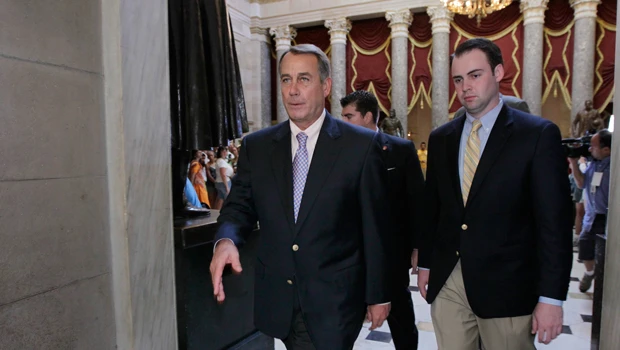
- WASHINGTON: The Republican-led House on Saturday rejected a Senate Democratic bill to raise the nation’s debt limit just three days before the deadline to avert a first-ever default on US financial obligations.
- President Barack Obama and lawmakers remained at an impasse on any possible compromise.
With tensions high at a rare weekend session, the legislation failed on a 246-173 House vote that was largely symbolic. The Senate has yet to vote on the bill.
Saturday’s result, however, could pave the way for negotiations on a compromise with Tuesday’s deadline on the government’s ability to pay its bills fast approaching.
Shortly after the House vote, President Barack Obama stepped back into the debt-ceiling talks, calling Congress’ top two Democrats, Senate Majority Leader Harry Reid and House Minority Leader Nancy Pelosi, to the White House for a meeting Saturday afternoon.
Top congressional leaders and the White House now have little time to work out a deal that can pass both chambers of Congress and be signed by Obama before a Tuesday deadline to avoid default.
Both the House and Senate debated through the afternoon in unusual weekend sessions at the Capitol as tourists sampled the sights on the National Mall outside. The temperature rose to the 90s Fahrenheit (mid-30s Celsius) on a sunny day.
Tuesday is when the government says it will run out of money to meet its financial obligations. It needs Congress to approve an increase in its borrowing authority, known as the debt ceiling. Past increases have been routine, but Republicans, citing the giant US deficit, have demanded huge spending cuts as a condition for approving the increase.
“There is very little time” Obama said Saturday in his weekly radio and Internet address. He called for an end to political gamesmanship, saying “the time for compromise on behalf of the American people is now.”
Setting the stage for the high-stakes weekend, Senate Democrats late Friday killed a House-passed debt-limit increase and budget-cutting bill less than two hours after it squeaked through the House of Representatives. Senate Majority Leader Harry Reid set up a test procedural vote for the wee hours of Sunday morning on his own legislation.
Reid’s task was made more difficult after 43 Senate Republicans declared they would oppose his bill — enough to block it from coming to a final vote. Reid’s measure would raise the debt limit by $2.4 trillion while cutting spending by $2.2 trillion.
In a letter to Reid, the Republican senators said his bill “fails to address our current fiscal imbalance and lacks any serious effort to ensure that any subsequent spending cuts are enacted.” The 43 are enough to block passage of Reid’s bill under Senate rules.
At the start of the Senate’s session Saturday, Reid appealed to Republicans to work with him on his proposal, particularly McConnell.
“We’re willing to listen to Republican ideas to make this proposal better, but time is running short,” Reid said.
Senate Republican leader Mitch McConnell said the Reid plan wasn’t “going anywhere. Senate Republicans refuse to go along with this transparently political and deeply irresponsible ploy to give the president cover to make our debt crisis even worse than it already is.”
Saturday’s debate in the House was heated and sometimes nasty, with occasional efforts to shout down speakers. Pelosi, for her part, told the House it was “time to end this theater of the absurd. It’s time for us to get real.”
The top Republican in the House, Speaker John Boehner, made it clear that Reid’s bill would be dead on arrival in the House.
In a news release titled, Boehner said Saturday’s House vote “will demonstrate that the Reid bill cannot pass the House. This will also expose any Senate vote on the Reid bill as a pointless political exercise that squanders precious time as the specter of a job-crushing default looms.”
House Democrats said they would put aside their resistance to legislation that makes deep spending cuts and back the Senate Democratic measure in a show of strength that could improve Reid’s leverage in negotiations.
“There are some misgivings, but it’s the only game in town,” said Democratic Rep. Gerald Connolly of Virginia, as he emerged from an hour-long closed door meeting.
Democrats, Republicans and the White House, meanwhile, were expected to be deep in conversation in hopes of a potential compromise.
The outcome of the weekend endgame was anything but clear as Democrats and Republicans remain at odds over how to force lawmakers to come up with additional budget savings later this year beyond the almost $1 trillion in agency budget cuts over the coming decade that they basically agree on.
After a brutal week on Wall Street — investors lost hundreds of billions of dollars as the markets lost ground every day — pressure is intense to produce an accord before the opening bell on Monday.
The House measure squeaked through on a 218-210 vote, with 22 Republicans joining united Democrats in opposing the Republican measure, which pairs an immediate $900 billion increase in US borrowing authority along with $917 billion in spending cuts spread over the coming decade.
Friday’s roll call came after Boehner had been forced to call off a vote slated for Thursday in the face of opposition from his party’s most conservative members to the measure. He added a provision requiring that a second, up to $1.6 trillion debt increase be conditioned on House and Senate passage of a balanced-budget amendment to the US Constitution, which would require an unrealistic two-thirds vote by each chamber to send it to the states for ratification.
Boehner’s move to appease conservative tea party-backed Republican lawmakers with the balanced-budget amendment poison pill only cemented Democratic opposition to the measure and complicated prospects for a compromise over the weekend.
As soon as the House measure reached the Senate side of the Capitol, Senate Democrats scuttled it without so much as a debate on its merits. The vote was 59-41, with all Democrats, two independents and six Republicans joining in opposition.
Reid’s alternative measure would raise the debt limit by up to $2.4 trillion, enough to meet a demand by Obama that the increase be sufficient that Congress doesn’t have to wrestle with it again until 2013, pushing the issue past next year’s presidential and congressional elections.
Administration officials say that without legislation in place by the end of Tuesday, the Treasury will no longer be able to pay all its bills. The result could inflict significant damage on the economy, they add, causing interest rates to rise and financial markets to sink.
Executives from the country’s biggest banks met with US Treasury officials to discuss how debt auctions will be handled if Congress fails to raise the borrowing limit before Tuesday’s deadline.