
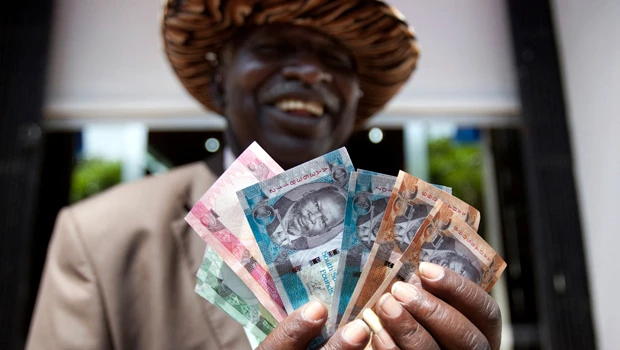
- JUBA: South Sudan has enough reserves to pay for the basic needs of the state for a “few months” even if it does not receive oil revenues, the central bank governor said.
Governor Elijah Malok said the new state was trying to stop a slide of the new currency, the South Sudan pound, which was issued after secession from the north in July.
South Sudan became independent on July 9, breaking away from its former foe in the north under a 2005 peace deal that ended a long-running civil war.
The new state has been trying to build up efficient institutions and develop an economy that is at present totally dependent on oil.
Asked about the central bank’s reserves, Malok said: “I will not give it (a figure) to you but we are ok. Even if we do not receive the oil money for the next few months, we can survive at the rate of $50 million expenditure per month for goods and services coming to the South.”
“We are alright, we can pay for the basic services of the state,” he said.
The South took 75 percent of the united country’s 500,000 barrels a day of oil production when it broke away. But it depends for exports on a pipeline that runs through the north.
The two sides have yet to agree a transit fee. The north said on Friday it had halted a shipment from the south because of the dispute.
On the new currency, the governor said: “The rate when we broke off was 2.70 (to the dollar). After briefing the government of South Sudan, we put it at 2.90. It has moved since then to be 3.30.
“Why is that? We believed having put in $28 million thus far, there are people who like to hoard this money and possibly take it ... outside, either to the north or outside, so the dollar is in demand,” he said.
But he added: “We do not need to alarm people, it is under control.”
The central bank sold $3 million to banks on Wednesday to stabilize the currency, he said.
“I am now told that our oil will be sold by our minister of energy and mining, but the money has not yet come. We are still depending on some of the (money) that we left (aside) for the good of the nation,” he said.
Looking ahead, Malok said he expects the pound’s exchange rate against the dollar to improve to between 2 and 3 after September.
“We will have closed our borders, there will be no exchange ... Our worry is that people living in the north might decide to bring a huge amount of money into our country across our borders in the next month. This would destroy our economy,” he said.
North Sudan has started circulating a new currency after the South moved forward plans for its own money but the two sides have yet to agree on the fate of up to 2 billion old pounds in use in the South.
Khartoum considers the pounds — worth $700 million there, according to the south — worthless and has banned the import of these notes, a move that could hurt the southern economy.
The South could hit back at the North by trying to export the pounds there, which would add to inflationary pressures in the heartland where 80 percent of 40 million Sudanese live.
Apart from the currency and oil-sharing, the two countries need to sort of out various other issues such as finding a compromise over the disputed Abyei region.
The old Sudanese pound has been also falling in the North which the central bank blames on “speculators” and southerners getting paid in dollars before they return home.