
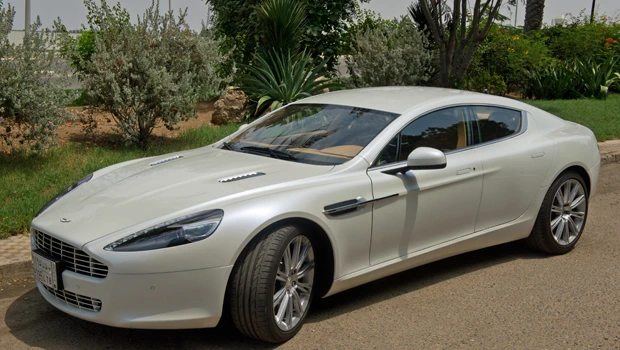
- Aston Martin is at heart a two-seater sports car.
- It was how the company started at Bamford Martin and changed its name after outstanding success at hill-climbing events in Aston Clinton, Buckinghamshire, in England in 1914.
Successes at Le Mans over the years added reliability to the sporting heritage and the marque was able to take on the role of high speed touring as well as that of outstanding sports car performance.
In 1953 the DB2/4 went into production and the idea if not the fact of the four-seat Aston Martin was born. The designation was 2+2 and referred to two people in the front and two souls whose age was less than their shoe size in the rear. The then established role of gentleman’s touring car required that the interiors were appointed to very high standards and that imperative follows through to this day. The 1955 DB2/4 Mark II went into production and laid the foundation for the slippery smooth shape that has characterized Aston Martins since then.
It took another half a century for the company to get round to a full four-seat Aston Martin and the Rapide is the result. Sit in the driver’s seat and all the way from front air scoop to the central door pillar it is pure DB9. Thence rearwards it is a genuine, cosy four-seater.
It is a redesigned car, not a simple stretch, and that is why it looks deceptively small for a four-seater. The designers avoided their nightmare, the central “flat-roof-of-death” section in a stretched vehicle composed of graceful aerodynamic curves. Put the DB9 and the Rapide a few meters apart and you would be hard pressed to see that the Rapide’s wheelbase is 25cm longer and the car 25 cm wider. From the front aspect, the wider stance of the rear wheels retains the crouching ‘big cat’ look. It is a masterpiece of subtle design and is pure Aston Martin.
Four-door sports car has always been something of a motoring oxymoron. This beauty gives traction and agility that you will not encounter in other sports sedans (somehow it feels wrong to classify it as a sedan) yet it delivers the superlative touring car ride in comfort mode. Slip into the low slung driver’s seat that has ample room for taller drivers and the cloistered view of the road and the feel of the car is definitely sports car. The backseat certainly offers more space than a GT coupe such as the DB9, but headroom and legroom are limited. A six-footer can fold himself in, but the hip room is limited by the transaxle’s wide tunnel.
In practical terms, rear passengers would enjoy a relatively short trip, but three or four hours in the rear would be a challenge. Yet it is a four-door sports car and its hatchback-style luggage space and rear bucket seats deliver the kind of practicality that a GT coupe never could. All very pretty, but does it work like an Aston should? Oh yes!
The skeleton under the sleek exterior is Aston Martin’s bonded-aluminum ‘VH’ chassis that houses and rear-mounted transaxle. The driving force is the proven 5.9-liter 470 horsepower V12, shared with the DB9. The single six-speed transmission option in full automatic is accessed by simple buttons on the dashboard or the much more exciting paddle-shift mounted on the steering column.
In the slightly soft and lazy full automatic mode and in “touring” mindset the Rapide is a comfortable and gloriously appointed car for a long journey. The firm-ish suspension and low profile tires produce a responsive ride with a higher level of road noise than from a touring sedan. However, while noticeable it never really intrudes and the Bang and Olufson sound system easily overcomes that.
The ambient noise though hints at the other side of the Rapide’s split personality. A dab on the “sport” button and a firm foot on the accelerator and the willing V12 announce itself with a very audible “bark.” From standstill it will see you through 100kmh in five seconds and on to 300kmh. It is very rapid but, being that much heavier and bigger, not as fast as the DBS, for example.
Any thoughts that a heavier car might be ponderous in corners are quickly disabused as it handles them cleanly and smoothly with very communicative feedback through the steering wheel. It is back to driving as you think you remember it; through the seat of your trousers and the nerve ends in your hands. And it is glorious stuff! Four-wheel drive is safe; two-wheel rear drive with a sporting heritage that adds all the accumulated experience is simply exciting. If you want the “full monty” crack the window and enjoy the exhaust note — visceral stuff indeed.
Should safety be a prime concern at these moments then: a) don’t push it or: b) read the following. “The Rapide comes standard with antilock disc brakes, brake assist, limited slip differential, stability and traction control, front side airbags and side curtain airbags.” It is as safe as it gets given the type and purpose of the car, but at these moments it is probably safer to concentrate on the road.
Standard equipment on the car, confirming its touring credentials, includes 20-inch cast-aluminum wheels, adaptive dampers, a limited-slip differential, bi-xenon head lamps, front and rear parking sensors, power outside mirrors, front and rear automatic climate control, power front seats with memory functions, heated front and rear seats, a full leather interior, an auto-dimming rear view mirror, Bluetooth, a hard-drive navigation system and a 15-speaker Bang & Olufsen audio system with a CD player, an iPod/USB audio interface, an auxiliary audio jack and satellite radio. In typical Aston style, the access to the electronics from the cabin is laid out with such care that the console and dash look surprisingly clean. Not quite a sports car in the full sense and equally not quite a sedan, the Rapide exceptionally neatly avoids the embarrassment of falling between two stools and delivers very satisfactory elements of functions in one of the best looking bodies on the road.