- TRIPOLI/JEDDAH: When Arab News tried to visit the Indian Embassy in Tripoli three weeks ago, a month after the city had been liberated, no one was there.
Like most of the 18,000 Indians who lived and worked in the country before Libya’s revolution, the diplomats had gone. Eventually, we found one of the few Indians left in the city and, by chance, he was looking after the embassy buildings.
Someone needed to. There had been one attempted burglary at the ambassador’s residence while Qaddafi still held Tripoli, and on the night the city was liberated, thieves again broke into the residence and this time stole computers and silverware while only just failing to take the vehicles as well.
Who the burglars were no one could say. Some accused Qaddafi loyalists of trying to cause panic; others said that it was opportunists. The Indian Embassy was not the only target that night. There were others, including the Greek Orthodox church in Tripoli’s Old City. It was ransacked.
The volunteer caretaker put us in touch with some of the others who had stayed on. There are not many. One Indian suggested that out of the more than 10,000 in Tripoli there were probably no more than about 120 left. Most were doctors, nurses, engineers and other professionals. Those who remained worked for construction and engineering companies such as DS Group and Unitech. They had stayed on to protect company equipment and assets after work on infrastructural projects ground to a halt with the uprising in February.
Arab News was invited to visit a group of them and their Bangladeshi colleagues working for another of India’s major construction groups, Punj Lloyd. We would not have difficulty finding the site, we were told. It was opposite an entrance to the city’s Mitiga air base and there was a large sign with the company’s name on it.
They did not tell us to look out for what clearly had been a battleground. The experience of these Indians and Bangladeshis in the final hours of Qaddafi’s rule in the capital was something they will not forget. They are extremely lucky to be alive.
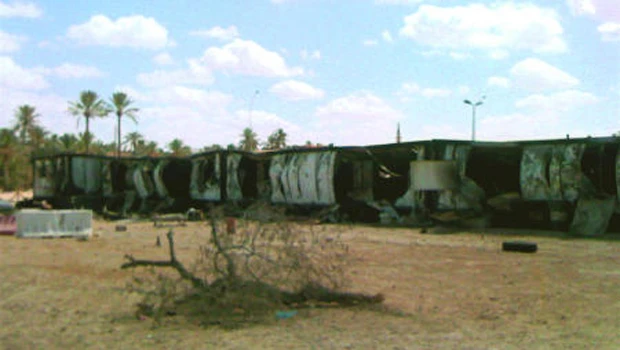
Many of the portacabins at the company’s campsite were burned out wrecks. “That is where I lived,” pointed a Bangladeshi member of the team. It was a charred ruin. Washing hung out on lines stretched between the burned buildings; the men were trying to lead as normal a life as possible among the wreckage.
Punj Lloyd had 500 Indians and 400 Bangladeshis working in Libya before the revolution. A couple of weeks ago there were less than a couple of dozen. They included Harinder Chhena from Amritsar and Gurwinder Singh Bedi from Chandigarh. Unlike Saudi Arabia and the Gulf, where so many Indians are from Kerala, many in Libya were from the north, notably Sikhs or Punjabis. Bedi had arrived in Libya only 11 months earlier. Nothing could have prepared him for the baptism of fire he and the others were to experience.
After the uprising started and the bulk of their colleagues had gone, the remaining men continued doing occasional rehabilitation work until May. At that point all work stopped. “We simply kept an open eye. We were silent witnesses (to the unfolding revolution),” Harinder said.
In the days immediately before the fall of Tripoli, they were warned of trouble ahead. “People were warning us that something was going to happen,” said Harinder. “It was a warning to leave. To save our lives.” Then on Aug. 20, “We received calls. Tonight will be critical. Revolutionaries from Zawiyah and Misrata are coming.”
So much for surprise. The timing of the attack on Tripoli appears to have been common knowledge.
In the evening, the revolutionaries arrived. “They wanted equipment,” Harinder recounted. “But some youngsters then fired at the air base gates.” It was less than a hundred meters away from the campsite.
Qaddafi forces at the air base returned fire. “We had to take cover for half an hour.”
The young revolutionaries then withdrew. “At about 11 p.m., (Qaddafi) army forces entered the camp and asked: ‘Why did you fire at us?’ We said it wasn’t us. They didn’t believe us. We couldn’t give the identities of the attackers. They took us to the air base. They made us lie down on the road and searched us.
“After about 40 minutes a commander arrived and realized that we were Indians and that it couldn’t have been us who had shot at the base. He ordered us to sit facing a wall near the gate.”
They were given some blankets and pillows. At that point fighting erupted around the base. The battle for Tripoli was in full force. “At 4 a.m. we thought both sides would break for Suhoor and we would be able to leave,” said Harinder. “But the firing was intense.”
It continued for hours. The revolutionaries were firing from the roofs of nearby buildings, including probably from on top of the campsite portacabins. Some of the weaponry was fairly amateur. There were petrol bombs. “One fell a meter from me,” continued Harinder, “I used a pillow to put out the fire.”
“All of us were lying flat out on the ground,” said Bedi. “Bullets were flying overhead.”
At one point two hand grenades fell close by. “The commander then moved us 200 meters further inside the base,” explained Harinder. “It was low-lying ground and they left us there.” There they remained for hours.
From that point onward, Qaddafi’s forces were not to be seen, but there was no letup in the firing. “It was very frightening, every few seconds hearing bullets flying. Branches and leaves in the trees above us were falling, hit by the bullets.”
Around 1 p.m., a bomb exploded. It seemed to be about 90 meters away. “That scared us," admitted Harinder. “There was heavy firing from machine guns all around. We could hear grenades going off.
“At 4:30 p.m., a rocket landed very near where we were. Fortunately all that happened is that we were showered in sand. Another landed around 5 p.m.
“It shook us. We know that we were stuck. We had no options. Every moment we were expecting to die.”
By that time, it seemed that the Qaddafi forces had been pushed back. “The revolutionaries were only 100 meters away,” Harinder continued.
“Around 5:30 p.m., we shouted to them: We are Indians and Bangladeshis. The firing slowed. Again we shouted: We’re Indians and Bangladeshis. The firing stopped. A voice told us to run fast toward them. They gave us covering fire.
“They took us to a nearby mosque and gave us water and food. We had not eaten or drunk anything for over 18 hours. They helped us a lot. We felt in safe hands. We could have been used as hostages (by the Qaddafi forces) to negotiate.
“Looking back, God was very good to us. There was no loss of life. We thank God for that.”
When they got back to camp, they found it a burned out wreck. Staying there would probably have been even more dangerous than being in the thick of the fighting at the base. Yet more reason to be thankful.
Those portacabins that had not been destroyed had been ransacked. Computers and other equipment had gone. It had clearly happened while they were under arrest. They do not know who had done it. “It could have been Qaddafi’s men, we don’t know,” Bedi said.
The gates to the campsite are now kept firmly locked just in case anyone tries to steal what remains. The men are carrying on as best they can, hoping to be able to restart their work soon.
None of them seem to think they were courageous or were heroes. However, they were and it is impossible not to have the greatest admiration for them or be amazed at what they went through.
Given their experience, did they want to get back to India and Bangladesh as soon as possible? The answer was no. “We want to stay.”
How many Indians will return to Libya is unknown. Bedi reported this week that some colleagues were returning. They had flown in from Tunis. “(But) there are still no Indian diplomats,” he said.