LONDON: What does an entrepreneur need to do to achieve sustainable success? How can SMEs be supported and who should be providing the support?
These issues were at the heart of the discussions at the Saudi/UK SME Partnership Forum held in London recently under the auspices of the Saudi British Joint Business Council and the Council of Saudi Chambers.
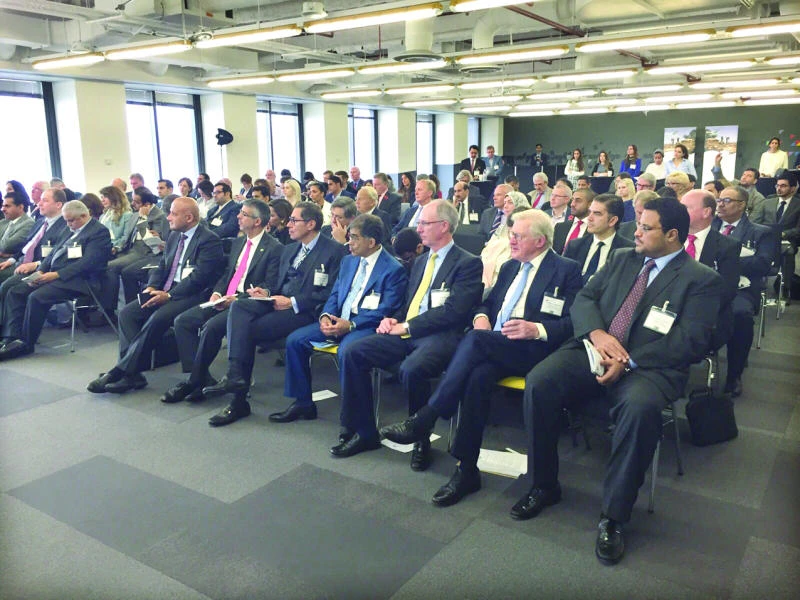
The 39th Floor of One Canada Square, Canary Wharf, with its sweeping views over the capital, was packed with delegates from Saudi and the UK, including young would-be entrepreneurs, who listened to a range of high level speakers share their experience and offer guidance.
In their opening remarks, Baroness Symons and Sheikh Nasser AlMutawa Alotaibi, respective co-chairs of the Saudi British Joint Business Council, stressed the vitally important role that the SMEs play in the global economy especially in terms of job creation and building diversity.
Baroness Symons pointed to the significant contribution that incubators and tech hubs play in the UK in well-established centers including London, Oxford, Cambridge, Manchester and Southampton.
Sheikh Nasser said he greatly welcomed the newly formed Public Authority for Small and Medium Enterprises approved by the Cabinet. “This is an extremely important initiative. I think it is going to make a big, big difference,” he said.
Speaking about the impact of the London forum, he added: “Already some partnerships have been formed at this conference and we hope to have a follow up meeting later this year.”
He expressed a wish that ‘sustainable, long term relationships’ would be established.
Eric Van der Kleij, head of Level 39 and managing director, ENTIQ, spoke about the contribution that Fintech is making to young companies.
Level39 is Europe’s largest technology accelerator space for finance, cyber-securities, retail and future cities technology companies.
He said Fintech is a ‘new world of finance’ that is proving a lifeline for enterprise.
He said that he has a philosophy of being open and sharing ideas and is keen to promote and collaborate with the Saudi market.
In the UK, he said the regulator is supportive of new enterprise and an army of inspired young entrepreneurs was emerging.
Citing his personal experience, he said that success came for him on his third venture and that dealing with failure at the outset is part of the learning curve.
“Embrace failure on the road to success,” he advised.
Hashim Alawadi, general manager, Technology Investments Company (Tech Invest Com), said that there was plenty of scope for UK companies in the Kingdom.
In Saudi Arabia, he pointed out, “there is cheap energy and land, government subsidies, no income tax and competitive corporate tax rates”.
He also pointed out that 300 million people live within a two to three hour flight of Saudi Arabia — 300 million people who share a common religion and language making marketing easy from Saudi Arabia.
Mansour Al-Saghayer, regional head of commercial banking, Saudi British Bank (SABB), gave his views on the development of the SME sector.
“For Start-Up businesses it’s not just about giving the money — you have to make sure that the business is sustainable and can stay alive,” he said.
On the new Public Authority for SMEs, he added: “I think the new initiative shows that the Saudi government is really serious about taking this sector to the next level.”
He took a positive approach to UK/Saudi relations: “I think the level of cooperation between Saudi and the UK is very good and we are looking forward to going to the next level,” he said.
As for the kind of attitude that he looked for in successful entrepreneurs, he commented: “I think many entrepreneurs experience a downside in their business cycles – they may fail once or twice or three times and they still come back. Those who experience failure and then quit the market to go into full time employment — I am not sure that these are real entrepreneurs. They don’t have the visionary view.”
Tuba Terekli, co-founder and CEO, Qotuf Al-Riyadah Development Company, made some frank remarks about the need for foreign companies to make more effort in ‘giving back’ to the Saudi people.
Speaking to Arab News on the side-lines of the forum, she said:
“It costs only $1.5 million to put up an accelerator. For the last four years we could not find a single institute to put up an accelerator in their niche; Intel for hardware, Google in digital or YouTube, Facebook and Instagram.
“They are not looking at us as a producer market they are looking at us as a consumer market — and that is not right.
“I really believe these companies should be giving back; I mandate a talk with each of them whenever I have the chance to rush through something called corporate entrepreneurship responsibility. We need this in Saudi Arabia.”
She said that a failure to ‘give back’ could lead to a stalling in relationships.
“Sooner or later the young people are going to wake up to the fact that they don’t need just to use YouTube but they need to produce money out of YouTube and they will look around and say, ‘How come YouTube studios exist elsewhere but not in Saudi? Why hasn’t YouTube put a studio here?’
They are coming to that realization and they may opt to create the alternatives like Kik, she commented.
She concluded: “I really believe that when a country is seeking relations with another country the multinationals should foster their SMEs going into that market.”
Tony Raven, CEO, Cambridge Enterprise, pointed out during a panel discussion on forming successful partnerships and growing SMEs that the ‘next big ideas’ are likely to come from the ‘world outside’ rather than in-company teams.
Kevin Chong, managing partner, AngelLab LLP, being introduced to the right people, having the right regulatory framework within a well-developed eco system with focused accelerators and incubators were all important elements in creating a positive environment for SMEs to flourish.
He was speaking during a panel discussion on access to finance and mentoring.
Tony Bury, founder and chairman, The Mowgli Foundation, said that entrepreneurs needed to focus on building competence in the areas of skills, knowledge and behavior.
Martyn Best, CEO, Cultural Innovations spoke about the opportunities in the Saudi creative industry and design sector.
He advised companies wishing to enter the Saudi market to emphasize knowledge transfer.
Jan Ward, co-chair, Saudi British Joint Business Council SME Working Group, said in her overview of the morning session that entrepreneurs setting up SMEs needed to have self-belief, hard work and complete dedication.
She also highlighted the point that SMEs bring innovation and brand new ideas into the market.
After a networking lunch followed by a presentation on franchising by Cathryn Hayes, head of Business, British Franchising Association, the delegates were split off into roundtable workshops that enabled sharing of ideas and expertise in the following areas: mobile apps, cyber security, digital marketing and ecommerce and creative industries, including fashion, retail and marketing.
Manal AlFaris, fashion buyer for Vanilla, who also has her own haute couture business said attending the forum was very useful.
“I have learnt a lot — and concerning my own company I am at the start-up stage. I have an ecommerce fashion company and we deal with the Saudi market.
Speaking of her experience of working for Vanilla, she commented: “I have acquired a lot of skills in the technology area.”
Saudi Arabia and UK share expertise to foster enterprises