DUBAI: Dubai Design Week program Abwab features work by five creatives responding to the theme ‘In Other Words.' The design fair runs until Nov. 8.
‘A Library of Paper Memories’
Grace Shieh
Shieh is a writer and visual artist who works between Taiwan, the US and the UAE. She employs handmade paper as a language in its own right through “A Library of Paper Memories.”
“As a poet, maker, and artist, this work combines my practices. Working across writing and visual art, I’m always translating between languages — not just the written language, but material, visual, spatial, and transient languages,” Shieh says. “My installation responds to this ‘multilingualism’ that we all carry. Through my handmade paper, I explore paper as language itself, recentering this silent carrier of stories as narrative and narrator itself. My papers each carry their own narrative, whether that is through texture, translucency, composition, or fiber form. Papers made with fibers such as lokta, abaca, and cotton reimagine how intangible languages of communities can be encountered. I use my own pulp-pouring technique that captures and locks in … the flow of the water and the pulp’s movement within it. It’s a way for me to record and give body to the invisible languages of time, memory, and movement. There is something very powerful and moving to me about working with something that everyone has access to and experiences with.
“Everyone knows about paper and text, and I’m intrigued by the challenge of showing the complexity and many possibilities they have. My experimental poetry is incorporated into some paper pieces as a way to reimagine storytelling, explore multimodal writing, and activate a readership that is seeking rather than receiving.
“Together, the piece asks for slow reading and mindful encountering. Visitors explore the tangibility and intangibility of languages and a reimagined relationship between paper and text.”
‘Cheent Devanagari’
Kanaka Raghavan
The Dubai-based designer, educator and researcher presents “Cheent Devanagari,” reconsidering Devanagari typography — used across the Indian subcontinent — while challenging the use of Latin typography as a universal design default.
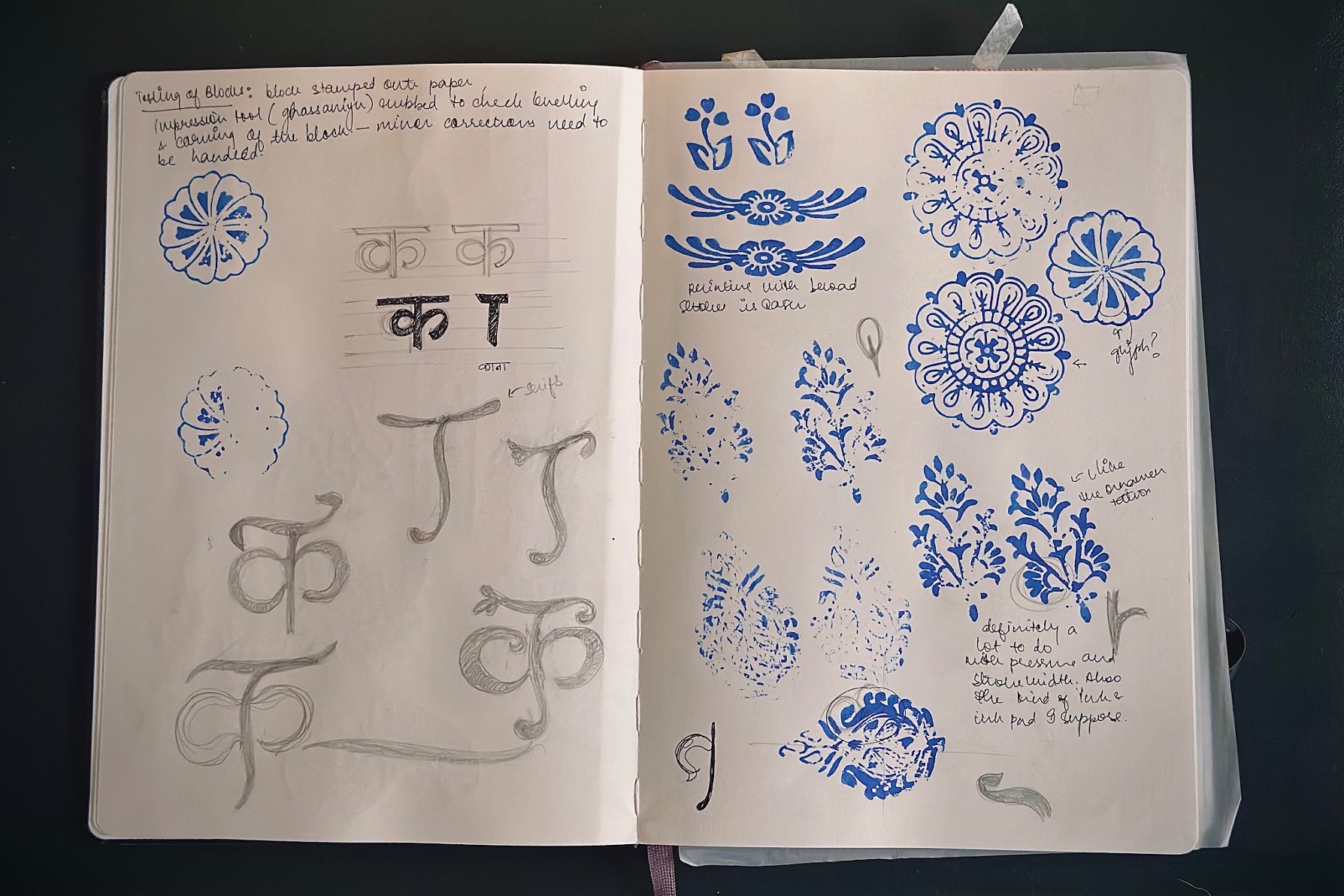
“‘Cheent Devanagari’ is a typeface I designed through a decolonial lens, inspired by the art of block printing,” Raghavan says. “What drew me most to the brief was the idea of making languages like Hindi visible, and giving them space to coexist alongside others.
“Typography, design and the rules of setting type are still largely taught through Eurocentric frameworks, and often presented as the universal way to learn about type. When non-Latin scripts are designed, they’re usually treated as variations on a Latin default, rather than as language systems with their own histories of legibility, construction and material culture. Even many typeface design tools carry that bias.
“With ‘Cheent Devanagari,’ my approach was to learn the craft of typeface design through Devanagari first, a script I grew up reading and writing, and one that’s shared by more than 120 languages. Instead of fitting it into Latin typographic rules, it a first language in its own right, with its own logic, structure, rhythm and craft. (The work) grows from Devanagari’s conjuncts and stroke construction, while its shapes, textures, ink traps and ornamentation are drawn from the technique of block printing itself.
“I analyzed and mapped the maker’s marks that come out of that process, and used them to define the strokes, shapes and junctions of the typeface. In that sense, block printing became both a source of inspiration as well as a site of knowledge.
“‘Cheent Devanagari’ is presented as an immersive spatial installation, inviting visitors to walk through the process of designing a typeface. The typeface came out of my practice-based PhD, and that research is auto-ethnographic, so much of it is private and happens through constant iteration. Rather than showing just the finished letterform, the design process itself is made visible in layers, printed onto translucent fabric and suspended in the space. As visitors move between the layers, they overlap in different ways, revealing new views of the letterform. What you can read depends on where you stand, which challenges the idea that there’s only one fixed or universal way of reading.
“I took this approach because I wanted people to experience language and block printing with their bodies, not just look at them. I hope visitors sense the skill involved in each, see how one informs the other, and leave recognizing indigenous traditional modes of production not as something on the margins of design, but as a knowledge system in its own right.”
‘Non/Sense’
UBIK
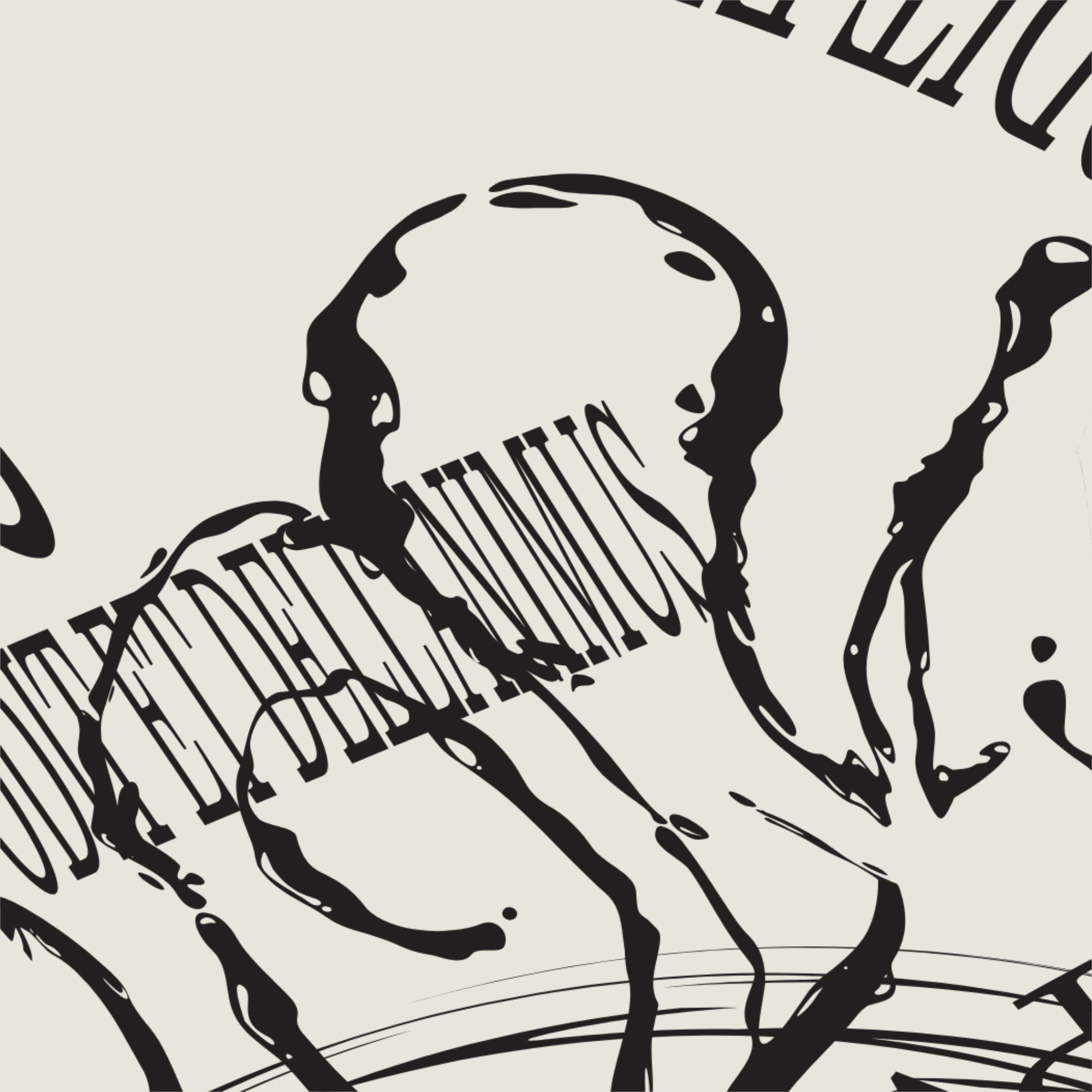
The India-based conceptual artist presents “Non/Sense,” a floor-based intervention inspired by science-fiction writer Philip K. Dick’s “How to Build a Universe That Doesn’t Fall Apart Two Days Later.”
“My work explores three aspects of ‘In Other Words’: The instability of meaning; the limits of language as communication; and the possibility of interpreting text beyond its literal meaning,” he says. “Through ‘Non/Sense,’ I play with the tension between words that appear familiar and those that resist comprehension. By placing text within a physical space, I extend these ideas into our experience of navigating and interpreting our surroundings, questioning our need to make sense of everything we encounter.”
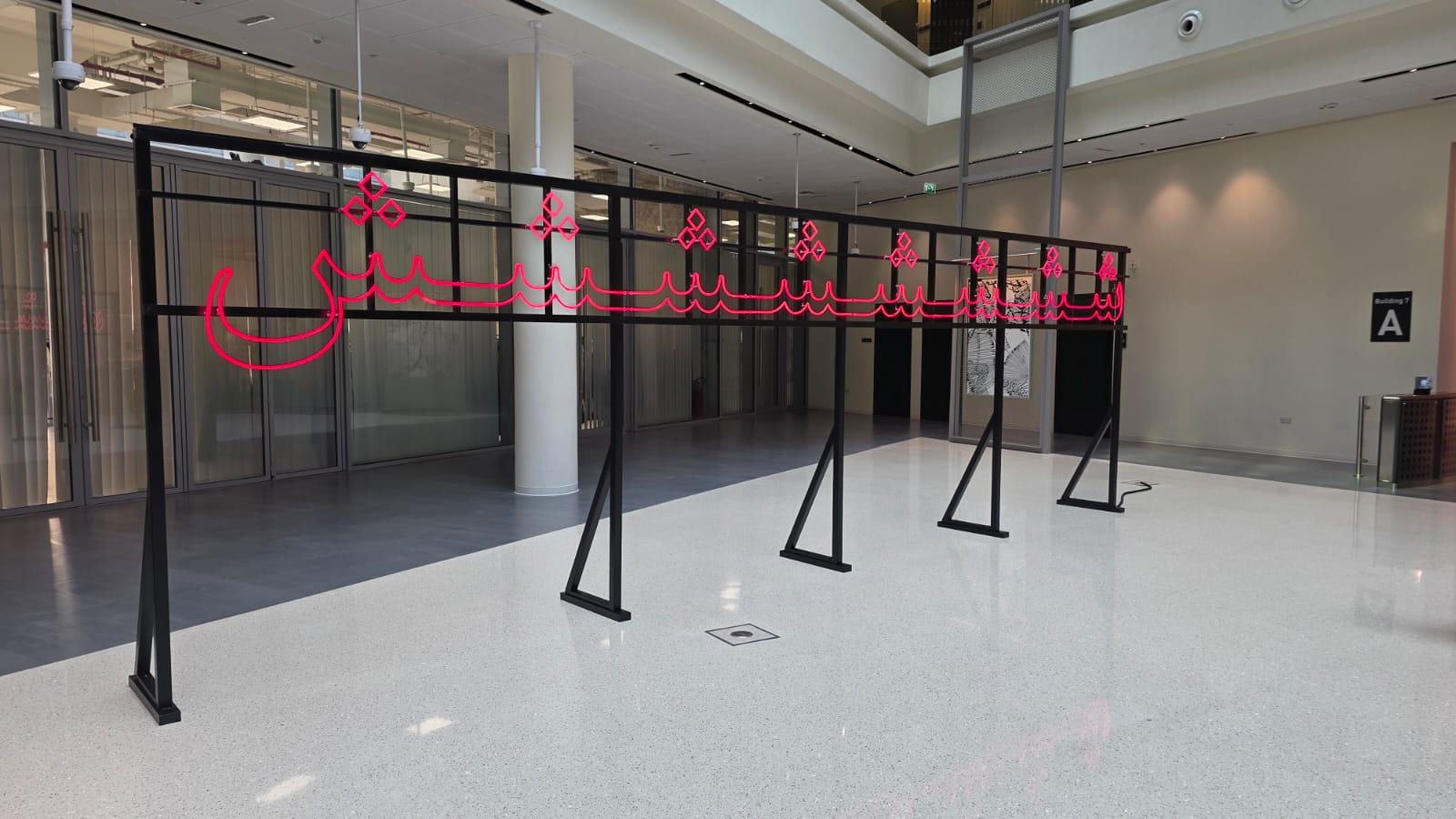
Shhhhh
Dalia Rafeh
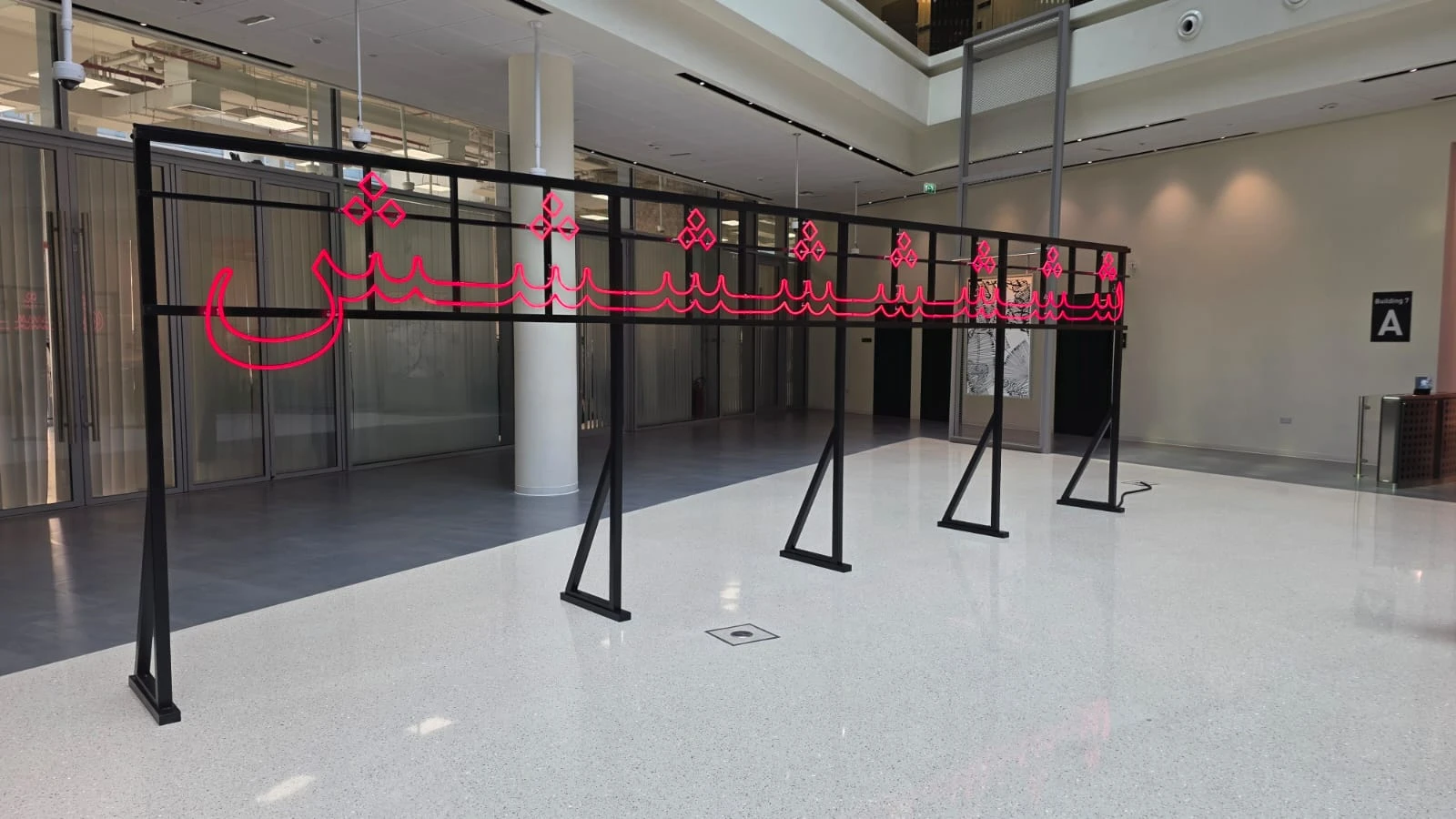
The Lebanese multidisciplinary artist explores the Arabic language and visual expression through her work “Shhhhhhhh,” which transforms the Arabic letter “ش “ into a seven-meter installation.
“My work ’Shhhhh’ responds to the theme ’In Other Words’ by exploring silence as a form of language. We live in a world filled with noise, where words are constantly spoken, repeated, and consumed, yet often seem to have lost their meaning,” Rafeh tells Arab News. “I chose to explore what happens when language fails us. Can silence communicate what words no longer can?
“Through a large-scale red neon installation, ’Shhhhh’ becomes both a visual statement and a call for quiet. It invites us to pause, reflect, and question what silence means to each of us.
For me, silence is not necessarily the absence of expression. Sometimes, it is the strongest form of it.”
Taleem
Varussi
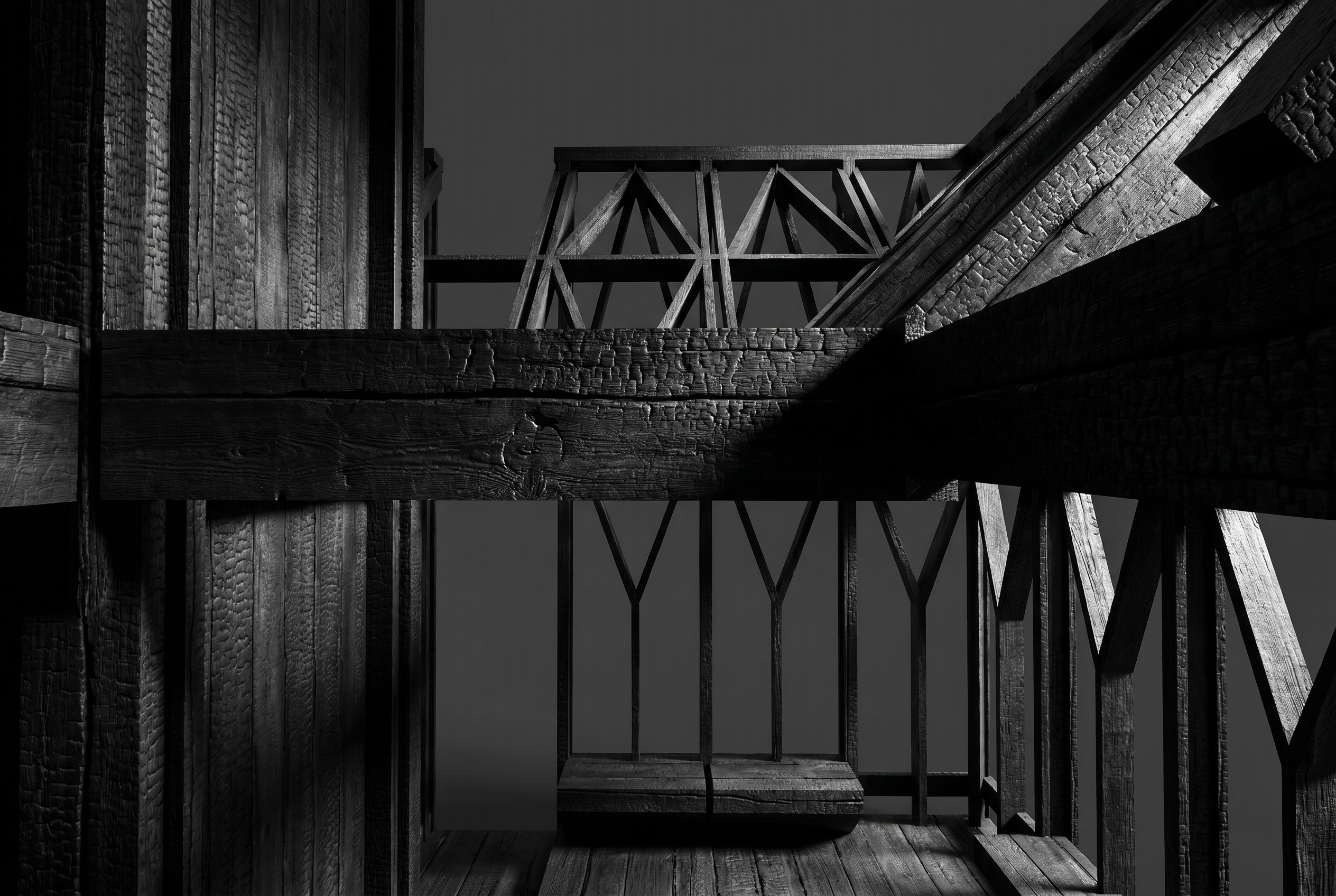
Varussi is a creative duo: Owais Asif Khan and Samreen Junaid Wani. Their work, “Taleem,” considers the ways knowledge is communicated through gestures, materials and systems of making.
“Our response to ‘In Other Words’ began with the question, “What if language could be experienced rather than read?” We looked at ‘Taleem,’ the system of notation used in Kashmiri carpet weaving and Kani shawl making, where sequences of symbols, numbers and colors guide the maker in translating a design into a finished pattern. What interested us was the relationship between the instruction and the outcome, and how a complex image can emerge through the interpretation and repetition of a set of codes,” the pair told Arab News in a written statement.
“We translated this principle into architecture by repeating and rotating a single timber frame around a central point, allowing a sequence of instructions to generate a spatial form. Rather than reproducing the visual language of Kashmiri craft, we wanted to work with the logic behind it. By turning Taleem into a space that visitors can move through, we explore how knowledge traditionally communicated through making can find another expression through architecture, becoming something that can be physically encountered rather than simply observed.
“Dubai Design Week creates room for experimentation and encourages architecture to be explored beyond the building itself. For us, design is as much about asking questions and exchanging ideas as it is about arriving at a finished form. We see this as an opportunity to contribute to that conversation and to build connections with practitioners across the region.”