- college journalism educators are changing the way they teach in a race against obsolescence
NEW YORK: The Daily Orange isn’t daily anymore.
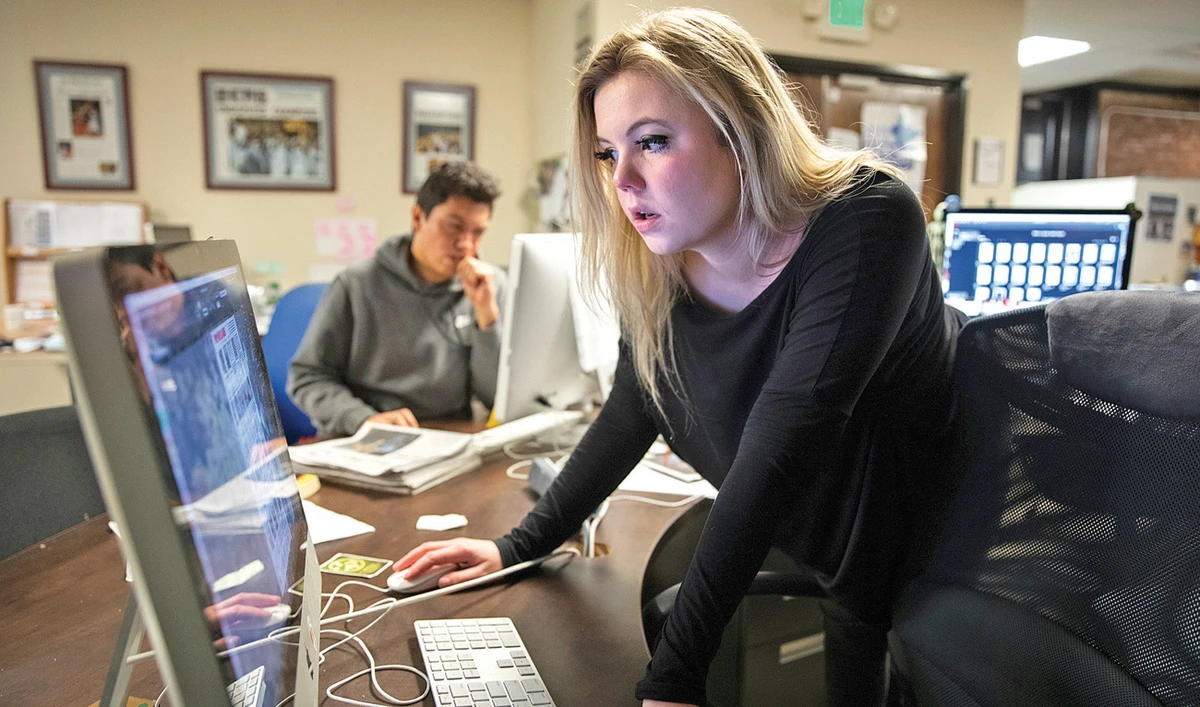
The student-run newspaper that has covered Syracuse University since 1903, and trained generations of journalists, now prints three issues per week. Editor-in-Chief Haley Robertson wonders where she’ll find advertisers, worries about firing friends, and searches for alumni donors who will pay to send reporters on the road to cover the university’s sports teams.
These are problems not unlike those that bedevil executives two or three times her age — evidence of how the news industry’s woes have seeped onto campuses that try to harness youthful energy and idealism to turn out professionals who can inform the world.
Meanwhile, college journalism educators are changing the way they teach in a race against obsolescence. They’re emphasizing versatility and encouraging a spirit of entrepreneurship.
After some brutal years, there are signs of life. Much as the journalistic pursuit of a crooked president in the 1970s inspired a generation, another leader who denounces reporters as enemies on a nearly daily basis has given birth to a new resolve: Enrollment in journalism programs is up.
“When I look at local news and see what’s happening, I’m pessimistic,” said Kathleen Culver, journalism professor at the University of Wisconsin at Madison. “When I look at 18- and 20-year-olds and see what they want to do, I’m optimistic.”
Thousands of young journalists train for the future on a dual track, in classrooms and in student-run newsrooms that are models for the places they hope to work someday.
For Robertson, that means hours a day in a dingy office with yellowed headlines glued to the wall, metal file cabinets signed by editors dating back nearly 50 years and a ripped upholstered couch carried from the Daily Orange’s old office, now a parking lot.
College publications occasionally make national news while chronicling the rhythms of campus life, as happened this fall when Arizona State University’s student newspaper had a scoop on the resignation of Kurt Volker, US envoy to the Ukraine.
Volker runs Arizona State’s McCain Institute.
Daily Orange in 2018 first posted video of racist and sexist comments made at a Syracuse fraternity, leading to embarrassing headlines for the university across the country. Robertson’s managing editor, Catherine Leffert, sat on the floor at a campus meeting as that story swirled, tapping out updates on her mobile phone, and slept on the office couch in two-hour intervals. The fraternity was suspended.
Journalists of all ages understand the adrenaline rush.
“Seeing the layoffs and seeing newsroom cutbacks is really disheartening,” Leffert said. “But what keeps me wanting to be a journalist and wanting to do it here is seeing the effect that the D.O. has. It’s really cool and exciting.”
Few college publications have shut down the way local newspapers in towns and cities across the country have, said Chris Evans, president of the College Media Association and adviser to the University of Vermont newspaper. Many are supported by student fees and pay their staff members little if anything.
Thirty-five percent of school papers say they’ve have reduced the frequency of print issues to save money, according to a CMA survey taken earlier this year. Five percent have gone online-only, as the University of Maryland’s Diamondback said that it would do early next year. Half of the newspapers that haven’t abandoned paper, like the Daily Orange, say they’re not printing as many copies.
Robertson touts the transition as a way to follow the industry by going more digital, and the D.O. has an active web site and social media presence. Yet there’s only so much staff members can do. They are students, after all.
The University of North Carolina’s Daily Tar Heel switched to three days a week in 2017 when its directors suddenly realized they were going broke, said Maddy Arrowood, the paper’s editor-in-chief. The newspaper cut the pay of staff members and moved into a new, smaller office above a restaurant.
The Daily Tar Heel is testing out newsletters targeted at people with special interests, and its reporters are trying to attract off-campus readers and advertisers by covering news in the surrounding community of Chapel Hill, N.C.
“I spend most of my time very aware of our financial situation,” Arrowood said. “We’re always trying to tell the newsroom that your goal is to produce the best content that you can and be an indispensable resource for our readers.”
One small victory: Last year the Daily Tar Heel reported a tiny profit.
Struggling with a $280,000 debt, the Hilltop at Howard University printed its first edition this semester in mid-October. The Maneater at the University of Missouri used to print twice a week, then once. Now it’s down to once a month. It operates separately from a newspaper run by faculty and students that covers the town of Columbia.
Staff members are now charged annual dues — in other words, they must pay to work there, said Leah Glasser, the paper’s editor. They can avoid the dues if they find an alumni sponsor or sell enough advertising to cover it.
The paper has a web site, and Glasser and her staff are slowly getting used to the new monthly schedule.ƒst