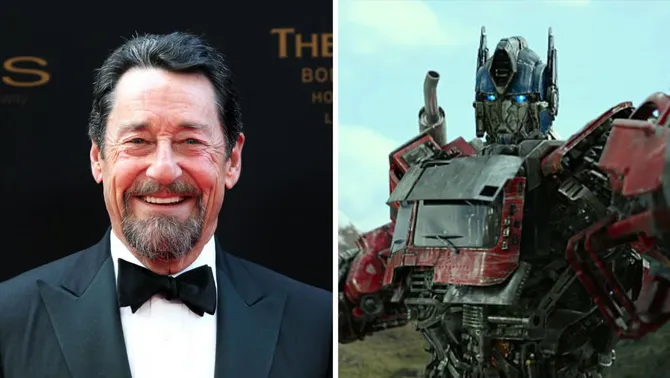
- Peter Cullen has been the voice of the Transformers iconic leaders hailed by many since the eighties
LONDON: There are voices that belong to actors, and there are voices that seem to belong to the characters themselves.
For more than four decades, Peter Cullen’s was the latter.
To generations of “Transformers” fans, Optimus Prime did not merely sound like Cullen. Cullen was Optimus Prime: the deep, deliberate baritone; the paternal authority; the restraint of a commander who could flatten an enemy but would rather appeal to something better in those around him.
Cullen, the Canadian actor who first gave voice to the heroic leader of the Autobots in 1984, died on Wednesday at his home in Los Angeles at the age of 85.
His death closes one of the longest and most distinctive performances in popular entertainment — a role that began in a Saturday-morning cartoon designed in part to sell transforming robot toys, and grew into a global cultural phenomenon spanning cinema, television, comics, video games and collectibles.
It was a phenomenon that travelled far beyond North America.
In Saudi Arabia and across the Arab world, “Transformers” became part of the visual language of childhood: brightly colored robots on television screens, shelves filled with vehicles that unfolded into warriors and playground arguments over whether Optimus Prime or Megatron would win.
For Saudi children growing up in the 1980s, imported “Transformers” toys appeared alongside the other global franchises reaching the Kingdom’s expanding toy market. Collectors who remember the period recall finding the figures in stores including Toyland, where the red-and-blue Optimus Prime truck was among the most coveted toys of the era.
What those children were buying was not simply a toy truck.
Hasbro had launched the “Transformers” brand in the US in 1984 after acquiring rights to transforming Japanese robot toys and building an entirely new mythology around them. Optimus Prime, Megatron, Bumblebee and Starscream were among the names that became inseparable from the brand. An animated television series and Marvel comic followed almost immediately.
At the center of it stood Cullen, who brought the icons to life.
Born in Montreal in 1941, he graduated with the first class of Canada’s National Theatre School in 1963 and built a career in radio, television and voice acting. Long before Optimus Prime, his voice had already become his livelihood.
But the performance that would define him came from somewhere much more personal.
When Cullen was preparing to audition for the role of a heroic robot leader, he told his older brother Larry, a decorated US Marine Corps veteran of the Vietnam War, that he was going to audition to play a truck.
Larry’s advice was simple: do not play him as a swaggering Hollywood tough guy. Be a real hero. Be, as Cullen repeatedly recalled him saying, “strong enough to be gentle.”
Cullen essentially performed an impression of his brother.
“I just did my brother, Larry,” he later told NPR, explaining that Larry’s quiet authority, strength and compassion became the foundation of Optimus Prime.
That decision changed the character.
Optimus could easily have been played as another booming action hero. Instead, Cullen gave an enormous machine something approaching humanity. He rarely sounded hurried. He did not need to shout to establish authority. Even declarations of battle carried the gravity of someone who understood what battle cost.
It helped turn a cartoon character created to support a toy line into an archetype of leadership.
That quality translated even when Cullen’s voice itself did not.
An Arabic version of the original “Transformers” series circulated across several Arab television markets from the mid-1980s, part of a much broader era in which imported animation was localized and became a shared experience for children from the Gulf to North Africa. Records of the classic Arabic version trace its release to 1985 and broadcasts across a number of Arab national television stations.
Arabic-speaking children watching a dubbed Optimus Prime were therefore not necessarily hearing Cullen’s baritone.
But they were encountering the character he had defined.
The pauses, the dignity, the moral certainty and the almost fatherly conception of Optimus had already been established by Cullen before another actor ever interpreted the character in another language.
That distinction is central to understanding his global legacy.
Cullen did not simply provide dialogue. He established the template.
Then, for a time, Optimus Prime disappeared.
In 1986’s “The Transformers: The Movie,” the Autobot leader was killed — a decision that became infamous among the franchise’s young audience. Cullen later recalled being devastated by the character’s death. He had no idea at the time just how emotionally attached viewers had become to Optimus.
The franchise continued through new characters, animated series and reinventions. In the Arab world, subsequent generations encountered “Transformers” through satellite television and children’s channels as the regional broadcasting landscape expanded.
MBC Group’s MBC3 channel, for example, later aired several “Transformers” properties in Arabic, including “Armada,” “Energon” and the Japanese “Super-God Masterforce,” helping carry the brand into another generation of Middle Eastern childhoods during the 2000s.
But the most important transformation came on the big screen.
In the mid-2000s, Hollywood set about turning the toys and animated characters of the 1980s into a live-action blockbuster.
And when Michael Bay’s “Transformers” arrived in cinemas in 2007, Optimus Prime regained his voice.
Cullen returned to the role more than two decades after he first entered the recording booth.
The film was an enormous commercial success, earning almost $710 million worldwide and launching a film franchise that would introduce Autobots and Decepticons to children who had never seen the 1980s cartoon. It also performed across international markets, including the Middle East.
For Arab audiences, the blockbuster era altered the relationship with Optimus Prime.
The character was no longer primarily a brightly drawn television hero or a plastic figure transformed by hand on a bedroom floor. He was a towering photorealistic machine filling cinema screens, backed by explosions, military hardware and Michael Bay’s maximalist action.
And behind all of it was the same voice.
Cullen’s return connected the children who had grown up with “Transformers” in the 1980s to those discovering the franchise in the 2000s.
He continued through the sequels, later animated series, video games, “Bumblebee” and 2023’s “Transformers: Rise of the Beasts.” The Middle East Film & Comic Con described him as the voice of Optimus across the cartoons, live-action films and games, and noted his induction into the Hasbro Hall of Fame.
By then, Cullen himself had become almost as beloved as the character.
That became particularly visible in the Arab world in February 2024, when he travelled to Abu Dhabi for the Middle East Film & Comic Con.
There, Cullen appeared alongside Frank Welker — the equally legendary voice actor associated with Optimus Prime’s nemesis Megatron — before a regional audience that included adults who had grown up with the franchise and children born decades after its debut.
The convention, held at ADNEC in Abu Dhabi, bills itself as the region’s major festival of film, television, animation, comics, gaming and collectibles. Cullen’s appearance demonstrated how far a character created for American children’s television in 1984 had travelled.
Four decades after the first toys arrived in children’s hands, Arab fans could stand face to face with the man who had given Optimus Prime his soul.
Cullen’s wider career was formidable.
He voiced the melancholy Eeyore in “Winnie the Pooh,” KARR in “Knight Rider,” characters in “G.I. Joe,” “DuckTales” and “Chip ’n Dale: Rescue Rangers,” and supplied vocalizations for the creature in “Predator.” In 2023, the National Academy of Television Arts and Sciences presented him with its Lifetime Achievement Award at the Children’s & Family Emmy Awards.
Optimus Prime passed through an American cartoon studio, across dubbed Arab television, onto toy-store shelves in Saudi Arabia, through satellite channels and into cinemas packed with a new generation of viewers.
And eventually it brought Cullen himself to the Middle East, where fans who had known Optimus for decades finally met the man behind the machine.
His family returned to that philosophy in announcing his death, asking those who admired him to honor his legacy through compassion, integrity, loyalty and service to others.