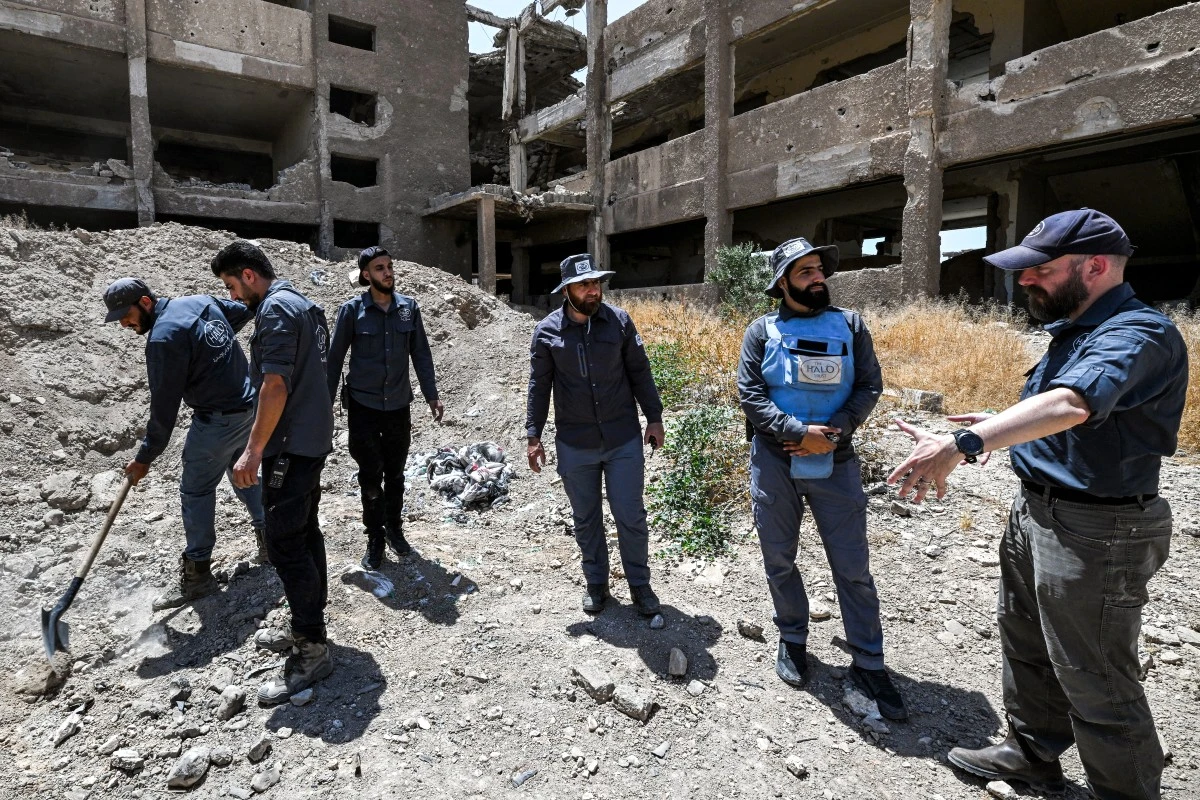
- Three aged 8 to 12 were killed near Palmyra while herding sheep when unexploded ordnance detonated
- The UN reported that since December 2021, landmines and UXO have killed 269 children and injured 1,616
LONDON: Four children have been killed by landmines and unexploded ordnance in Syria in less than a week, Save the Children said on Tuesday, warning that explosive remnants of war are endangering families returning home after years of displacement.
Three children aged 8 to 12 were killed on Monday when unexploded ordnance detonated as they herded sheep near Palmyra, according to local news reports.
Their deaths followed a landmine explosion at a school in Hasakah last week that killed a child and injured 14 people, including children and teachers.
Save the Children said in a statement received by Arab News that four deaths were double the weekly average of children killed by landmines from July through September.
Jeremy Stoner, the organization’s acting country director in Syria, said children face danger whether they are attending school, working to support their families or playing.
“Children in Syria are playing a deadly game of stepping stones where one misstep will end their life,” Stoner said. “In Syria, when a child leaves their home, their parents often fear for their life.”
“Schools, which are protected under international law, are no longer safe, as we saw in Hasakah last week,” he added.
“Meanwhile children who have been forced out of school and into work just to support their families do so at their own peril. Others who seek a brief respite through play pick up what they think is a toy or something to kick around, only to have their life shattered.”
The UN said in September that landmines and unexploded ordnance had killed 269 children and injured 1,616 since December 2024, as displaced families began returning to their homes.
Meanwhile, the UN Children’s Fund, UNICEF, estimates that 5 million children live in areas contaminated with landmines and explosive remnants of war. More than two-thirds of recorded incidents have occurred on agricultural and grazing land, putting farmers, herders and children tending livestock at particular risk.
State-run Syrian media recently reported estimates that more than half a million mines contaminate Palmyra.
In another incident on Nov. 2, a child and an adult were killed, and another child and adult were injured, in a grazing area in Deir Ezzor.
The toll extends beyond those killed. Survivors can face lasting disabilities, costly treatment and the loss of income their families depend on.
Yaser, 15, lost a little finger and suffered an eye injury when an object he picked up exploded weeks ago in Deir Ezzor, one of Syria’s most heavily contaminated areas, according to Save the Children.
“I saw something that looked like a pen. I didn’t know what it was. I lifted it and it exploded,” he told the organization. “I didn’t feel pain at the beginning, but I then looked at my hand and saw my pinkie finger wasn’t there. I then started screaming and running.”
Yaser said his eye hurts and his vision is blurred. He fears losing his sight as his family waits to learn the cost of surgery.
No longer in school, he had been earning about $15 a week at an aluminum workshop to help support his family. His injuries have left him unable to work.
“Now that I can’t work for a long time, my brother alone cannot support the whole family and pay for my treatment and surgery,” he said.
The Syrian government has made mine clearance a priority and established a national mine action center led by the Ministry of Emergency and Disaster Management.
However, Save the Children said funding and equipment remain far below what is needed to clear contaminated areas, support survivors and teach communities how to recognize explosive hazards.
The organization urged Syrian authorities to accelerate clearance efforts and called on international donors to provide more funding and equipment to identify, mark and remove mines and unexploded ordnance.
“Any child killed is one too many,” Stoner said. “But the fact that hundreds have lost their lives to landmines in less than two years should be shaking up the world to intervene and support clearance and recovery.
“We need to see a huge shift — it is the only way to support children and families to be safe and to recover from a conflict that has already taken so much from them.”