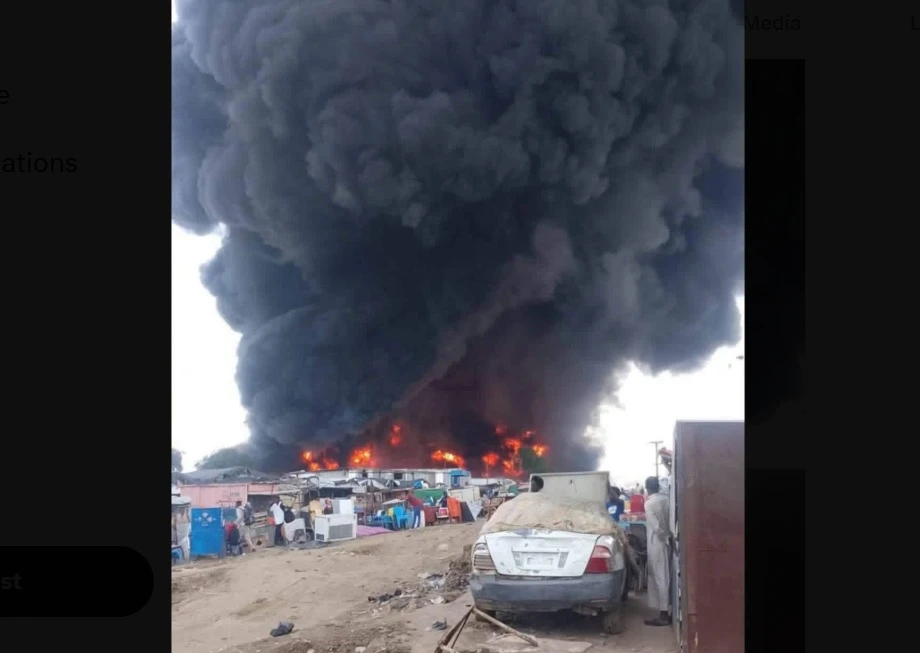
- The attack occurred at Amiet market, an area disputed between Sudan and South Sudan
- At least 27 people were wounded, including vulnerable civilian populations
NAIROBI: South Sudanese officials said Sudan’s military had carried out drone strikes that hit a market in the disputed Abyei region, killing more than 150 people, the latest in a series of strikes in one of the bloodiest weeks of a war that has spilled across Sudan’s borders.
The strike pushed the toll from attacks in recent days to more than 250, underscoring the lethality of airstrikes in Sudan’s war, which erupted in April 2023 between the Sudanese Armed Forces and the paramilitary Rapid Support Forces (RSF), triggering a major humanitarian crisis and drawing in local militias and foreign powers.
Yohana Akol Ngor, the caretaker minister of information in Abyei, told Reuters on Tuesday that the death toll from the attack on the market in Abyei on Monday had jumped to 153 from 73, but was likely to rise further.
“The fire is still burning. So the recovery process of the dead ones is still continuing. The situation is terrible,” Ngor said, adding that some bodies had been burned to ashes.
A video filmed at the scene on Tuesday and verified by Reuters showed the charred and twisted remains of vehicles and buildings. Flames still billowed from one building as residents inspected the damage.
He said Sudan’s army was responsible for the attack, without providing evidence. A spokesperson for Sudan’s armed forces did not immediately respond to a request for comment.
Three diplomatic sources, an aid worker and an expert on the conflict told Reuters the strike hit a fuel depot in the market. The diplomatic sources said the depot had been used in the past by the RSF to supply its forces. A spokesperson for the RSF did not immediately respond to requests for comment.
OIL-RICH ABYEI
South Sudan declared independence from Sudan in 2011. Since then, both countries have staked a claim to oil-rich Abyei, which is jointly administered. It borders Sudan’s Kordofan region, which has become a major center of fighting in the war.
Officials in Sudan’s military-led government told Reuters the RSF is active in parts of Abyei. Ngor denied the presence of the RSF in Abyei. Reuters could not immediately verify the claims.
The United Nations Interim Security Force for Abyei (UNISFA) warned in May that the presence of the RSF in Abyei had increased insecurity there, adding that delays in determining the disputed region’s final status had put civilians and UNISFA personnel at risk.
UN spokesperson Stephane Dujarric said the UN strongly condemned the series of drone attacks in Abyei and other areas.
“We remain alarmed by the relentless drone attacks across Sudan, as well as the damage they are causing to critical infrastructure — these attacks are taking a devastating toll on communities already struggling with the consequences of more than three years of conflict,” Dujarric told reporters in New York.
STRUGGLE TO RETRIEVE BODIES
Ngor told Reuters that emergency workers had struggled to retrieve the bodies because of fires caused by the strikes.
Some 8,000 people had been displaced by Monday’s bombing, Ngor added.
South Sudan’s foreign ministry said late on Monday that drones struck a market located north of Abyei town, but did not specify the number of civilian casualties or provide a toll. The ministry said it had summoned the Sudanese ambassador in protest.
An eyewitness said he heard five large explosions that led to the fuel market catching fire. “People started evacuating the casualties. They had injuries from shrapnel on their stomach and legs ... In one site, I saw 28 bodies that were burnt,” the witness said, asking not to be named for safety reasons.
The witness said they did not see any sign of RSF or other uniformed fighters in the market, where goods like sugar, flour and biscuits are also sold for shipment into Sudan.
DEADLY WEEK
Sudanese armed forces and the RSF have recently escalated drone strikes, with a series of attacks targeting RSF-held Nyala and army-held Khartoum airport this week.
On Sunday, drone attacks in West Kordofan state in Sudan, controlled by the RSF, killed some 84 people and injured 65 others, according to the local Emergency Response Room. On Monday, four children were killed after repeated drone attacks targeted SAF-controlled Khartoum airport.
On Friday, an attack on a market in RSF stronghold Nyala killed 23 people and injured 44, according to volunteers there.
Chadian authorities have accused Sudan’s military of carrying out drone strikes on its territory, which UN experts say is regularly used by RSF supply lines. Sudan’s foreign ministry said in late August that its armed forces were acting to protect the country’s security.
On October 10, an airstrike close to Sudan’s border with Egypt killed more than 70 artisanal miners, according to a local rights group.
PATIENTS TREATED FOR BURNS
Abyei experiences frequent bouts of violence, with clashes usually involving rival ethnic groups or armed militias. The attack is the deadliest in years to hit the area, where medical supplies and health care are scarce.
South Sudan’s government says it has not taken sides in its neighbor’s war. However, diplomats and experts say Abyei has established itself as crucial, serving as a transit point for RSF logistics, particularly fuel.
Medical charity Medecins Sans Frontieres (MSF) said it was treating more than 20 wounded, some with burns, at the nearby Ameth Bek Hospital.
“We are providing surgical services and wound dressing, along with other emergency care,” said Christian Lindauer, MSF medical activities manager at the facility.
Photographs shared on MSF’s official social media account showed bandaged patients lying on the floor as they received care for their injuries.