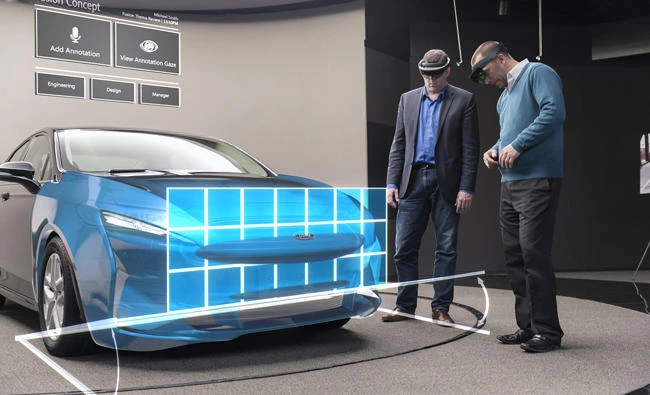
Ford designers have been swapping some clay-sculpting steels and rakes for mixed reality headsets and visualization software that can change vehicle design elements — side mirrors, grilles, vehicle interiors and more — in mere seconds.
Designers have been piloting Microsoft HoloLens technology for a year now in Ford’s Dearborn studios, allowing them to see proposed virtual design elements as if these pieces were part of physical vehicles. They have been able to explore different shapes, sizes and textures of future vehicle attributes in minutes and hours instead of the weeks and months it can take to create clay models. Ford said it is expanding this pioneering testing across the globe.
“It’s amazing we can combine the old and the new — clay models and holograms — in a way that both saves time and allows designers to experiment and iterate quickly to dream up even more stylish, clever vehicles,” said Jim Holland, Ford vice president, vehicle component and systems engineering. “Microsoft HoloLens is a powerful tool for designers as we continue to reimagine vehicles and mobility experiences in fast-changing times.”
HoloLens technology uses mixed reality, which enables designers to see holograms in photo-quality backdrops through wire-free headsets.
“We may not be able to teleport yet, but HoloLens allows us to review full-size 3D designs with designers and engineers around the world in real time,” said Craig Wetzel, Ford manager, design technical operations. “And we’ve only just scratched the surface, so possibilities for the future seem almost limitless. This is very exciting.”
The technology allows designers to quickly evaluate the design, make changes, and determine styling options earlier in development.
“With HoloLens, we can instantly flip through virtual representations to decide which direction they should go,” said Michael Smith, Ford design manager. “As a designer, you want to show, not just tell. This is much more compelling.”
“HoloLens allows a whole team of people to collaborate, share and experience ideas together,” said Elizabeth Baron, Ford virtual reality and advanced visualization technical specialist. “Mixing virtual and physical models is exciting, because it helps our designers and engineers communicate effectively and ideate to see what the future looks like earlier in the process. This allows great freedom and efficiency in how prototypes are created or changed.”
Designers have been piloting Microsoft HoloLens technology for a year now in Ford’s Dearborn studios, allowing them to see proposed virtual design elements as if these pieces were part of physical vehicles. They have been able to explore different shapes, sizes and textures of future vehicle attributes in minutes and hours instead of the weeks and months it can take to create clay models. Ford said it is expanding this pioneering testing across the globe.
“It’s amazing we can combine the old and the new — clay models and holograms — in a way that both saves time and allows designers to experiment and iterate quickly to dream up even more stylish, clever vehicles,” said Jim Holland, Ford vice president, vehicle component and systems engineering. “Microsoft HoloLens is a powerful tool for designers as we continue to reimagine vehicles and mobility experiences in fast-changing times.”
HoloLens technology uses mixed reality, which enables designers to see holograms in photo-quality backdrops through wire-free headsets.
“We may not be able to teleport yet, but HoloLens allows us to review full-size 3D designs with designers and engineers around the world in real time,” said Craig Wetzel, Ford manager, design technical operations. “And we’ve only just scratched the surface, so possibilities for the future seem almost limitless. This is very exciting.”
The technology allows designers to quickly evaluate the design, make changes, and determine styling options earlier in development.
“With HoloLens, we can instantly flip through virtual representations to decide which direction they should go,” said Michael Smith, Ford design manager. “As a designer, you want to show, not just tell. This is much more compelling.”
“HoloLens allows a whole team of people to collaborate, share and experience ideas together,” said Elizabeth Baron, Ford virtual reality and advanced visualization technical specialist. “Mixing virtual and physical models is exciting, because it helps our designers and engineers communicate effectively and ideate to see what the future looks like earlier in the process. This allows great freedom and efficiency in how prototypes are created or changed.”