QatarEnergy strengthens global footprint with offshore expansion in Namibia 

QatarEnergy strengthens global footprint with offshore expansion in Namibia 
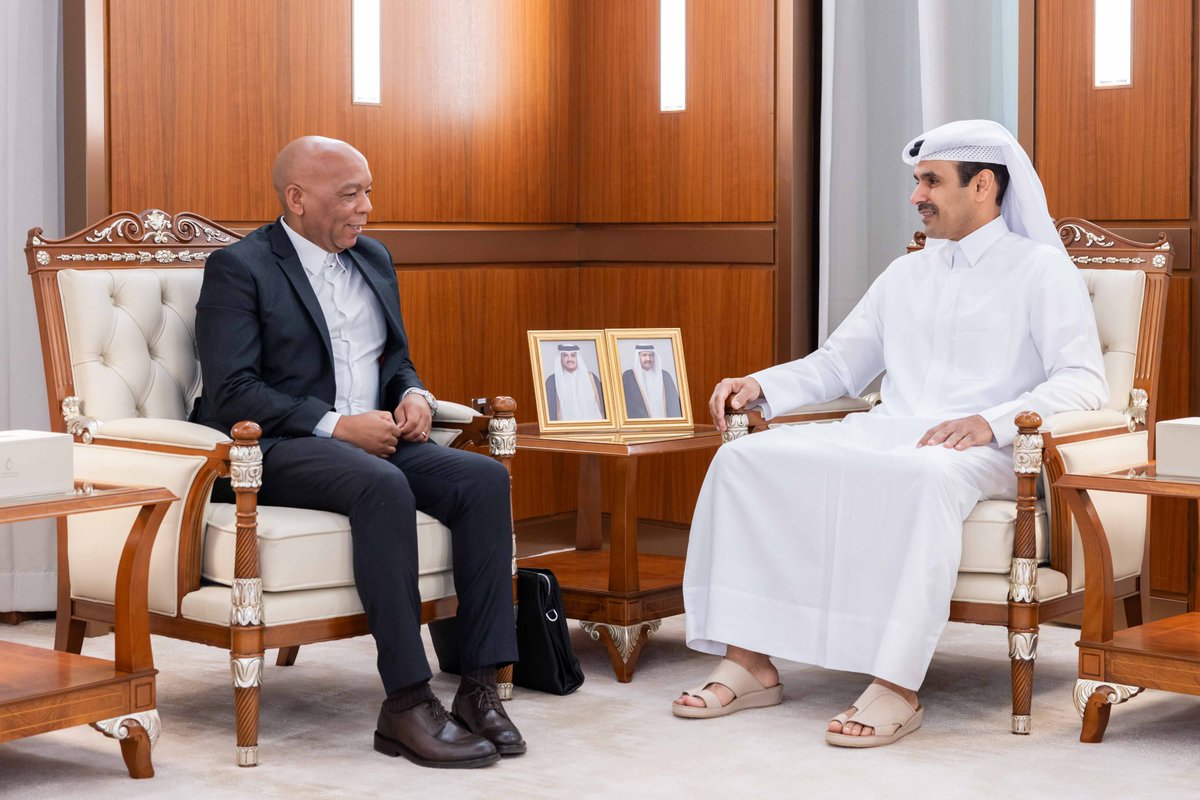
Qatar's Minister of State for Energy Affairs and CEO of QatarEnergy, Saad Sherida Al-Kaabi, meets with South Africa's Minister of Electricity and Energy, Kgosientsho David Ramokgopa. Supplied.
Short Url
Updated 24 November 2024
Follow

QatarEnergy strengthens global footprint with offshore expansion in Namibia 

QatarEnergy strengthens global footprint with offshore expansion in Namibia 

RIYADH: QatarEnergy has expanded its portfolio through a new agreement with TotalEnergies to increase its ownership stakes in two offshore blocks in Namibia’s Orange Basin. 

According to a press release, the state-owned energy firm will acquire an additional 5.25 percent interest in block 2913B and an additional 4.7 percent interest in block 2912 under the new deal, subject to customary approvals.  

Once finalized, QatarEnergy’s share in these licenses will rise to 35.25 percent in block 2913B and 33.025 percent in block 2912.  

Saad Sherida Al-Kaabi, Qatar’s minister of state for energy affairs and CEO of QatarEnergy, said: “We are pleased to expand QatarEnergy’s footprint in Namibia’s upstream sector. This agreement marks another important step in working collaboratively with our partners toward the development of the Venus discovery located on block 2913B.” 

TotalEnergies, the operator of both blocks, will retain 45.25 percent in block 2913B and 42.475 percent in block 2912. Other partners include Impact Oil & Gas, which holds 9.5 percent in both blocks and the National Petroleum Corp. of Namibia, which owns 10 percent in block 2913B and 15 percent in block 2912.   

Located about 300 km off the coast of the African country, in water depths ranging from 2,600 to 3,800 meters, these blocks host the promising Venus discovery. The Venus field has attracted considerable attention as a significant find that could impact Namibia’s energy future.  

This offshore acquisition complements QatarEnergy’s recent ventures into renewable energy. In October, the company announced a 50 percent stake in TotalEnergies’ 1.25-gigawatt solar project in Iraq.  

The initiative, part of Iraq’s $27 billion Gas Growth Integrated Project, aims to enhance Iraq’s energy self-sufficiency by addressing its reliance on electricity imports and reducing environmental impacts.   

The solar project, set to deploy 2 million bifacial solar panels, will generate up to 1.25 GW of renewable energy at peak capacity, supplying electricity to approximately 350,000 homes in Iraq’s Basra region.  

QatarEnergy will share equal ownership of the project with TotalEnergies, which retains the remaining 50 percent. 

The firm’s dual focus on traditional and renewable energy highlights its strategic approach to meeting global demands while addressing sustainability concerns.  

Its involvement in Namibia’s offshore blocks and Iraq’s shift toward renewable energy highlights a well-rounded portfolio that includes fossil fuels and clean energy investments. 

Saudi Arabia’s non-oil sector posts strong growth as PMI hits 60.2 

Saudi Arabia’s non-oil sector posts strong growth as PMI hits 60.2 
Updated 04 November 2025
Follow

Saudi Arabia’s non-oil sector posts strong growth as PMI hits 60.2 

Saudi Arabia’s non-oil sector posts strong growth as PMI hits 60.2 

RIYADH: Saudi Arabia’s non-oil economy accelerated in October, with the Purchasing Managers’ Index climbing to 60.2, its second-highest level in more than a decade, signaling strong business growth momentum. 

The latest survey by Riyad Bank and S&P Global showed a sharp improvement in operating conditions across the Kingdom’s private sector, underpinned by solid demand, rising employment, and robust output growth.  

The October reading, up from 57.8 in September, highlights the sustained momentum of the non-oil economy as Vision 2030 reforms continue to drive diversification away from crude revenues. 

Speaking at the Future Investment Initiative in October, Saudi Arabia’s Minister of Economy and Planning Faisal Alibrahim said the Kingdom’s gross domestic product is expected to expand by 5.1 percent in 2025, supported by continued growth in non-oil activities. 

Commenting on the latest report, Naif Al-Ghaith, chief economist at Riyad Bank, said: “Saudi Arabia’s non-oil private sector recorded a solid improvement in business conditions in October, with the PMI rising to 60.2, marking one of the strongest readings in over a decade.”  

He added: “The acceleration was driven by broad-based gains in output, new orders, and employment, reflecting sustained demand momentum and continued strength in the non-oil economy.”  

Al-Ghaith noted that the latest survey results also indicate a strong start to the final quarter of the year, supported by both domestic and external demand. 

According to the report, the pace of growth in new orders received by non-oil companies accelerated for the third consecutive month in October, with 48 percent of surveyed firms reporting higher sales. 

Participating companies attributed the sales growth to improving economic conditions, a growing client base, and increased foreign investment. 

Output and employment also expanded sharply during the month, with job creation rising at the fastest pace in nearly 16 years.

Al-Ghaith said the persistent rise in new export orders highlights the growing competitiveness of Saudi firms and the progress achieved under ongoing diversification initiatives. 

“The rise in demand encouraged firms to expand production and workforce capacity at the fastest rate since 2009, as businesses expanded capacity to meet new workloads. Purchasing activity and inventories also increased, while suppliers’ delivery times continued to improve, reflecting efficient coordination and resilient supply chains,” he added.  

October data indicated a sharp rise in input costs for non-oil firms, driven mainly by wage increases from salary revisions and bonuses. 

On the outlook, companies remained optimistic, citing strong market demand, ongoing project work, and government investment initiatives. 

“Optimism is underpinned by solid domestic demand and the momentum of ongoing projects. Although some concerns persist around costs and competition, sentiment overall remains strongly positive, reflecting confidence in the economy’s continued expansion and the strength of the non-oil private sector,” concluded Al-Ghaith.