
BNPL emerges as the preferred payment option for Saudi consumers

BNPL emerges as the preferred payment option for Saudi consumers
According to a recent report from leading BNPL provider Tabby, 77 percent of Saudi consumers now use BNPL for essential purchases. Shutterstock
Short Url
Updated 27 December 2024
Follow

BNPL emerges as the preferred payment option for Saudi consumers

BNPL emerges as the preferred payment option for Saudi consumers

RIYADH: The fintech landscape in Saudi Arabia is rapidly transforming daily financial practices, with buy now, pay later services gaining significant popularity. This shift is simplifying access to flexible payment options, reshaping how people manage their finances and make purchases across the nation.

According to a recent report from leading BNPL provider Tabby, 77 percent of Saudi consumers now use BNPL for essential purchases. 

Data from Tabby shows that first-time BNPL transactions are twice as likely to be for necessary items rather than discretionary ones, with education and medical expenses at the forefront. This indicates that a large portion of BNPL usage is dedicated to essential transactions rather than non-essential wants.
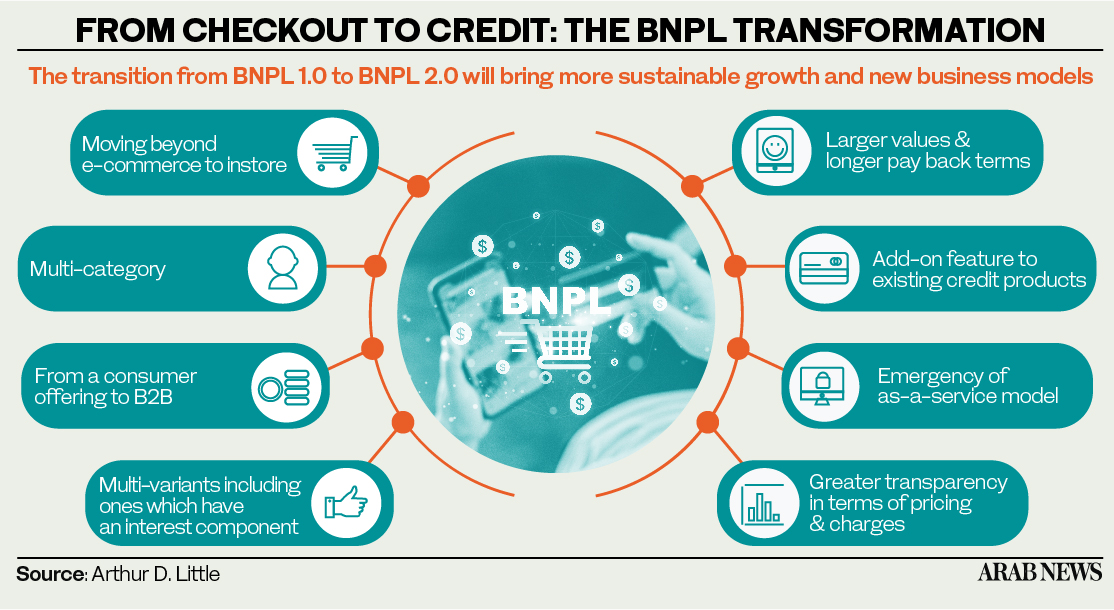
Tabby’s data also reveals that the average value of essential purchases made through BNPL is higher than that of discretionary spending. This suggests that while consumers are prioritizing needs, BNPL offers an accessible and affordable way to purchase high-value necessities, such as insurance and home goods.

Impact of BNPL

By allowing payments to be spread over an extended period, BNPL has revolutionized shopping habits. Not only does it provide consumers with more control over their finances, but it also alters their relationship with businesses.

In an interview with Arab News, Tarabut CEO Abdulla Al-Moayed explained that the rise of BNPL among Saudi consumers can be attributed to several factors. 



Tarabut CEO Abdulla Al-Moayed

“BNPL’s interest-free installment structure makes it an attractive and Shariah-compliant payment option for many Saudi consumers — a positive shift from traditional credit cards or loans,” he said.

“Because BNPL offers a low-barrier alternative to traditional credit, it doesn’t require a high credit score or lengthy approval process, making it accessible to a wider population, particularly younger and lower-income individuals. The ease of using BNPL through mobile apps and online platforms also aligns well with a generation that values convenience and speed,” Al-Moayed added.

He also pointed out that the supportive regulatory environment in Saudi Arabia has fueled the rapid growth of fintech solutions, leading to the emergence of various local BNPL providers. This increased competition has ultimately led to better services and offerings for consumers.

Arjun Vir Singh, partner and global head of fintech at business intelligence firm Arthur D. Little, offered another perspective on the surge in BNPL adoption. He noted that the e-commerce boom, accelerated by COVID-19, has significantly driven the growth of BNPL among consumers. Singh also emphasized the growing convergence of online and offline shopping experiences. 



Arjun Vir Singh, partner and global head of fintech at business intelligence firm Arthur D. Little. Supplied

“As customers’ journeys and payment methods in-store and offline become increasingly digital, we expect BNPL adoption to expand into this segment as well,” he said.

Singh further explained that digital payments, seamless integration, merchant sponsorship, and the rising cost of living have all contributed to BNPL’s rapid growth.

BNPL vs. traditional credit

Singh noted that BNPL is beginning to disrupt traditional credit models in consumer finance, a trend that is expected to expand as BNPL adoption spreads across sectors like travel, real estate, and automotive. “Arguably, the biggest impact will come if BNPL successfully expands into the B2B credit and financing segment,” he stated.

Singh also highlighted that banks and credit card companies are already responding to the rise of BNPL by adjusting their consumer finance offerings. Many are now partnering with BNPL providers or collaborating with major players like Visa and Mastercard, which are concerned about losing consumer spending. Some banks are even developing their own flexible payment solutions that mimic the BNPL model.

For Al-Moayed, the simplicity, transparency, and digitalization of consumer credit will force traditional credit models to adapt.

“Traditional credit models that rely on rigorous background checks and higher entry barriers need to evolve quickly while still managing risk effectively, in order to appeal to a broader consumer base and offer more flexible, secure, and customer-friendly credit options,” he said.

He also emphasized the role of Open Banking in this evolution, saying it could revolutionize credit risk management by utilizing real-time and historical behavioral data. “Open Banking has the potential to make a significant impact by giving lenders more agile and secure access to data, enabling personalized credit solutions,” Al-Moayed added.

As BNPL expands consumer spending power, he believes that as the market matures, empowered consumers will become more financially literate, leading to better-informed financial decisions. 

“Open Banking will help by providing enriched data to improve insights into consumers’ financial health, preventing unsustainable debt,” he said.

Al-Moayed also pointed out that early adopters of Open Banking will gain a competitive edge by providing more intelligent financial services, better user experiences, and faster, more affordable options for all consumers.

Singh concurs, noting that as traditional players adjust to the changing landscape, innovation in consumer finance will continue to flourish. “This shift includes segmenting customers based on different criteria, using alternative data to enhance credit models, and adapting models to the nature of the spend. Innovation is also extending to customer service, not just credit models,” Singh said.

Merchants and BNPL

“Retailers have been the greatest sponsors of BNPL, helping to legitimize and drive the growth of e-commerce,” said Singh. This was initially true for e-commerce platforms, but as more retail experiences shift online, BNPL adoption among merchants has grown exponentially. “The adoption of digital payment solutions across all retail models is driving BNPL growth,” Singh added.

Arthur D. Little’s proprietary research has shown that merchants are seeing substantial benefits from BNPL, including increased average transaction values, more frequent purchases, access to new customers, and lower customer acquisition costs. Merchants also enjoy a differentiated offering compared to their competitors.

Al-Moayed agrees that BNPL offers numerous advantages for merchants but suggests that more value could be unlocked by leveraging the data collected on consumer behavior and spending patterns. “Merchants should explore how to use this valuable data to offer personalized promotions or product recommendations,” he said.

“Hyper-personalized sales and marketing will be key to increasing customer engagement and loyalty. This will soon be expected across the Kingdom’s retail market,” Al-Moayed added.

The future of BNPL

“Over the next few years, BNPL services will become even more integrated into the broader financial ecosystem, using Open Banking to enhance personalization and accessibility,” said Al-Moayed. 

He also foresees the global adoption of big data and artificial intelligence further enhancing the BNPL customer experience. “We may see BNPL providers developing educational tools to help consumers manage their financial health effectively while using these services,” he added.

Singh, however, envisions a different future for BNPL. “BNPL will expand into the B2B segment, particularly as a tool to service underserved micro and small businesses,” he said. 

Singh also predicts that AI, enhanced regulations, and market consolidation will all play crucial roles in BNPL’s future growth.

From consumers to creators: Saudi Arabia is engineering its own AI future

From consumers to creators: Saudi Arabia is engineering its own AI future
Updated 14 November 2025
Follow

From consumers to creators: Saudi Arabia is engineering its own AI future

From consumers to creators: Saudi Arabia is engineering its own AI future
  • KSU is training engineers to not just use AI, but design the systems

RIYADH: King Saud University’s College of Engineering is positioning itself as a proving ground for a new kind of Saudi engineer — one who treats AI not as a mere software tool, but as an engineering layer that redefines how the Kingdom designs infrastructure, energy systems, defense technologies, communications networks, and smart materials.

This transformation is not cosmetic. It is structural, embedded deep in the curriculum, linked with industry, and aligned with a national mandate. “KSU’s College of Engineering is aligning its AI push squarely with Vision 2030 toward building a talent base to deliver on the 66 of 96 national objectives linked to data and AI,” said Abdulelah Alshehri, assistant professor of chemical engineering at the college. 

“The result would be engineers who do not just adopt tools, but create local and superior technologies that boost competitiveness, security, and a knowledge economy.”

King Saud University and Saudi Data & AI Authority unite to advance AI-driven education. (Supplied)

The shift reflects a broader reality: AI is no longer an isolated discipline buried inside computer science departments. It has become a force multiplier shaping which nations lead in defense autonomy, manufacturing localization, space systems, medical devices, energy optimization, and the next generation of 6G networks. To lead, engineers must understand physics, hardware, data, and algorithms as a unified system, not as separate domains.

“Future engineers should not be just AI users; they would architect the systems within which AI is implemented,” said Alshehri. “They would frame the problem and data, build and test AI models, and finally fuse algorithms with hardware, safety and regulation so systems act responsibly in the real world.”

Opinion

This section contains relevant reference points, placed in (Opinion field)

This vision is being formalized through KSU’s flagship AI for Engineering Center, approved for launch in 2025. The center merges academic research with real-world application, acting as a living testbed where students and researchers develop and test AI-driven solutions for energy, autonomous mobility, national defense, and environmental analytics. By connecting university labs directly with industry needs, the center accelerates prototyping, real-data validation, and faster deployment for sectors such as energy and mobility.

The transformation also reaches classrooms. The college has introduced a new bilingual AI and Engineering curriculum that treats AI and engineering as one language with two alphabets: physics and data. “Unlike traditional programs where AI is a late-stage elective, KSU’s bilingual model teaches engineering students to think in two languages from day one,” Alshehri said. 

Abdulelah Alshehri, assistant professor of chemical engineering. (Supplied)

Graduates will leave with AI literacy embedded in labs, capstones, and industry projects — not as a certificate, but as a default competency.

Majid Altamimi, dean of the College of Engineering, describes this decision as a response to the speed of global change.

“We realized that artificial intelligence is transforming every field of engineering. It is becoming the key to building smarter systems, complex automation, and creating more sustainable designs,” he said. “By weaving AI into everything we teach and research, we are ensuring our graduates are not just ready for the future, they are ready to shape it.”

Majid Altamimi, dean of KSU's College of Engineering. (Supplied)

That ambition is already taking physical form. The KSU college has inaugurated two AI-driven specialized labs, one focused on communication networks and the other on advanced materials, both aligned with national industrial priorities. “Our new labs in communication networks and advanced materials are designed to turn great ideas into real-world products,” Altamimi said.

“In one lab, we’re working on the next wave of connectivity like 6G and IoT. In the other, we’re creating new, smarter materials for energy and sustainability. Crucially, we work hand-in-hand with industry partners to prototype and test these innovations, ensuring our research makes a tangible impact on Saudi Arabia’s technological competitiveness,” he added.

DID YOU KNOW?

• KSU’s College of Engineering trains Saudi engineers to design AI systems, not just use them. The college is aligning its AI push squarely with Vision 2030 toward building a talent base. It is ensuring that its graduates are not just ready for the future, they are ready to shape it.

• The college is aligning its AI push squarely with Vision 2030 toward building a talent base.

• It is ensuring that its graduates are not just ready for the future, they are ready to shape it.

KSU is also expanding its international footprint through deep collaboration with leading global universities. The College has signed five two-year partnerships with UCL, NUS, Tsinghua, Shanghai Jiao Tong, and Zhejiang University to advance joint research, faculty exchange, and dual-degree programs. These collaborations provide students and researchers access to world-class expertise, strengthening KSU’s research capacity and reinforcing Saudi Arabia’s position as an emerging global innovation hub.

Yet the most strategic value of the College’s pivot may not lie in its labs or partnerships, but in its timing. Saudi Arabia has already built the infrastructure for an AI economy through sovereign cloud platforms, national data policies, and hyperscale compute deals. The next bottleneck is talent. The Kingdom needs engineers capable of building 6G-secure networks, autonomous defense systems, AI-guided energy grids, and locally designed materials — not just operating imported software.

AI-driven communication research at KSU explores next-generation 6G and IoT connectivity to power Saudi Arabia’s smart cities. (CCNull image)

“Tomorrow’s engineering is AI-defined from grids that self-optimize, materials discovered by algorithms, to autonomous systems coordinating at city scale,” Alshehri said. “Future engineering graduates who can architect these agentic, trustworthy systems will power Vision 2030’s diversification.”

This is the quiet race beneath the AI headlines: not who installs AI, but who engineers it. Not who consumes compute, but who designs the systems that require it. Not who imports models, but who trains the minds that build sovereign ones.

A 3D printing and prototyping lab at King Saud University supports hands-on AI engineering projects and technology localization under Vision 2030. (Supplied)

Alshehri believes the coming decade will belong to Saudi engineers ready to lead with curiosity, ethics, and skill. “The nation is investing and offering tremendous opportunities and the world is watching, so be curious, ethical, hands-on so we can lead the shift from using engineering tools to creating them in the new era of AI-driven engineering,” he said.

KSU’s bet is that the next great Saudi breakthrough will not come from a cloud console, but from a lab table where equations, code, and national strategy meet.