Jeddah port receives LNG-powered MV BYD HEFEI 

The ship is powered by eco-friendly dual-fuel technology and is designed to meet the latest environmental and operational efficiency standards. 
Short Url
Updated 30 July 2025
Follow

Jeddah port receives LNG-powered MV BYD HEFEI 

Jeddah port receives LNG-powered MV BYD HEFEI 

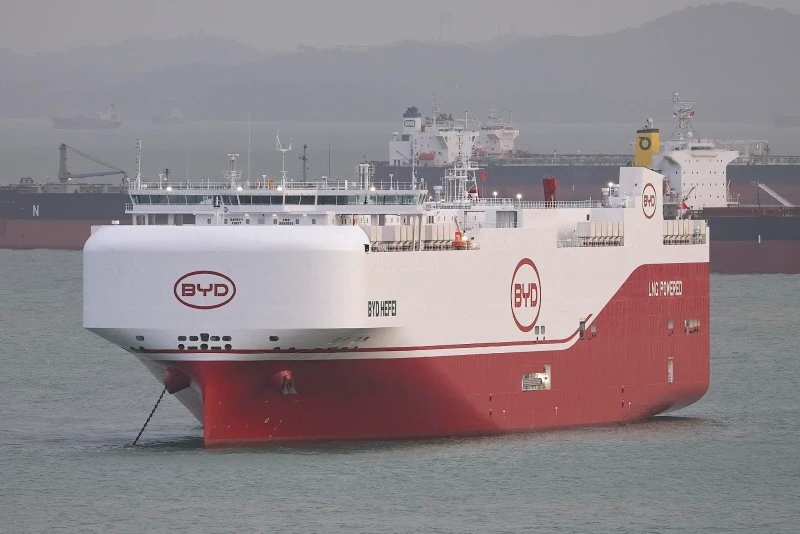
RIYADH: Jeddah Islamic Port has received the motor vessel BYD HEFEI, a dual-fuel roll-on/roll-off carrier with a 7,000-unit capacity for vehicles and heavy equipment. 

The vessel’s arrival at the Red Sea Gateway Terminal reflects the port’s readiness to handle next-generation maritime traffic and supports the Kingdom’s broader push to enhance supply chain efficiency under Vision 2030. 

Operated at RSGT — Saudi Arabia’s first privately funded Build-Operate-Transfer terminal operator, partly owned by the SISCO Holding, Public Investment Fund, and COSCO SHIPPING Ports Limited — the MV BYD HEFEI highlights the Kingdom’s ongoing efforts to modernize terminals and advance sustainability initiatives.

The ship is powered by eco-friendly dual-fuel technology and is designed to meet the latest environmental and operational efficiency standards. 

“This reflects the port’s readiness to accommodate various types of vessels and highlights its advanced operational capabilities,” according to the Saudi Ports Authority, also known as Mawani. 

Strategically positioned near global shipping lanes, Jeddah Islamic Port handles over 65 percent of Saudi Arabia’s seaborne imports, playing a central role in the Kingdom’s National Transport and Logistics Strategy. 

The integration of liquefied natural gas-powered vessels aligns with the NTLS goals and the Saudi Green Initiative, which aim to reduce emissions and promote clean energy in the transportation sector. 

As ports across the UAE, Oman, and major global hubs like Singapore and Rotterdam invest in similar capabilities, Jeddah’s adoption of dual-fuel infrastructure bolsters its regional competitiveness and positions it firmly in the worldwide shift toward sustainable maritime logistics. 

As part of its strategic efforts to strengthen maritime connectivity and diversify trade routes, Mawani has significantly expanded shipping services at Jeddah Islamic Port in 2025. 

Among the newly added services is FRS1, operated by CSTAR LINE, which connects Jeddah to Chinese ports — Ningbo, Shanghai, and Nansha — as well as Aqaba in Jordan and Ain Sokhna in Egypt, with a capacity of up to 2,000 twenty-foot equivalent units. 

In addition, the LRX service by CMA CGM began operations in July, linking Jeddah with key ports in the Levant and Eastern Mediterranean, including Latakia, Iskenderun, Mersin, and Beirut, with a TEU capacity of 2,826. 

Earlier in the year, the IM2 service, jointly operated by Emirates Line and Wan Hai, was introduced, connecting Jeddah to Mundra, Alexandria, and Mersin, with capacity for 2,800 TEUs. 

Sea Lead launched its RESIN service in June 2025, facilitating trade between Jeddah and Nhava Sheva, Ain Sokhna, Djibouti, and Jebel Ali, with a handling capacity of 1,000 TEUs. 

Meanwhile, CMA CGM’s MEDEX service now connects Jeddah to 12 ports across the Middle East, South Asia, and Europe, including Abu Dhabi, Karachi, Colombo, and Piraeus, as well as Malta, Genoa, Fos, Barcelona, and Valencia. 

These service expansions underscore Jeddah Islamic Port’s role as a growing transshipment and trade hub. 

In 2024, the terminal, considered the busiest on the Red Sea and a critical gateway for Saudi Arabia’s trade, handled 5.58 million containers, marking a 12.6 percent year-over-year increase and positioning it 32nd globally by container volume. 


Saudi Arabia eyes top 10 global tourism ranking, says Al-Khateeb

Saudi Arabia eyes top 10 global tourism ranking, says Al-Khateeb
Updated 10 November 2025
Follow

Saudi Arabia eyes top 10 global tourism ranking, says Al-Khateeb

Saudi Arabia eyes top 10 global tourism ranking, says Al-Khateeb

JEDDAH: Saudi Arabia is on track to rank among the world’s top 10 tourist destinations, according to Minister of Tourism Ahmed Al-Khateeb.

Speaking at a press conference on Monday, Al-Khateeb highlighted that the 26th UN Tourism General Assembly in Riyadh focused on digital transformation in tourism, with member states committed to advancing initiatives, particularly in artificial intelligence.

UN Tourism Secretary-General Zurab Pololikashvili and Shaikha Al-Nowais, newly elected secretary-general of the organization, were also present.

Al-Nowais becomes the first woman and the youngest person to lead the global tourism body in its 50-year history.

Al-Khateeb described the Riyadh Declaration as a roadmap for the organization’s future.
“Through the executive council, the member states will work with the current and future secretary general to ensure the implantation of the Riyadh Declaration.”

He stressed that the declaration emphasizes sustainability, air connectivity, investment attraction, and the training and empowerment of human resources.

“Using technology, we are enhancing the tourist journey with solutions that require minimal human intervention, such as facial recognition at airports to streamline the travel process,” he said.

Al-Khateeb also highlighted the importance of human interaction in tourism. “We are also keen to develop human capabilities in the sector.” He added that tourism serves as a bridge between cultures.

Al-Nowais underscored sustainable and responsible growth as her top priority, alongside transparency, ethical governance, digital transformation, and smart tourism. She noted the organization has already launched initiatives like the Best Tourism Village program, which certifies rural villages and small destinations within larger regions to promote development and support local communities.

She added that the entity has done a “great” job in this regard and stressed that technology and innovation will play an increasing role in managing growing numbers of travelers.
“We need to see how we can propose or advocate or suggest areas where we can ask destinations and governments to empower themselves with those tools and see how we can instead divert the crowd or the travelers to new destinations and emerging destinations,” she said.

Commenting on her election, Al-Nowais called it a profound honor to represent women in such a leadership role.
“I think my message is with dedication, with passion, with commitment, with hard work, you know things like that will always pay off.”

She added: “No matter how difficult it is, you have to live by your principles, your values, and believe in yourself. And I think nothing is ever impossible,” she added.

Pololikashvili described the Riyadh Declaration as a shared commitment among countries.
“All these three days we were talking. It's not the idea of one or two countries, and it's the process to support sustainable development.”

He emphasized that the declaration aims to leave a lasting legacy, noting that it is fully transparent and clearly outlines priorities for the coming years.
“And priorities are the same, more or less now, the digitalization, education, investments, and it is a more concrete and more detailed document and guideline,” he said.

In response to a question about this year’s focus on AI-powered tourism and making the technology accessible for countries with limited infrastructure, Pololikashvili said that it is a new area for them as well. He highlighted the pioneering role of Saudi Arabia and the UAE in establishing innovation hubs, a first-of-its-kind initiative globally.

“These hubs are designed to transfer expertise to less developed countries, particularly in the tourism sector, over the next two to three years,” he said, adding that the initiative is seen as a strategic investment to attract knowledge and skills from leading countries and support member states’ development.

Under the theme “AI-Powered Tourism: Redefining the Future,” the four-day event brought together representatives from more than 150 countries, including ministers, global tourism leaders, and industry experts, to discuss the future of travel, innovation, and sustainable development.

The General Assembly is the highest decision-making body within the UNWTO, comprising more than 159 member states, as well as representatives from the private sector and nongovernmental organizations.