
Arab, Islamic foreign ministers condemn Netanyahu’s ‘Greater Israel’ remark

Arab, Islamic foreign ministers condemn Netanyahu’s ‘Greater Israel’ remark
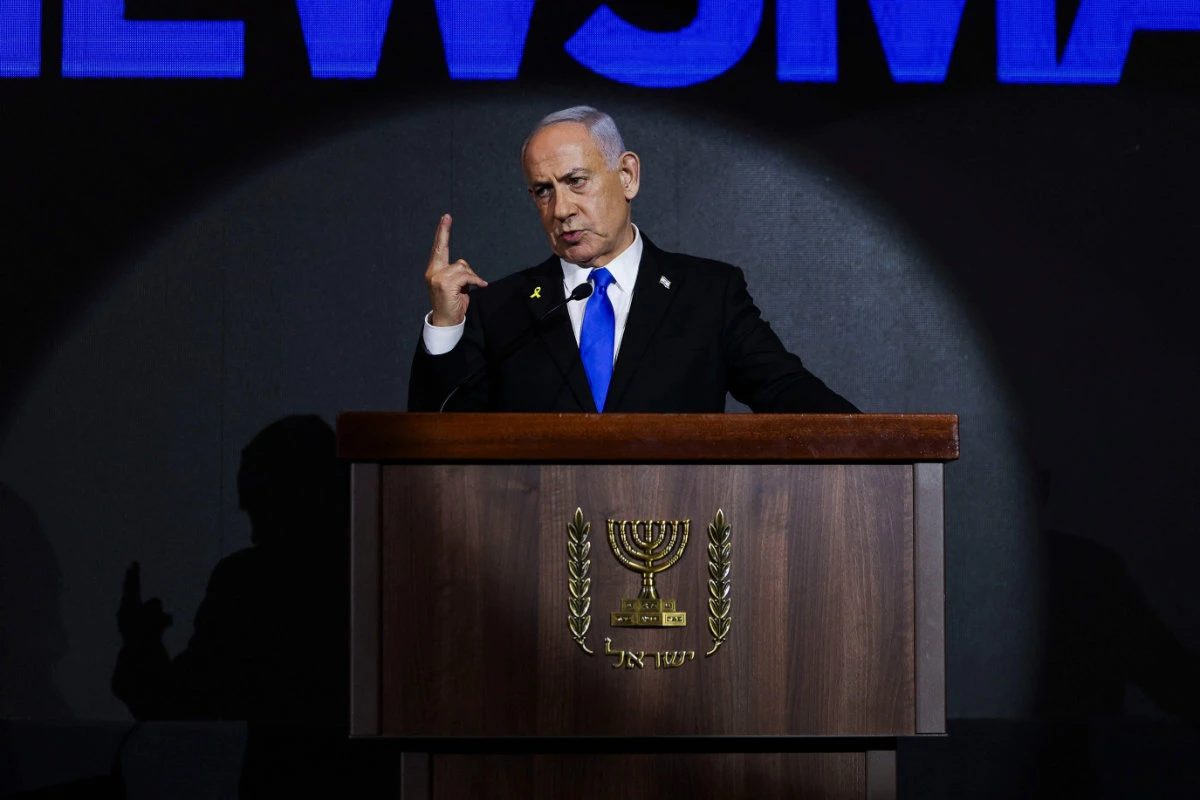
Israeli Prime Minister Benjamin Netanyahu. (AFP/File photo)
Short Url
Updated 16 August 2025
Follow

Arab, Islamic foreign ministers condemn Netanyahu’s ‘Greater Israel’ remark

Arab, Islamic foreign ministers condemn Netanyahu’s ‘Greater Israel’ remark
  • In a joint statement, the ministers said the pronouncements by Netanyahu and his ministers were “a blatant and dangerous violation” of international law
  • The statement was signed by foreign ministers of 31 nations and the heads of the Arab League, OIC and GCC

RIYADH: The foreign ministers of Arab and Muslim nations on Saturday denounced statements about a “Greater Israel” that Israeli Prime Minister Benjamin Netanyahu was reported to have made in the wake of pronouncements by his far-right allies to annex Palestinian territories.

In a joint statement the ministers said the pronouncements by Netanyahu and his ministers were “a blatant and dangerous violation” of international law.

“They also constitute a direct threat to Arab national security, to the sovereignty of states, and to regional and international peace and security,” said the statement carried by the Saudi Press Agency.

Signatories of the document included the foreign ministers of Saudi Arabia, Algeria, Bahrain, Bangladesh, Chad, Comoros, Djibouti, Egypt, Gambia, Indonesia, Iraq, Jordan, Kuwait, Lebanon, Libya, Maldives, Mauritania, Morocco, Nigeria, Oman, Pakistan, Palestine, Qatar, Senegal, Sierra Leone, Somalia, Sudan, Syria, Turkiye, the UAE, and Yemen. Also included were the secretaries-general of the League of Arab States, the Organisation of Islamic Cooperation, and the Gulf Cooperation Council.

The ministers stressed that “while their states reaffirm their respect for international legitimacy and the Charter of the UN, particularly article 2, paragraph 4 which prohibits the use of force or the threat thereof, they will adopt all policies and measures that preserve peace, in a manner that serves the interests of all states and peoples in achieving security, stability, and development, away from illusions of domination and the imposition of power by force.”

The ministers pushed back against Israeli minister Bezalel Smotrich’s approval of the settlement plan in the E1 area of the West Bank, along with his statements rejecting the establishment of a Palestinian state.

European nations are also alarmed at the move and have called on the Israeli government to halt its plans, with Germany warning that the E1 settlement plan and the expansion of Maale Adumim would further restrict the mobility of the Palestinian population in the West Bank by splitting it in half and cutting the area off from East Jerusalem.

The statement said Israel’s plan would constitute a “blatant violation of international law and a flagrant assault on the inalienable right of the Palestinian people to realize their independent, sovereign state on the lines of June 4, 1967, with occupied Jerusalem as its capital.”

It warned of Israel’s blatant disregard for the rights of Palestinians and its neighbors as the international community as a whole “directly fuel cycles of violence and conflict and undermines prospects for achieving just and comprehensive peace in the region.”

Ministers “reiterated their rejection and condemnation of Israel’s crimes of aggression, genocide, and ethnic cleansing” and reaffirmed the need for a ceasefire in the Gaza Strip “ensuring unconditional humanitarian access to end the policy of systematic starvation that Israel is pursuing as a weapon of genocide.”

More than 61,000 Palestinians have been killed in Gaza since Hamas’ attack on Israel on Oct. 7, 2023. Israel has also continued to block international humanitarian agencies from delivering food to starving people in the enclave.

International forces in Gaza should ensure Palestinians and Israelis don’t pose threat to each other, Qatar PM tells CNN

International forces in Gaza should ensure Palestinians and Israelis don’t pose threat to each other, Qatar PM tells CNN
Updated 5 sec ago
Follow

International forces in Gaza should ensure Palestinians and Israelis don’t pose threat to each other, Qatar PM tells CNN

International forces in Gaza should ensure Palestinians and Israelis don’t pose threat to each other, Qatar PM tells CNN
  • Sheikh Mohammed bin Abdulrahman Al-Thani says International Stabilization Force should have clearly defined mandate
  • PM reaffirms: ‘There is no solution except the two-state solution’

DUBAI: International forces to be deployed in Gaza under the US-brokered ceasefire plan should ensure that Palestinians and Israelis do not pose a threat to each other, Qatar’s Prime Minister Sheikh Mohammed bin Abdulrahman Al-Thani told CNN.

Sheikh Mohammed added that the International Stabilization Force should have a clear mandate, which “we are working together with the United States in order to define.”

Speaking to CNN’s Fareed Zakaria, he said: “When we are talking about international presence … there should be a defined mandate. And we are working together with the United States in order to define the mandate of the international forces. And basically, the international forces’ role should be securing the Palestinians and the Israelis that both of them … don’t pose a threat for each other.”

Under the ceasefire between Hamas and Israel, a coalition of mainly Arab and Muslim nations is expected to deploy forces in the Palestinian territory.

Sheikh Mohammed also spoke about the recent truce violations in Gaza, which he said were “happening every day,” recalling the Jan. 25 ceasefire, which Israel was also accused of violating.

“A lot of Palestinians (were) being killed during that ceasefire,” he said.

“The violations are happening every day. And we have, like we have in the deconfliction room, the operation room that we did together with Egypt and the United States. We register everything over there.

“The attack was really disproportionate and was about to jeopardize the deal. But what we have seen, we have seen that, then both parties, we work together very closely with them in order to make sure that the ceasefire stay intact.” 

Sheikh Mohammed reiterated Qatar’s support for the Palestinian Authority to be the “single agency” that presides over Gaza and the West Bank.

“Right now, there (are) ongoing talks between all the Palestinian factions, including Fatah and the PA, in order to make sure that this technocratic committee, it’s apolitical. It will take care of Gaza in this transition period, and it will be linked somehow to the Palestinian Authority … Once the reforms are in place, the Palestinian Authority should take over the governance in Gaza and the West Bank together,” he said.

“We cannot separate those two units. Those are one unit. Those are the future Palestinian state. Look, Fareed, whatever we do, whatever we say, there are wishful thinking from some politicians, maybe in Israel, that there are other solutions other than the two-state solution. There is no solution except the two-state solution. How can we figure out the formula where two people, they can live side by side together and feel safely?”