Elderly British couple to fly home after release by Taliban

Elderly British couple to fly home after release by Taliban
1 / 2
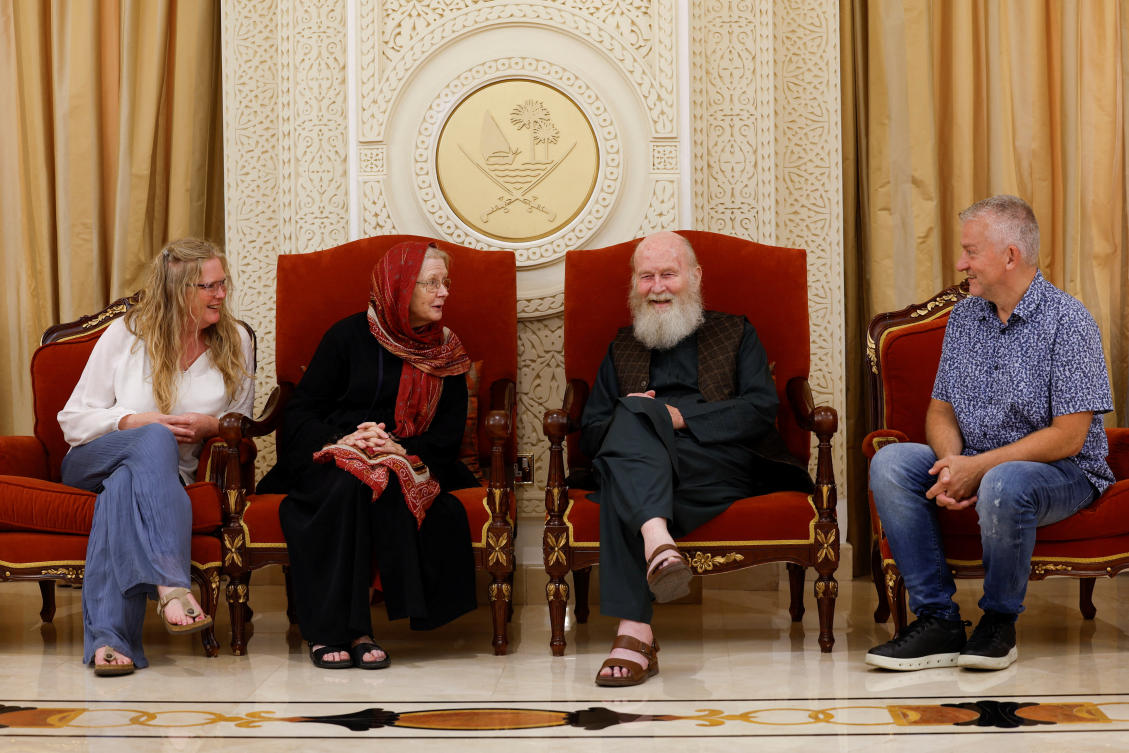
British couple Peter and Barbie Reynolds, who were released from Taliban detention in Afghanistan, speak with their daughter after disembarking from a plane, in Doha, Qatar September 19, 2025. (Reuters)
Elderly British couple to fly home after release by Taliban
2 / 2
Journalists stand in a designated area as the plane carrying British couple Peter and Barbie Reynolds lands at the airport in Doha on September 19, 2025, upon their arrival after they were freed following several months of detention in Afghanistan. (AFP)
Short Url
Updated 20 September 2025
Follow

Elderly British couple to fly home after release by Taliban

Elderly British couple to fly home after release by Taliban
  • Taliban authorities arrested Peter Reynolds, 80, and his wife Barbie, 76, in February as they were returning to their home in Bamiyan province
  • Following concerns for their health, the pair were freed on Friday and flown to the Qatari capital Doha

DOHA: An elderly British couple released after almost eight months in detention in Afghanistan are expected to fly back to the UK on Saturday.
Taliban authorities arrested Peter Reynolds, 80, and his wife Barbie, 76, in February as they were returning to their home in Bamiyan province, central Afghanistan.
Following concerns for their health, the pair were freed on Friday and flown to the Qatari capital Doha.
They are expected to leave for London on a commercial flight on Saturday after completing medical checks.
The Reynoldses married in Kabul in 1970 and have spent almost two decades living in Afghanistan, running educational programmes for women and children. They also became Afghan citizens.
When the Taliban returned to power in 2021, they remained in Afghanistan against the advice of the British embassy.
The Taliban have not explained why the pair were detained, and Qatar brokered the negotiations for their release.
Speaking on the tarmac at Kabul airport on Friday, Barbie Reynolds said the couple had been treated well and were "looking forward to seeing our children".
"We are looking forward to returning to Afghanistan if we can. We are Afghan citizens," she added.
They were embraced by family members on arriving in Doha, with their daughter Sarah Entwistle telling AFPTV she was "overwhelmed with gratitude and relief".
The couple were first held in a maximum security facility, "then in underground cells, without daylight, before being transferred" to the intelligence services in Kabul, UN experts have said.
In July, independent UN human rights experts called on the Taliban government to free them, warning that they risked "irreparable harm or even death" as their health deteriorated.
The couple's family had made repeated pleas for their release, citing their failing health.
Taliban foreign ministry spokesman Abdul Qahar Balkhi said on Friday that the couple "had violated the laws of Afghanistan" and were released from custody "following the judicial process".
The Reynolds' four children hailed their parents' release but said they face a "long" recovery.
Britain's Prime Minister Keir Starmer said the "long-awaited news will come as a huge relief" to the family.
The British government advises citizens against travelling to Afghanistan, warning that its ability to offer consular assistance is "extremely limited".
Russia is the only country to have officially recognised the Taliban government, which has imposed a strict version of Islamic law and been accused of sweeping human rights violations.
Dozens of foreign nationals have been arrested since the Taliban returned to power in August 2021 following the NATO pullout.
At UN climate talks in Brazil, the only sign of the United States is an empty chair

At UN climate talks in Brazil, the only sign of the United States is an empty chair
Updated 11 November 2025
Follow

At UN climate talks in Brazil, the only sign of the United States is an empty chair

At UN climate talks in Brazil, the only sign of the United States is an empty chair
  • Brazil President Luiz Inácio Lula da Silva, whose nation is hosting these talks, urged negotiators not to forget that “the climate emergency is an increase of inequality”

BELEM, Brazil: A litany of recent weather disasters rang long Monday at the opening of UN climate negotiations: Hurricane Melissa in Jamaica, a deadly tornado in Brazil, droughts and fire in Africa. Against that backdrop, activists used an empty chair to drive home the absence from these talks of the United States, the world’s richest nation and second-biggest carbon polluter.
World leaders highlighted the devastation wrought on some of the world’s poorest places to show the need to work collectively to fight global warming, which is fueling extreme weather. But any united front will be without the US, one of only four nations missing the talks, along with tiny San Marino and strife-torn Afghanistan and Myanmar.
The 195 nations who did come to Belem, a weathered city on the edge of the Brazilian Amazon, for the talks known as COP30 were told that only together can they swiftly reduce the emissions from coal, oil and gas that cause climate change.
While the activists’ empty chair primarily illustrated the US absence, it was also intended to be a call-out for other nations “to step in and step up,” Danni Taaffe with Climate Action Network International told The Associated Press.
Those leading the talks sounded a similar note.
“Humanity is still in this fight. We have some tough opponents, no doubt, but we also have some heavyweights on our side. One is the brute power of the market forces as renewables get cheaper,” United Nations climate secretary Simon Stiell said.
A clear mandate
Brazil President Luiz Inácio Lula da Silva, whose nation is hosting these talks, urged negotiators not to forget that “the climate emergency is an increase of inequality.”
“It deepens the perverse logic that defines who is worthy of living and who should die,” Lula said.
This year’s talks are not expected to produce an ambitious new deal. Instead, organizers and analysts frame this year’s conference as the “implementation COP.” Countries had a clear mandate: arrive with their updated national plans to fight climate change.
On Monday, the United Nations released updated calculations showing that those national pledges promise to reduce projected 2035 global greenhouse gas emissions 12 percent below 2019 levels. That’s 2 points better than last month, before new pledges rolled in.
Attendees on Monday stressed cooperation, with Stiell saying that individual nations simply cannot cut heat-trapping gas emissions fast enough on their own.
André Corrêa do Lago, president of this year’s conference, emphasized that negotiators must engage in “mutirão” — a local Indigenous term that refers to a group uniting to complete a task.
A united front — without the US
Complicating those calls is the absence of the United States, where US President Donald Trump has long denied the existence of climate change.
The UN’s updated figures Monday depend on a US pledge that came from the Biden administration in December — before Trump returned to the White House and began working to boost fossil fuels and block clean energy like wind and solar. His administration did not send high-level negotiators to Belem, and he began his second term by withdrawing for the second time from the 10-year-old Paris Agreement, the first global pact to fight climate change.
The Paris Agreement sought to limit warming to 1.5 degrees Celsius (2.7 degrees Fahrenheit) above the historical average, but many scientists now say it’s unlikely countries will stay below that threshold.
The United States has put more heat-trapping carbon dioxide into the air from the burning of coal, oil and natural gas than any other country. China is the No. 1 carbon polluter now, but because carbon dioxide stays in the air for at least a century, more of it was made in the US.
Palau Ambassador Ilana Seid, who chairs the Alliance of Small Island States, said the US withdrawal “has really shifted the gravity” of the negotiating system.
Trump’s actions damage the fight against climate change, former US Special Envoy for Climate Todd Stern said.
“It’s a good thing that they are not sending anyone. It wasn’t going to be constructive if they did,” he said.
Though the US government isn’t showing up, some attendees including former top US negotiators are pointing to US cities, states and businesses that they said will help take up the slack.
‘A tragedy of the present’
Lula and Stiell said the 10-year-old Paris Agreement is working to a degree, but action needs to be accelerated. They pointed to devastation in the past few weeks including Hurricane Melissa in the Caribbean, typhoons smashing Vietnam and the Philippines and a tornado ripping through southern Brazil.
Scientists have said extreme weather events have become more frequent as Earth warms.
“Climate change is not a threat of the future. It is already a tragedy of the present time,’’ Lula said.