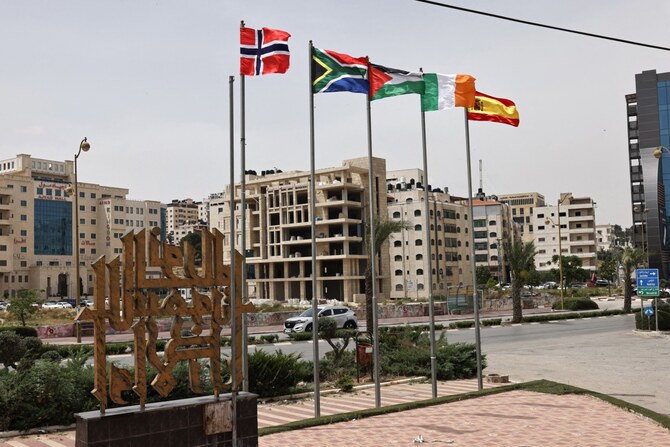
- The very act of recognition — granted on 28 May, 2024 — means that Oslo no longer considers Palestinians like Adam to be stateless
- “We don’t know what is the reason behind this. Is it to satisfy some parties who are against immigrants or is it for some other reasons?” said Adam
LONDON: When Norway recognized Palestine as a state, Palestinian engineer Adam was thrilled by the show of support, little knowing the move would ultimately derail his family’s dream of winning citizenship in their adopted homeland.
The very act of recognition — granted on 28 May, 2024 — means that Oslo no longer considers Palestinians like Adam to be stateless, according to the Norwegian Directorate of Immigration (UDI) which oversees visa processes.
And this change has upended Adam’s dreams and left him dumbfounded by what has turned out to be a poisoned chalice.
“We don’t know what is the reason behind this. Is it to satisfy some parties who are against immigrants or is it for some other reasons?” said Adam, who wanted to use a pseudonym for fear of retaliation.
“You support us, which is appreciated. At the same time, you are punishing Palestinians when you recognize their state. It doesn’t make any sense,” the father of two told the Thomson Reuters Foundation in a video interview from Norway.
Legal and migrant charities worry that Norway may also have set a dangerous precedent — denying millions of other Palestinians who live outside their homeland the protections that are routinely granted to the stateless.
Britain, France and Australia were among the latest nations to officially recognize the Palestinian state last month, with leaders hoping the move would pressure Israel to end its devastating two-year military campaign in Gaza.
A ceasefire in Gaza was announced on Thursday as part of the first phase of a US-backed peace deal to end a conflict that has killed more than 67,000 Palestinians.
Israel launched its assault on Gaza after Hamas-led militants attacked southern Israel on Oct. 7, 2023, killing 1,200 people and seizing 251 hostages.
Arab countries say the peace plan must lead to eventual independence for a Palestinian state. Israeli Prime Minister Benjamin Netanyahu says this will never happen.
Experts meanwhile worry that the pickup in recognition for a Palestinian state — more than 150 countries have now made the move — may perversely curtail the rights of some of the 7.6 million Palestinians living outside the occupied territories.
LEGAL LIMBO
Adam would have been able to apply for citizenship in 2026 under rules that make stateless people eligible for naturalization after living in country for three years.
Children born stateless can become citizens after one year.
But that all changed after Norway backed statehood.
The UDI says Palestinians who are on the civil registry in the West Bank, Gaza or East Jerusalem and assigned ID cards can no longer apply for Norwegian citizenship as stateless persons.
Born in the West Bank, Adam and his family all have Palestinian documents which means they now need to wait eight years — like any other migrant — before they can apply for citizenship, leaving them in legal limbo.
Nor does it just affect Palestinians in Norway.
“We are worried about our people in other countries because these countries may do exactly what Norway did,” said Adam.
The Norwegian Ministry of Labour and Social Inclusion, which oversees immigration and welfare policies, did not respond to a request for comment before the publication of this article.
The European Network on Statelessness (ENS), a civil society alliance, said Palestinians who have no other nationality should retain protections as their homeland remains under Israeli occupation.
Patricia Cabral, legal policy coordinator at ENS, says other authorities could follow Norway’s example — noting that Palestinians in Bulgaria and Hungary had already seen their rights curbed by statehood recognition.
“Stateless Palestinians, as other stateless people, should be granted residency rights, access to economic and social rights, and a facilitated route to naturalization,” Cabral said. “They shouldn’t be kept in limbo for a long time.”
STATEHOOD?
Despite growing political support, a Palestinian state currently lacks the core elements of a state, Cabral said.
These would include control over borders and a population registry, the ability to issue identity and travel documents, and the right to decide how nationality is passed on, she said.
As it stands, Israel restricts access into Palestinian territories for goods, investment and educational or cultural exchanges.
There are no Palestinian airports.
The landlocked West Bank can be reached only through Israel or through the Israeli-controlled border with Jordan.
Israel now controls all access to the Gaza Strip since capturing Gaza’s buffer zone on the border with Egypt last year.
As part of the ceasefire deal, it is supposed to eventually withdraw troops, although timings remain unclear.
“You recognize Palestine as a state, but does Palestine actually have a nationality law? They don’t,” said Marek Linha, senior legal adviser at the Norwegian Organization for Asylum Seekers charity, which is supporting affected Palestinians.
“There are legal questions that need to be carefully considered, and unfortunately, it has not been done as far as I can see, or from what is publicly available (in Norway),” he said in a phone interview.
Adam said he and his wife have abandoned plans for a third child since any newborn would now start life stateless.
Palestinians typically need to travel to Palestinian territories to give birth and get a birth certificate, plus other documents, since most embassies cannot issue them.
Adam said he fears one of his children’s passports might expire by the time they can apply for citizenship, which means they would need to travel to the West Bank for renewal.
“Norway is pushing us to do this. I am forced to go to Palestine to renew my documents. We have to go to Palestine if we have a new baby. It means exposing our young children to dangerous and traumatic experiences in conflict zones,” he said.
“We both work. We have an income. We are not looking for any social support from the government. We’re looking for stability.”