Legal battle looms over Nepal’s post-uprising interim government

Legal battle looms over Nepal’s post-uprising interim government
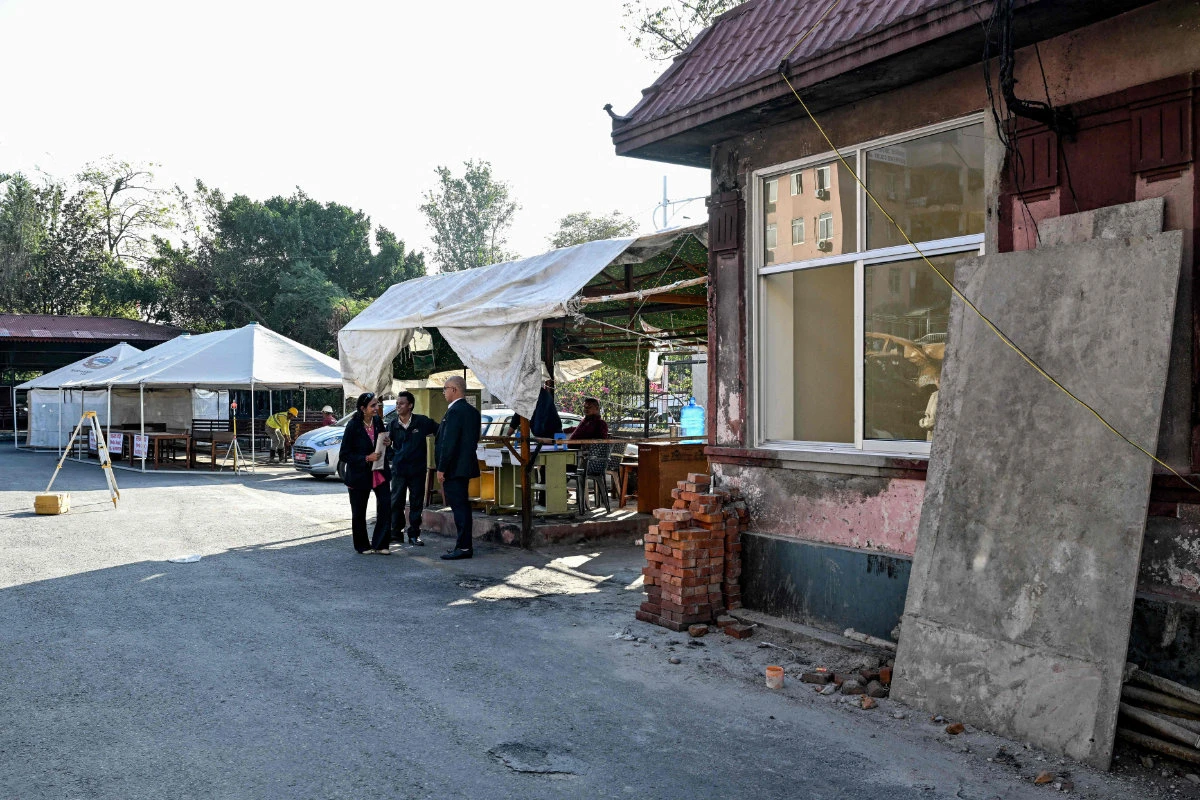
People gather near makeshift tents set up beside an under-renovation structure at the fire-damaged Supreme Court premises in Katmandu on October 15, 2025. (AFP)
Short Url
Updated 15 October 2025
Follow

Legal battle looms over Nepal’s post-uprising interim government

Legal battle looms over Nepal’s post-uprising interim government
  • Youth-led protests over economic hardship and corruption in September forced the government’s collapse
  • A day after the dissolution, leaders of eight political parties calrrg for the reinstatement of parliament

KATMANDU: Petitions have been filed in Nepal’s Supreme Court challenging the formation of an interim government and the dissolution of parliament following last month’s uprising, a court official said Wednesday.
The youth-led protests, which erupted on September 8 over a brief social media ban, economic hardship and corruption, quickly morphed into nationwide fury after a deadly crackdown.
Two days of violence left at least 73 people dead, the parliament and government offices burned down, and forced the government’s collapse.
Former chief justice Sushila Karki, 73, was nominated as prime minister and the parliament was dissolved shortly after.
But the legality of those moves is now under scrutiny.
“Eleven petitions have been filed stating that the formation of the new interim government and the dissolution of the lower house is unconstitutional,” Nirajan Pandey, the court’s information officer told AFP.
Pandey said procedures were underway to register the petitions, after which hearings would be scheduled.
A day after the dissolution, leaders of eight political parties issued a joint statement calling for the reinstatement of parliament.
“It was not envisioned in the constitution that such a situation would arise,” lawyer Dinesh Tripathi said.
“It is a challenge, but the court will decide.”
KP Sharma Oli, the 73-year-old Marxist who served as prime minister four times before his ouster, has called for the reinstatement of the parliament “that was unconstitutionally dissolved,” in an address to supporters earlier this month.
The Supreme Court building was also damaged by fire during the protests, and only resumed full operations on Tuesday, with many sections operating under a tent.


UK sees surge in referrals of right-wing extremism to counterterrorism program

UK sees surge in referrals of right-wing extremism to counterterrorism program
Updated 7 sec ago
Follow

UK sees surge in referrals of right-wing extremism to counterterrorism program

UK sees surge in referrals of right-wing extremism to counterterrorism program
  • Cases linked to violent far-right ideology increase by almost 40% and are now more than double the number related to Islamist extremism
  • Home Office figures show sharp rise in overall referrals to the Prevent scheme, amid growing concerns about ‘no ideology’ radicalization

LONDON: The number of people referred to Britain’s counterterrorism program over concerns about right-wing extremism surged by nearly 40 per cent in the space of a year.

Of a total of 8,778 people flagged to the Prevent scheme in the year to March 2025, nearly 1,800 related to violent, far-right ideology, Home Office figures show. That compares with 1,314 in the previous 12 months.

The number of referrals for far-right extremism was more than double the number for cases of Islamist extremism, which fell by 13 percent to 870 in the same period.

The shift comes amid an overall sharp increase in the number of cases referred to Prevent, and a big jump in the number of referrals labeled as “no identified ideology.” The 27 percent rise in referrals to the program has been linked to the July 2024 attack on a children’s dance class in northern England in which three girls were killed, and the subsequent trial.

Prevent faced criticism in a review for prematurely closing its case on the attacker, 17-year-old Axel Rudakubana, who had been referred to the scheme three times between 2019 and 2021. The review said too much emphasis was placed on the observation that he did not have a distinct ideology.

The latest figures reveal that more than half of the referrals to Prevent involved individuals judged to have no identified ideology, 21 percent were due to concerns about extreme right-wing views, 10 percent related to Islamist ideology, and 5 percent were the result of concerns about “fascination with extreme violence or mass casualty attacks” where no other ideology had been identified.

Of the individuals referred to the scheme, 89 percent were male, 65 percent white, 19 percent Asian, and 8 percent black.

The program has faced extensive criticism from human-rights groups for disproportionately targeting the Muslim community. Amnesty International said the latest figures showed Prevent was failing to tackle rising extremism.

“It is an ineffective, discriminatory program which is not compliant with international human rights law,” said Alba Kapoor, Amnesty’s racial justice lead.

Prevent was established in 2003 and expanded after the July 7, 2005, terrorist attacks on London’s transport system. Schools, police, local authorities and members of the public can refer to the scheme people they fear might be susceptible to radicalization. After an initial assessment, cases can be passed a “Channel” panel that determines the severity of the risk and what action should be taken.

The latest figures show 1,727 individuals were discussed by one of these panels in the year to March and 1,472 were adopted for further support.