Hannibal Qaddafi, son of late Libyan leader, ordered released in Lebanon if he pays $11m bail

Update Hannibal Qaddafi, son of late Libyan leader, ordered released in Lebanon if he pays $11m bail
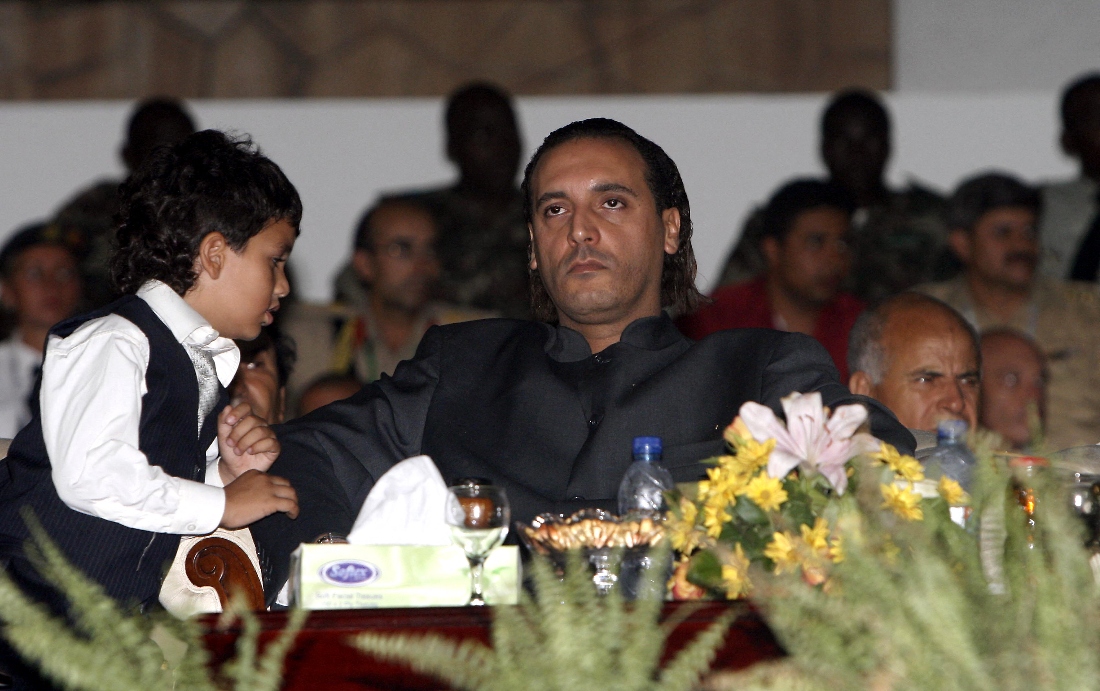
Hannibal Qaddafi, son of Libyan leader Moamer Kadhafi, attends a parade of marching bands as part of celebrations marking the 40th anniversary of his father's regime in Tripoli late 2009. (AFP)
Short Url
Updated 17 October 2025
Follow

Hannibal Qaddafi, son of late Libyan leader, ordered released in Lebanon if he pays $11m bail

Hannibal Qaddafi, son of late Libyan leader, ordered released in Lebanon if he pays $11m bail
  • Judge Zaher Hamadeh questioned him and later ordered his release once the money is paid
  • Another condition for his release, however, is that he be banned from traveling outside Lebanon for two months

BEIRUT: A Lebanese judge on Friday ordered the release of the son of Libya’s late leader Muammar Qaddafi on condition that he pay $11 million bail.
Hannibal Qaddafi has been imprisoned in Lebanon for a decade without being charged.
The expected release comes after his lawyers have said that he had been ill in his cell at police headquarters in Beirut. Libya in 2023 formally requested his release, citing his deteriorating health after he went on hunger strike to protest his detention without trial.
On Friday, judicial officials said he was taken to the Justice Palace in Beirut, where Judge Zaher Hamadeh questioned him and later ordered his release once the money is paid. Another condition for his release, however, is that he be banned from traveling outside Lebanon for two months.
After the session was over, Qaddafi was taken back to the cell.
Judicial officials in Beirut said Qaddafi’s defense team has filed a case against the Lebanese state in Geneva over holding him without trial, adding that the case is expected to be discussed in Switzerland next month.
One of Qaddafi’s lawyers, Charbel Milad Al-Khoury, told The Associated Press that Qaddafi does not have the money and does not have access to accounts in order to pay the bail. Al-Khoury added that Hannibal Qaddafi’s defense team plan to lodge an appeal on Monday over the $11 million bail and ask that it be abolished.
“This decision is almost impossible to be met,” Al-Khoury said about the bail. “Hannibal has been held for 10 years and it is not logical to release him for $11 million bail.”
Qaddafi has been detained in Lebanon since 2015 after he was abducted by Lebanese militants demanding information on the whereabouts of a prominent Lebanese Shiite cleric. Lebanese police later announced it had picked up Qaddafi from the city of Baalbek, in northeastern Lebanon, where he was being held. He has since been held in a Beirut jail.
Qaddafi had been living in exile in Syria with his Lebanese wife, Aline Skaf, and children until he was abducted and brought to Lebanon.
He has faced questioning over the past years over the 1978 disappearance of Shiite cleric, Moussa Al-Sadr, during a visit to Libya.
The case has been a long-standing sore point in Lebanon. The cleric’s family believes he may still be alive in a Libyan prison, though most Lebanese presume he is dead. He would be 96 years old.
Al-Sadr was the founder of a Shiite political and military group that took part in the long Lebanese civil war that began in 1975, largely pitting Muslims against Christians.
Asked on Friday, about Al-Sadr, Qaddafi responded “I Don’t know” and “I don’t remember,” according to four judicial officials who attended the session. They spoke on condition of anonymity in line with regulations.
Muammar Qaddafi was killed by opposition fighters during Libya’s 2011 uprising-turned-civil war, ending his four-decade rule of the North African country.
Hannibal Qaddafi, who was born nearly three years before Al-Sadr disappeared, fled to Algeria after his father was toppled and Tripoli fell to opposition fighters, along with his mother and several other relatives. He later moved to Syria where he was given political asylum and stayed there until he was abducted.
Muammar Qaddafi had eight children from two marriages. Most of them had significant roles in his government. His son Muatassim was killed at the same time as Qaddafi Sr. was captured and slain. Two other sons, Seif Al-Arab and Khamis, were killed in the uprising.
Seif Al-Islam, the one-time heir apparent to his father, has been in Libya since his release from detention there in 2017. Qaddafi’s son Mohammed and daughter Aisha live in Oman. Al-Saadi, a former soccer player, was released from prison in Libya in 2021 after being jailed following repatriation from Niger in 2014, and is believed to be living in Turkiye.

Israel’s longest war is leaving a trail of traumatized soldiers, with suicides also on the rise

Israel’s longest war is leaving a trail of traumatized soldiers, with suicides also on the rise
Updated 6 sec ago
Follow

Israel’s longest war is leaving a trail of traumatized soldiers, with suicides also on the rise

Israel’s longest war is leaving a trail of traumatized soldiers, with suicides also on the rise
  • Israel’s longest war is leaving a trail of traumatized soldiers, with a growing number suffering from mental health illnesses
  • The Back2Life farm is among several grassroots organizations stepping in to support the growing number of soldiers needing help
SDOT YAM, Israel: Wrapped tightly around his forearms, the former Israeli soldier feels the snakes’ cold skin against his, and for a moment he’s able to breathe.
It’s been nearly 18 months since he left the army after fighting in the war in Gaza, and the flashbacks and panic attacks haven’t ceased. He was wounded in a Hamas missile attack on his military base, and said two of his friends – also soldiers in their 20s – died by suicide. This farm in central Israel dedicated to helping soldiers has been a lifeline, he said.
“It doesn’t matter if a plane goes by or if the drone goes by or if someone is yelling. ... Because I’m here with the snake right now,” said the 27-year-old sergeant major, who called the experience grounding. Like other soldiers who spoke to The Associated Press, he insisted on anonymity to discuss private mental health matters.
Israel’s longest war is leaving a trail of traumatized soldiers, with a growing number suffering from mental health illnesses after two years of war with Hamas. Reports of post-traumatic stress disorder, depression and other mental health problems are increasing among soldiers, as are suicides.
Israel’s defense ministry says it has documented nearly 11,000 soldiers suffering from “mental health injuries” since the Oct. 7, 2023, Hamas attack that triggered the war in Gaza. That accounts for more than a third of the total 31,000 troops with such injuries in all of Israel’s conflicts since its founding nearly 80 years ago. The ministry defines mental health injuries as PTSD, anxiety, depression and other mental health issues.
Suicides have also spiked. In the decade preceding the war, the number of soldiers taking their own lives in the army averaged 13 per year. Since the war, the number has risen, with 21 soldiers dying by suicide last year, according to the army. The figures – which account for active duty and reserve troops – don’t include soldiers who took their own lives after leaving the military.
A report published by Israel’s parliament last month said an additional 279 soldiers tried to take their own lives from January 2024 through July 2025 but survived.
“There’s now a genuine understanding that psychological injuries have profound consequences and that treatment is both necessary and practical,” said Limor Luria, deputy director general and head of the defense ministry’s Rehabilitation Department.
“We’re seeing a generational difference,” she said. “While many wounded veterans from previous wars never sought help, today’s wounded are responding very differently.”
The army is scrambling to address the crisis, mobilizing hundreds of mental health officers. It has sent experts to the front lines to help soldiers during combat, established a hotline and provided group therapy sessions to fighters once they’ve left service. Yet experts warn Israel is not yet equipped to deal with the scale – a gap the rehabilitation department acknowledged, saying it impacts the entire national health system.
The length and intensity of this war on multiple fronts – with tens of thousands of active duty and reserve troops called up for repeated deployments – haven’t allowed soldiers to properly heal, which could have long-term consequences for the country, said Tuly Flint, a trauma therapy specialist who has counseled hundreds of Israeli soldiers.
“Those victims of war, if not treated, lose the potential for personal and social development possible for them and may become a burden on themselves, their families and society,” he said.
Half a dozen soldiers who spoke to the AP, as well as psychologists who have treated fighters, said they lacked purpose, had difficulty concentrating or having relationships, and as the war dragged on, a sense of hopelessness set in.
Flint said some also suffered from what he called “moral injury.”
“Soldiers come back asking themselves who are they after what they’ve seen and done, what kind of people are they?” he said.
Rescue animals help soldiers heal
The 27-year-old former soldier, who worked as a radio technician for about six months at the start of the war, said he came to the farm earlier this year because he felt lost.
A missile struck his base on the border with Gaza, badly injuring his back. After that, he was anxious, triggered by noise, constantly on edge.
“Everything got louder, like my aggressions, my yelling, my feelings, everything just went up,” he said – as though “someone broke the volume.”
He’s receiving therapy from the army, but the farm has allowed him to heal in a different way, surrounded by others with similar experiences and allowing him to calm his mind by focusing on the animals, he said.
Nestled in the Sdot Yam kibbutz, the Back2Life farm is among several grassroots organizations stepping in to support the growing number of soldiers needing help. It was co-founded by Assi Nave and dedicated to his friend from an elite military unit, Amir (Dani) Yardenai, who suffered severe PTSD for years after fighting in Gaza in 2014, and died by suicide last year.
“Dani’s loss left me with the sense that he’s not the last one,” Nave said.
The farm has become an oasis for dozens of veterans who have participated in its sessions – which in addition to traditional counseling includes therapy with dogs and other animals – to the backdrop of chirping birds and clucking chickens. Former soldiers work with rescue animals, each helping the other to heal.
Psychologist Guy Fluman, who works with former soldiers and is among the mental health experts advising the farm on therapeutic approaches, said a major challenge veterans face is readjusting to civilian life and being with animals is grounding.
“You need to help them resolve their memories, be able to live in peace with what has happened ... and on the other hand to reconnect them to life,” he said.
Stigma persists
One 31-year-old deployed in Gaza and the West Bank for a year said upon returning home everything was a struggle: His relationship ended and he had difficulty connecting with family and friends.
“I felt like I was back there,” he said “My body is here, but my mind is not.”
He was among several veterans who told the AP he suffered from mental illness for years, triggered by fighting in Israel’s previous wars, yet this was the first time he felt comfortable seeking support.
“Stigma around mental health persists” among soldiers, acknowledged Luria, the rehabilitation program director. “Combating this stigma is a top priority.”
“We’re addressing it on multiple fronts,” including public campaigns and media outreach, she said, as well as programs designed to engage younger veterans, like rehabilitation farms and adventure sports.
A 32-year-old reservist who was assigned to collect bodies in southern Israel after the Oct. 7 Hamas attack in which some 1,200 people were killed and 251 were taken hostage said his flashbacks were less connected to the sight of the decaying men and women but to the smell.
“I started to smell dead bodies ... all the time,” he said. He’d get triggered changing his child’s diaper.
A therapist himself, he recognized the signs and sought help for PTSD. He then started working with others to help with the army’s growing need.
He said the best way for soldiers to come forward is for their commanders on the ground to let them know that it’s OK.
“When the commander of the soldier says you can get help,” he said, “it works better and you have less stigma.”