Pakistan, Afghanistan to hold peace talks in Doha after deadly clashes

Pakistan, Afghanistan to hold peace talks in Doha after deadly clashes
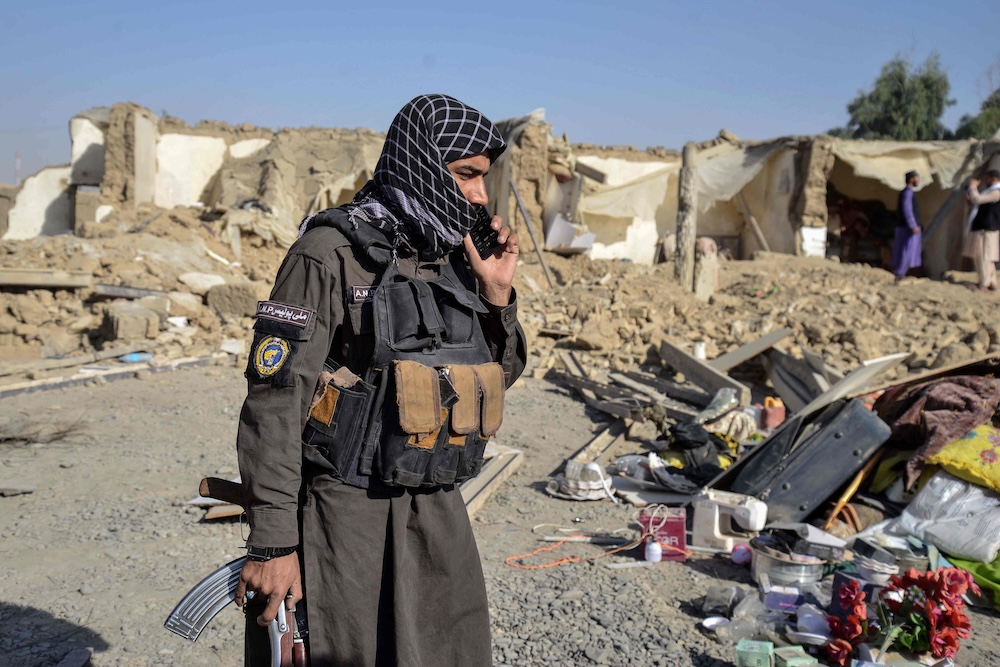
Above, a Taliban security member stands near a damaged house in the Spin Boldak district of Kandahar province on Oct. 16, 2025. (AFP)
Short Url
Updated 18 October 2025
Follow

Pakistan, Afghanistan to hold peace talks in Doha after deadly clashes

Pakistan, Afghanistan to hold peace talks in Doha after deadly clashes

KARACHI: Pakistan’s Defense Minister Khawaja Asif and intelligence chief will be traveling to Doha today, Saturday, to hold talks with representatives of the Afghan Taliban, Pakistani state media reported, hours after another Pakistani airstrike in Afghanistan.

The fierce battles between the two neighbors along their long, porous border broke out last Saturday and have led to the deaths of dozens of people on both sides, with Pakistan carrying out airstrikes in Kandahar and Kabul before a two-day truce that expired Friday evening.

Pakistan “conducted precision aerial strikes” in Afghan border areas on Friday, a security official said, adding that it targeted the Hafiz Gul Bahadur Group of the Tehreek-e-Taliban Pakistan (TTP). Friday’s strikes killed three Afghan cricketers among 10 people, authorities said.

The latest strikes ended 48 hours of calm between the two countries which was earlier reportedly extended for talks between Pakistani and Afghan officials in the Qatari capital of Doha.

“Pakistan’s Defense Minister Khawaja Asif and Intelligence Chief Lt General Asim Malik are scheduled to depart for Doha on Saturday,” the state-run Pakistan TV reported. “Taliban delegation is expected to be of equivalent seniority.”

Islamabad said the Hafiz Gul Bahadur group had been involved in a suicide bombing and gun attack at a military camp in the North Waziristan district that borders Afghanistan, which left seven Pakistani paramilitary troops dead on Friday.

The Afghanistan Cricket Board said that three players who were in the region for a tournament were killed by Friday’s airstrikes, revising down an earlier toll of eight.

Meanwhile, US President Donald Trump offered to help end hostilities between Pakistan and Afghanistan.

“I do understand that Pakistan attacked or there is an attack going on with Afghanistan,” he said in a meeting with the Ukranian president Volodymyr Zelensky at the White House.

“That’s an easy one for me to solve if I have to solve it. In the meantime, I have to run the USA. But I love solving wars.”

The clashes between Pakistan and Afghanistan broke out amid Islamabad’s claims that the Afghan Taliban had been sheltering banned militant groups like the TTP and the Baloch Liberation Army (BLA), which carry out cross-border attacks against Pakistan. Kabul denies the allegations.


This article also appears on Arab News Pakistan


As typhoons wreak havoc in Southeast Asia, scientists say rising temperatures are to blame

As typhoons wreak havoc in Southeast Asia, scientists say rising temperatures are to blame
Updated 10 November 2025
Follow

As typhoons wreak havoc in Southeast Asia, scientists say rising temperatures are to blame

As typhoons wreak havoc in Southeast Asia, scientists say rising temperatures are to blame
  • Warmer sea temperatures linked to stronger typhoons, scientists say
  • Back-to-back storms increase damage potential, warn researchers

SINGAPORE: As the year’s deadliest typhoon sweeps into Vietnam after wreaking havoc in the Philippines earlier this week, scientists warn such extreme events can only become more frequent as global temperatures rise. Typhoon Kalmaegi killed at least 188 people across the Philippines and caused untold damage to infrastructure and farmland across the archipelago. The storm then destroyed homes and uprooted trees after landing in central Vietnam late on Thursday. Kalmaegi’s path of destruction coincides with a meeting of delegates from more than 190 countries in the rainforest city of Belem in Brazil for the latest round of climate talks. Researchers say the failure of world leaders to control greenhouse gas emissions has led to increasingly violent storms.
“The sea surface temperatures in both the western North Pacific and over the South China Sea are both exceptionally warm,” said Ben Clarke, an extreme weather researcher at London’s Grantham Institute on Climate Change and Environment.
“Kalmaegi will be more powerful and wetter because of these elevated temperatures, and this trend in sea surface temperatures is extremely clearly linked to human-caused global warming.”

Warmer waters pack “fuel” into cyclones
While it is not straightforward to attribute a single weather event to climate change, scientists say that in principle, warmer sea surface temperatures speed up the evaporation process and pack more “fuel” into tropical cyclones.
“Climate change enhances typhoon intensity primarily by warming ocean surface temperatures and increasing atmospheric moisture content,” said Gianmarco Mengaldo, a researcher at the National University of Singapore.
“Although this does not imply that every typhoon will become stronger, the likelihood of powerful storms exhibiting greater intensity, with heavier precipitation and stronger winds, rises in a warmer climate,” he added.

More intense but not yet more frequent

While the data does not indicate that tropical storms are becoming more frequent, they are certainly becoming more intense, said Mengaldo, who co-authored a study on the role of climate change in September’s Typhoon Ragasa. Last year, the Philippines was hit by six deadly typhoons in the space of a month, and in a rare occurrence in November, saw four tropical cyclones develop at the same time, suggesting that the storms might now be happening over shorter timeframes. “Even if total cyclone numbers don’t rise dramatically annually, their seasonal proximity and impact potential could increase,” said Dhrubajyoti Samanta, a climate scientist at Singapore’s Nanyang Technological University.
“Kalmaegi is a stark reminder of that emerging risk pattern,” he added.

Back-to-back stormms causing more damage
While Typhoon Kalmaegi is not technically the most powerful storm to hit Southeast Asia this year, it has added to the accumulated impact of months of extreme weather in the region, said Feng Xiangbo, a tropical storm researcher at Britain’s University of Reading.
“Back-to-back storms can cause more damage than the sum of individual ones,” he said.
“This is because soils are already saturated, rivers are full, and infrastructure is weakened. At this critical time, even a weak storm arriving can act as a tipping point for catastrophic damage.”
Both Feng and Mengaldo also warned that more regions could be at risk as storms form in new areas, follow different trajectories and become more intense.
“Our recent studies have shown that coastal regions affected by tropical storms are expanding significantly, due to the growing footprint of storm surges and ocean waves,” said Feng.
“This, together with mean sea level rise, poses a severe threat to low-lying areas, particularly in the Philippines and along Vietnam’s shallow coastal shelves.”