- UN hearing lays bare stalled disarmament as Israel rejects withdrawal and multinational force remains a mere concept
- Analysts say rigid road map sequencing must be relaxed to break Gaza deadlock
LONDON: On Wednesday, frustration within the ranks of President Donald Trump’s Board of Peace at the lack of progress toward peace in Gaza finally boiled over in the very public forum of the UN Security Council.
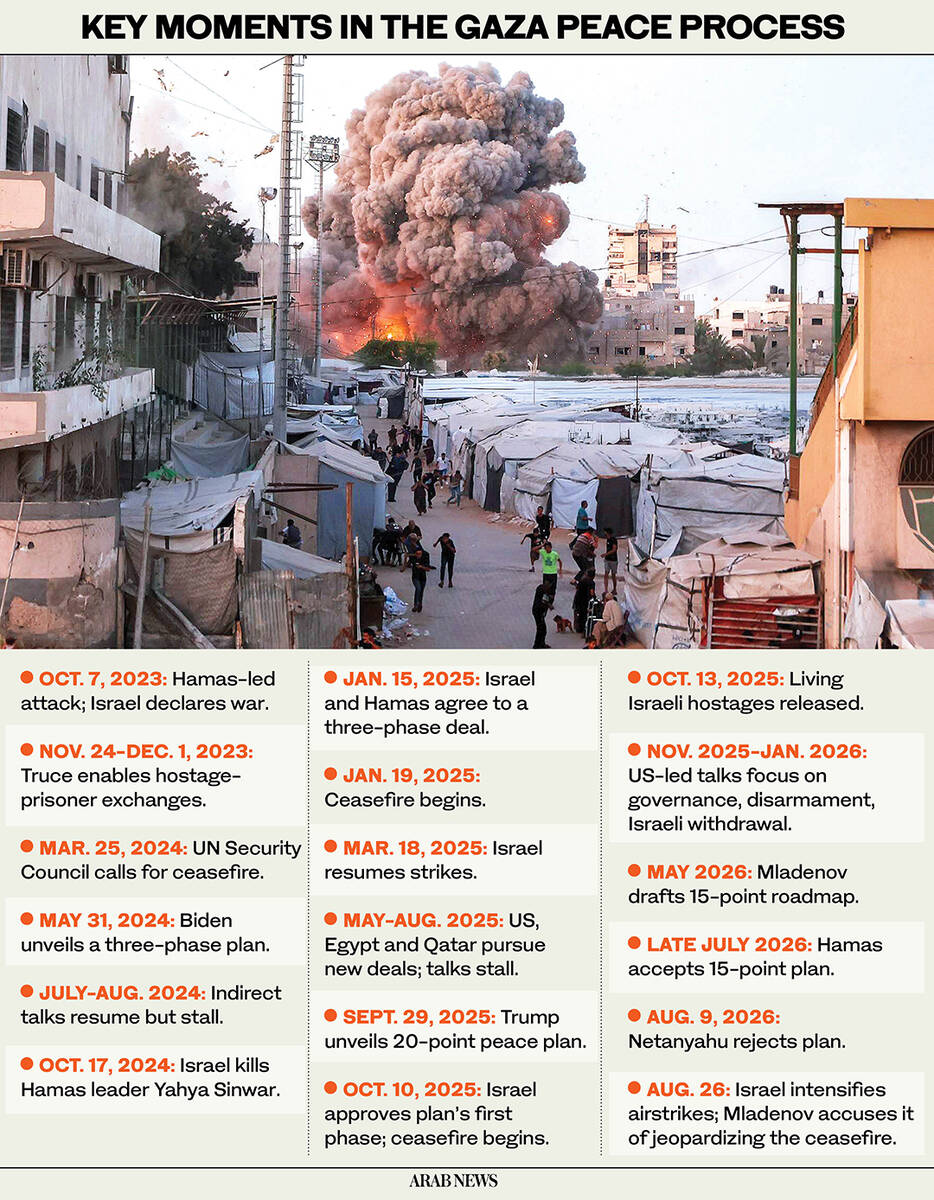
It is less than a month since President Trump announced that the board had reached “a historic agreement for the complete disarmament of Hamas.”
It was, he posted on social media on July 30, “a monumental step toward lasting peace and security” and “a major milestone in the implementation of the Trump 20-point plan.”
Unfortunately, as Nickolay Mladenov, the board’s high representative for Gaza, made clear in a frank address to the UN Security Council, no progress has since been made toward the disarmament of Hamas.
Mladenov, who between 2015 and 2020 was the UN special coordinator for the Middle East peace process, took both sides to task for repeated breaches of the ceasefire, and addressed them directly.
To Hamas, he said that “every weapon carried, every tunnel still worked on and every convoy still obstructed sets the process back” and “it will be Palestinian civilians, women and children, who will bear the consequences.”
Of Israel, he asked: “Will another strike on a munitions depot stop Hamas from rearming or tightening its grip on Gaza?” Mladenov answered his own question: “It will not.”
He added: “Every use of force that does not answer an immediate threat, and every incident that the deconfliction mechanism was not asked to resolve, costs the process something that is very, very hard to buy back.”
The peace plan, as Trump spelled it out on July 30, sounded straightforward.
As Hamas disarmed, Israeli forces would withdraw, and a multinational International Stabilization Force would move in to Gaza to work with a new Palestinian police force “to take responsibility for Gaza being safe for its residents and its neighbors.”
That same day, the US State Department allocated $206 million to supply the ISF with equipment, infrastructure, vehicles and operational costs.
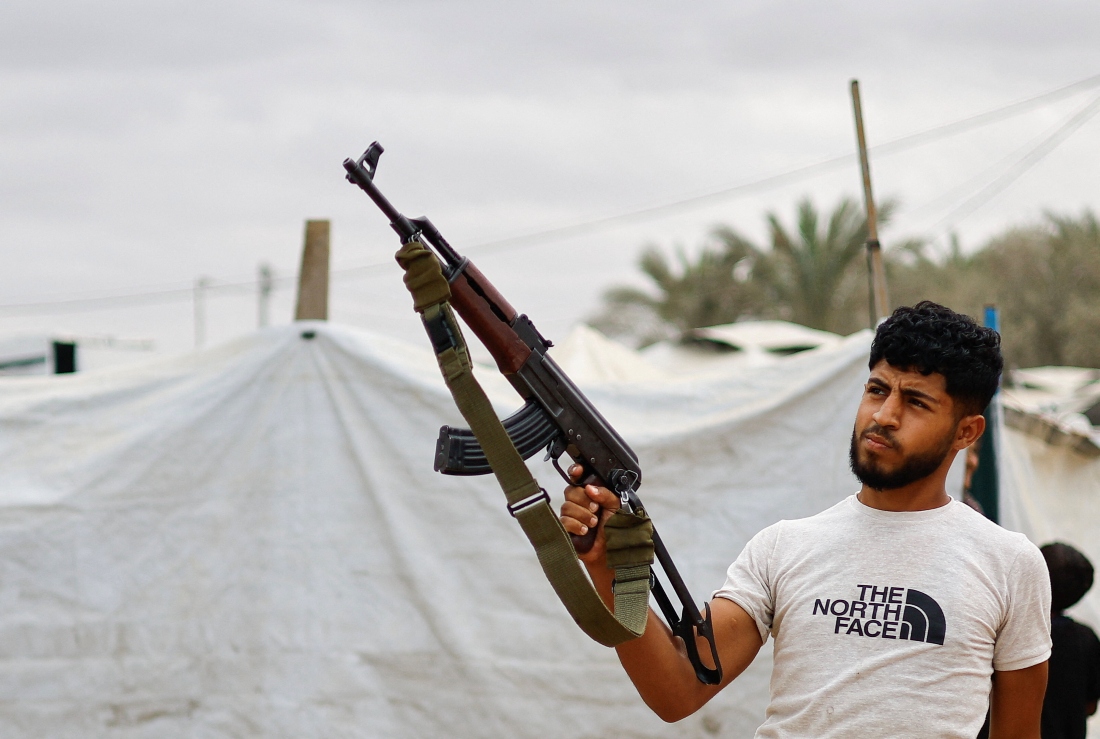
But Hamas has yet to disarm, insisting that Israel must first withdraw from Gaza.
Instead, on Aug. 11, Prime Minister Benjamin Netanyahu, facing elections in October and anxious to keep right-wing members of his cabinet on-side, publicly rejected the peace plan his government had already agreed to back in September.
The IDF, he insisted in a televised speech, “will not carry out any withdrawal until Hamas is disarmed.”
And, as the stalemate continues, the proposed ISF remains a force on paper only.
The problem is, in part, one of the static sequencing laid down by the Gaza road map.
Published on July 30, it states that “Israel shall fully complete, without delay, all remaining commitments under Sharm Sheikh Protocol, particularly the cessation of military operations,” while simultaneously “Hamas and the Palestinian factions shall also cease all military operations.”
Neither side, however, is prepared to blink first.
But under the terms of the road map, only when both sides have ceased fire, and Israel has withdrawn and Hamas has begun to disarm, can the next steps be taken: the deployment of the ISF, transfer of authority to the National Committee for the Administration of Gaza, and the disarmament of Hamas.
In its apparent anxiety to keep Israel on side, the Board of Peace has not helped by wavering over key issues.
As an analysis in The Times of Israel put it on Aug. 12, the day after Netanyahu’s rejection of the peace deal, the board has “maintained significant ambiguity as to how its post-war Gaza reconstruction is supposed to proceed, with decisions sometimes being made on an ad hoc basis.”
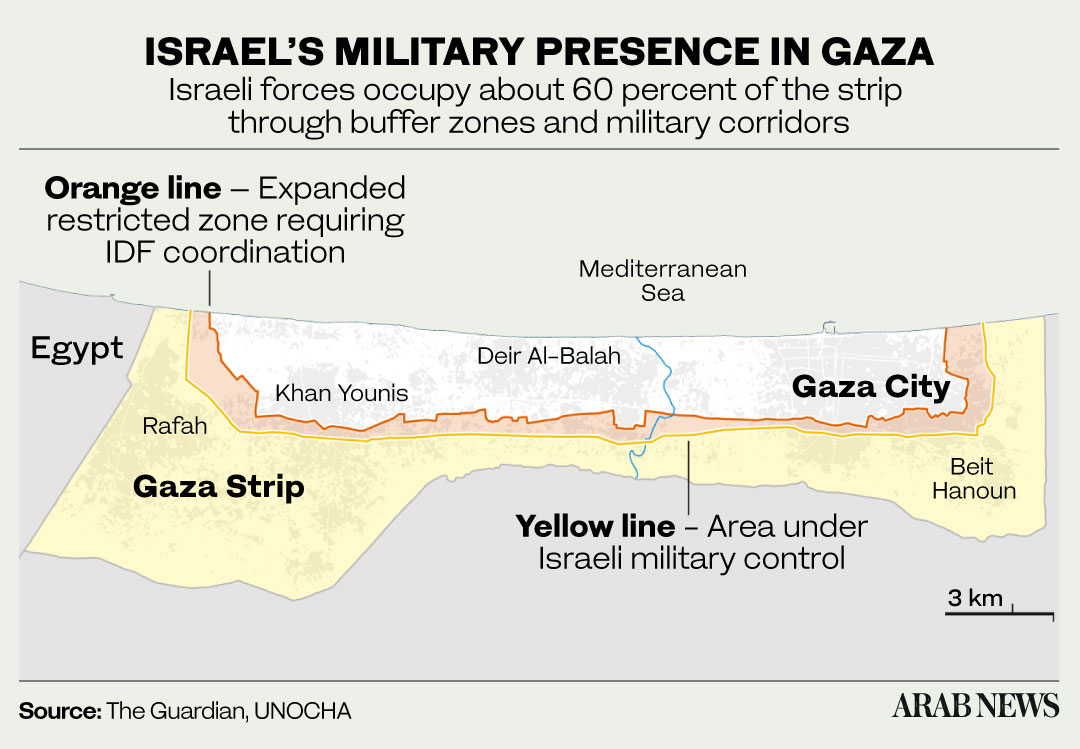
Under the terms of the October ceasefire deal, upon Hamas agreeing to disarm Israel was supposed to pull back its forces in Gaza to a “Yellow Line.” It did, briefly, but as disarmament talks dragged on, the IDF was ordered forward again.
An official told Israeli media that it would remain there until Hamas disarmed, even though that was very plainly not part of the deal to which Israel had originally agreed.
Alaa Zoubi, a researcher in the International Security team at the Royal United Services Institute, believes the strict sequence of events laid down by the road map may have to be relaxed for the deadlock to be broken.
“The Israelis need to create a new security environment in Gaza so they can withdraw, and they insist that Hamas must disarm,” she said.
“On the other hand, Hamas is not willing to disarm until they see a meaningful withdrawal of the IDF to the Yellow Line and beyond.”
The road map makes clear that the events it has devised must take place in a strict sequence, “but the issue now is the role of the third parties, the National Committee for the Administration of Gaza and the International Stabilization Force, which are supposed to govern and monitor this process.
“Right now there is a vacuum, a failure to establish meaningful control, which is seen by both parties and (is) why we are going around this circle again and again without moving forward.”
The answer, she believes, is for the Board of Peace to become more flexible and deploy the NCAG and ISF to break the deadlock.
Further delay, she added, could have ramifications for the future direction of Hamas, which is not merely refusing to disarm until the IDF withdraws.
“It is taking advantage of this vacuum to try to regain political power, to have a role in the future governance of Gaza, which obviously is not acceptable to Israel.”
It is also not acceptable to the Board of Peace. The road map specifies that Hamas shall surrender “all civilian governance and security functions in Gaza ... to NCAG.”
So far, despite the obvious deadlock, there has been no suggestion that the board is considering redrawing any elements of the road map.
As things stand, Sir John Jenkins, the UK’s former ambassador to Saudi Arabia and consul-general in Jerusalem, suggests a bleak prognosis for the peace process.
“I don’t see a solution,” he told Arab News.
He believes that “Hamas will never really disarm, and nor will Hezbollah,” because for them “the armed struggle is the only possible way forward.
“I know a lot of people, including Palestinians, quote the 1998 Belfast Agreement.
“But the Provisional IRA didn’t believe God had told them to fight to secure a united Ireland. They thought this was an anti-colonial struggle that they could win. When they realized they couldn’t, and that the Brits were offering them an easy political way out with lots of goodies — a more effective way of getting what they wanted — they decommissioned their weapons.
“Even then, it was a painful process, only being completed seven years after the agreement was signed.”
In contrast, “Hamas want to destroy Israel, and they think it’s a divinely sanctioned mission.”
Netanyahu, meanwhile, “does not want to look weak going into an election, and neither will his opponents. And whoever wins will not be able to afford to look weak afterward.”
Besides, Jenkins believes peace is not on Israel’s immediate agenda. Right now, he said, “Israel’s military planners and Mossad will be working fast to develop a new plan of campaign against Iran, Hezbollah and Hamas.”
The recent outbursts by Itamar Ben-Gvir, Israel’s far-right national security minister and one of the most outspoken Israeli opponents of the Board of Peace initiatives, offer a glimpse into the hardline pressures on Netanyahu and his government.
On a recent podcast he criticized any move to wind down IDF attacks in Gaza, adding: “I think targeted assassinations should be carried out in Gaza, taking down 30 to 40 every night.
“Not just those who pose an immediate threat — there are people there who are not worthy of life. They shouldn’t live. They’re not even people.”
Ben-Gvir is a prominent member of the settler movement, and the issue of Israel’s illegal settlements in the West Bank is also threatening to compromise the peace process.
On Thursday, The Times of London published a letter from the Council for Arab-British Understanding urging the British government to press ahead with plans being considered by Prime Minister Andy Burnham to ban trade with all illegal Israeli settlements in the West Bank.
Israel has already banned representatives of Spain and the Netherlands from the US-established Civil-Military Coordination Center, set up in Israel as part of the Gaza peace process, for criticizing Israeli actions in the West Bank.
According to reports, Netanyahu’s government is now also considering banning the UK from the center, but Doyle dismissed fears that provoking Israel by imposing a settlements trade ban at this time would undermine the peace process in Gaza.
“Frankly, that center is a farce,” Doyle told Arab News. “It’s really an American-Israeli show, where most of the other countries who are present are kept out of the decision-making.
“The broader issue regarding Gaza is that Britain should actually be saying that this is not working, that the Board of Peace is not delivering on reconstruction in Gaza, and having a more assertive line on that.
“It has now been 10 months since the (second) ceasefire in Gaza, and we haven’t seen a proper ceasefire at all.
“Over 1,200 Palestinians have been killed, and it’s time for the Burnham government to be more assertive, on Gaza as well as the West Bank.”
On Tuesday, Israeli airstrikes and tank fire in the Shati refugee camp in Gaza City and in Deir Al-Balah killed at least four people, including a 4-year-old boy. The IDF said it had targeted weapons dumps, but offered no evidence.
“This is the right time to keep up the pressure and impose penalties, because the situation in Palestine right now is really untenable, and Israeli politicians and voters should understand that there are consequences to flagrant violations of international law.”
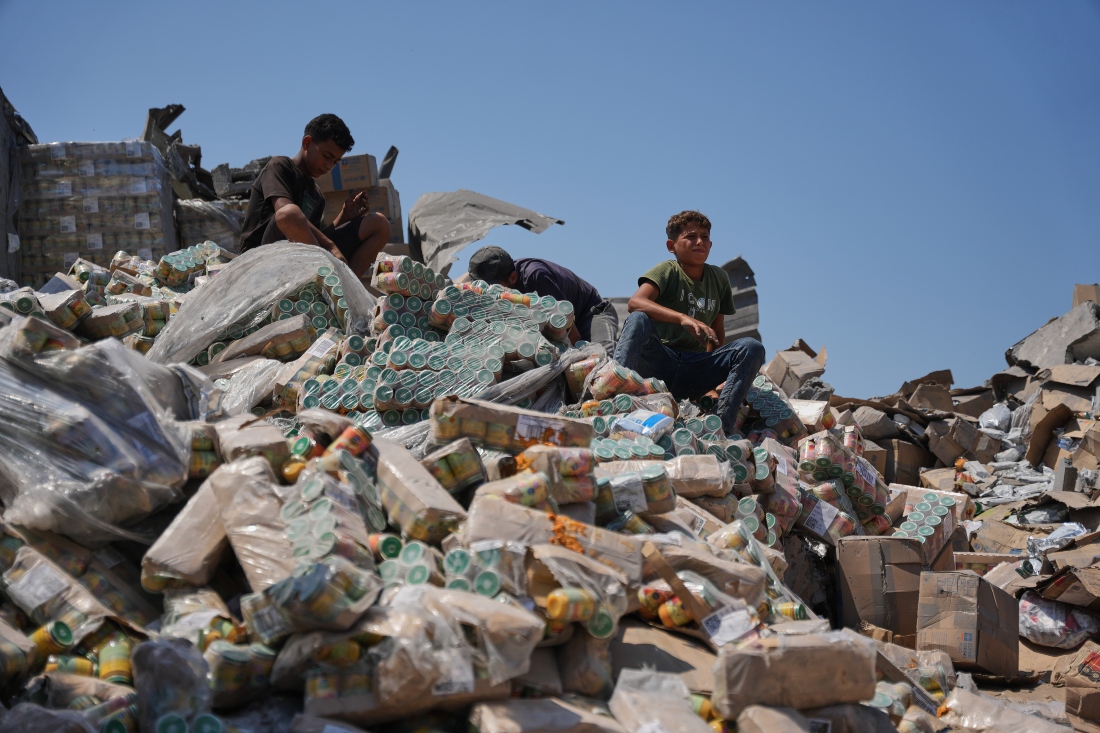
Meanwhile, as the Security Council heard on Wednesday, Gaza’s humanitarian situation is at “an absolute breaking point” ahead of winter, with 2 million people still trapped and families facing another cold season living in rubble and tents.
“This is not success,” Athena Rayburn, executive director of the Association of International Development Agencies, told the council.
Success, she said, should be measured by “whether the Board of Peace, International Stabilization Force and the National Committee for the Administration of Gaza provide immediate protection for civilians — and in the long term, whether they move Gaza toward the required legal endpoint: The end of Israel’s unlawful presence and realization of the Palestinian people’s right to self-determination.
“By these basic measures,” she added, “the Board of Peace is failing.”